
logo
logo
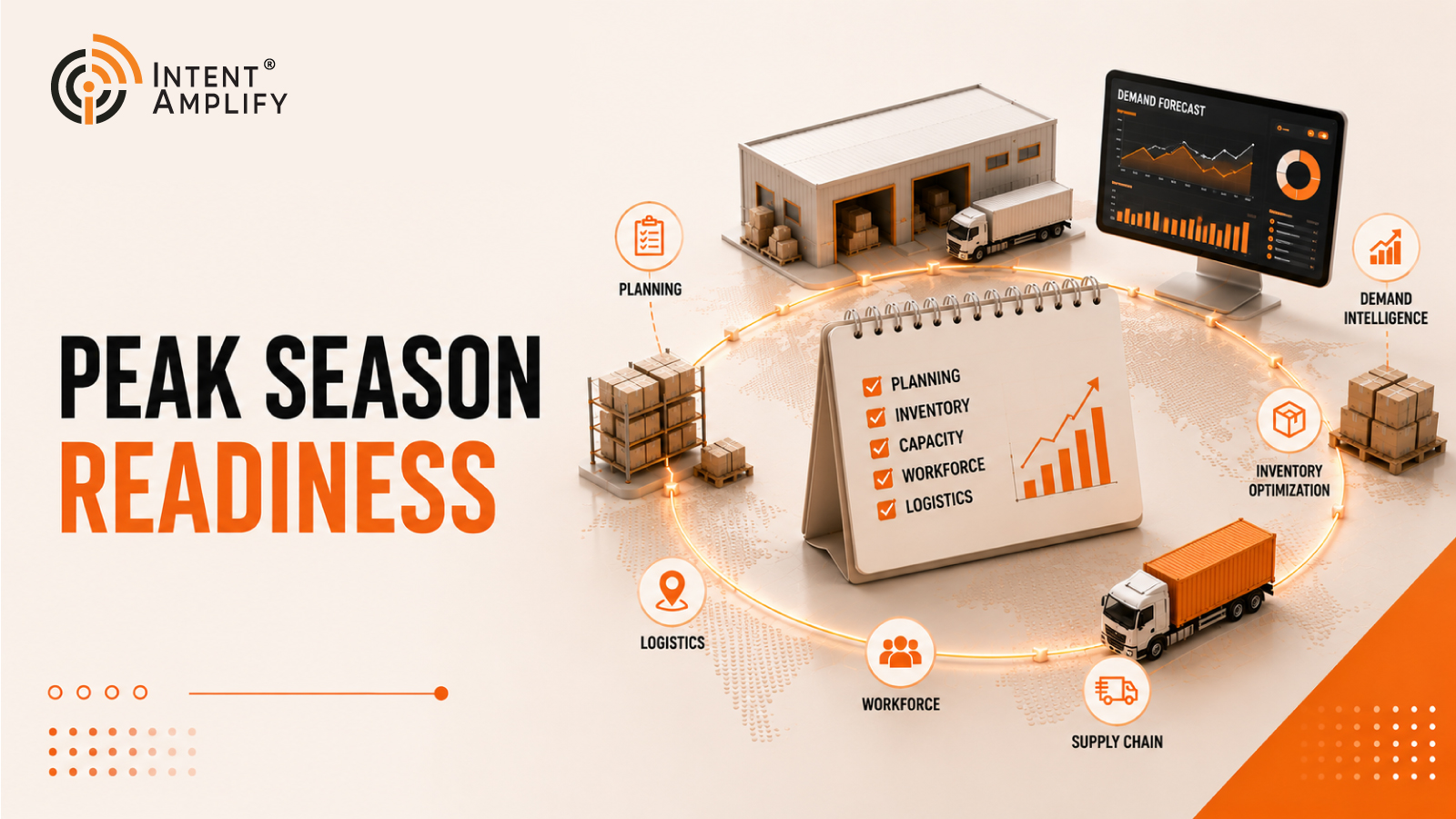
Peak Season Readiness Starts Before the Forecast Changes

NEWSLETTER

Peak Season Readiness Starts Before the Forecast Changes

Discover why Peak 2026 success depends on preparation, not just forecasting. Learn how AI demand forecasting, inventory readiness, logistics planning, and execution improve peak season performance.

Peak season planning often starts with a forecast update, but the teams that perform best during peak are rarely the ones that simply predicted demand more confidently. They are the ones that prepared the operation to move when demand changed, inventory pressure shifted, carrier capacity tightened, costs rose, and customers needed faster, clearer communication.

For Peak 2026, shippers need more than one view of the future. AI demand forecasting, analyst outlooks, carrier signals, retail demand patterns, inventory planning, and shipper experience all matter. The challenge is converting those signals into a readiness model that can survive execution pressure.

This is why readiness must start before the forecast changes. By the time a forecast moves, many operational decisions may already be constrained. Inventory may be in the wrong region. Carrier assumptions may no longer match lane pressure. Warehouse throughput may be stretched. Customer promises may have been made before tradeoffs were clear. Escalation ownership may still be informal.

EasyPost's Peak Reality Check 2026 webinar brings this challenge into focus by examining what shippers, analysts, and AI models are predicting for 2026 and how logistics leaders can translate those signals into practical preparation.

Understand how shippers can prepare for Peak 2026 by aligning supply chain forecasting, logistics planning, inventory readiness, scenario planning, digital resilience, customer communication, and decision ownership within one operating model. This EasyPost and Supply Chain Now webinar helps logistics leaders see how AI models, analyst perspectives, and shipper experience can support stronger peak season decisions.

Reserve Your Seat: Peak Reality Check, What Shippers, Analysts, and AI Models Are Predicting for 2026

Intent Amplify Perspective

Intent Amplify views Peak 2026 readiness as an execution discipline, not only a forecasting exercise. AI models, analyst outlooks, carrier signals, and historical demand patterns can help shippers understand what may happen, but operational performance depends on how well teams prepare inventory, logistics capacity, customer communication, risk ownership, and escalation paths before pressure begins.

According to Intent Amplify research and analysis, the strongest peak season strategies will not be built around the most confident forecast. They will be built around preparation-led operating models that connect demand signals with inventory readiness, logistics planning, scenario response, digital governance, customer communication, and accountable execution.

Intent Amplify Research Desk Observation

Peak season readiness is increasingly determined by how quickly organizations convert forecasts into governed operational action. Prediction may inform the plan, but preparation determines whether shippers can protect service, control cost, manage exceptions, and maintain customer trust when volume rises.

For Peak 2026, logistics leaders should treat forecasting as one input in a broader execution model. The practical advantage comes from connecting AI demand forecasting, inventory placement, carrier readiness, warehouse throughput, scenario planning, risk governance, and customer communication before peak pressure begins.

Forecasts Matter, but Execution Decides the Season

Forecasts estimate demand. They do not determine inventory positioning, transportation capacity, warehouse readiness, service priorities, customer communication, or escalation decisions. Those outcomes depend on execution frameworks that connect planning assumptions with operational response across fulfillment, logistics, support, technology, and customer commitments.

Adobe reported that U.S. online holiday spending reached $257.8 billion between November 1 and December 31, 2025, a 6.8% year-over-year increase. Mobile commerce contributed $145.2 billion, representing 56.4% of total online holiday revenue. These figures show why digital demand can create compressed planning windows and why peak readiness needs to connect forecast signals with inventory deployment, warehouse operations, carrier capacity, and fulfillment execution.

High-performing organizations integrate demand forecasting with inventory strategy, warehouse readiness, transportation planning, delivery commitments, returns operations, and customer communication. The objective is not only to predict demand. It is to coordinate enterprise execution as buying patterns shift across channels, regions, and promotional periods.

AI Forecasting Should Support Judgment, Not Replace It

AI forecasting for peak season planning can help teams interpret more signals than manual planning allows. It can evaluate historical demand, promotional activity, traffic patterns, channel behavior, product movement, regional demand, and external variables. Yet AI should not be treated as the final answer when customer commitments, inventory exposure, carrier choices, and logistics risk are on the line.

Adobe reported that traffic from AI sources to retail sites rose 693.4% during the 2025 holiday season compared with the previous year. Salesforce commerce research is powered by insights from more than 1.5 billion global shoppers and also connects its commerce reporting to research from commerce leaders and customers. These signals show why AI is becoming part of the demand environment itself, not only a tool used to predict it.

That creates a planning challenge. If AI tools influence how shoppers research products, compare prices, and move toward purchase, peak season demand may become less predictable through historical models alone. Shippers should use AI demand forecasting as one input, then validate it against inventory reality, logistics constraints, customer expectations, and operator judgment.

Peak Logistics Needs a Risk Plan Before Volume Arrives

Peak season logistics can fail when teams focus only on volume. Capacity matters, but risk often appears in smaller operational details such as address quality, warehouse labor, split shipments, late inventory arrivals, carrier cutoffs, returns handling, exception communication, API stability, and service-level updates.

Microsoft Dynamics 365 Supply Chain Management emphasizes capabilities such as AI-supported demand planning, rapid supply planning, real-time inventory and transportation data, automated inventory placement, and supply risk assessment. Those capabilities reflect the direction of logistics planning: more connected, more data-driven, and more responsive.

However, technology does not remove the need for ownership. A peak season strategy should define who reviews risk signals, who approves service-level changes, who handles carrier exceptions, who updates customer-facing teams, and how leadership decides when cost, speed, and service priorities conflict.

Cyber and AI Governance Belong in Peak Readiness

Peak season increases operational dependency on digital systems, carrier integrations, APIs, warehouse tools, customer data, dashboards, and AI-enabled workflows. That makes digital resilience, cybersecurity awareness, and AI governance part of logistics risk management.

IBM's Cost of a Data Breach Report 2025 reported a global average breach cost of $4.4 million and also found that many organizations lacked AI governance policies to manage AI or prevent shadow AI. AWS states that Amazon Bedrock powers generative AI for more than 100,000 organizations worldwide and that Bedrock Guardrails can help improve the safety and accuracy of AI-enabled workflows. For shippers, the point is not that peak season planning should become a cybersecurity program. The point is that logistics resilience now depends on secure, governed, and reliable digital operations.

If AI models, carrier APIs, customer communications, warehouse systems, and dashboards support peak execution, they must be monitored before peak begins. A readiness plan that ignores digital dependencies may look strong operationally while still carrying avoidable execution risk.

Preparation Turns Forecasts into Action

Preparation means converting a prediction into operational steps. It asks what the business will do if demand arrives early, if a region spikes unexpectedly, if inventory misses a node, if a carrier lane becomes expensive, if returns rise faster than expected, or if customer delivery expectations need to be reset.

Google Cloud's 2026 update lists real-world generative AI use cases from leading organizations, showing how AI is moving into practical enterprise workflows. IBM's enterprise research argues that AI will become part of business models rather than only a tool that enhances them. For logistics leaders, this supports a clear message: AI will be part of peak planning, but operational design determines whether it creates measurable value.

Intent Amplify Peak Readiness Framework

The Intent Amplify Peak Readiness Framework gives shippers a practical way to move from prediction-led planning to preparation-led execution. It helps logistics leaders confirm whether demand signals, inventory readiness, carrier strategy, scenario planning, operational risk, customer communication, and decision ownership are aligned before peak pressure begins.

Framework Area | What Shippers Should Confirm Before Peak | Why It Matters

Demand Signals | Forecasts include timing, channel, region, product, promotion, customer segment, and confidence assumptions. | Helps teams understand where demand may rise and where uncertainty remains.

Inventory Readiness | Critical SKUs are positioned against service priorities, regional demand, fulfillment capacity, and replenishment exposure. | Reduces avoidable stockouts, excess movement, split shipments, and late-stage cost pressure.

Logistics Planning | Carrier strategy supports capacity, cost, delivery expectations, cutoffs, exception handling, and lane resilience. | Protects service performance when volume, rates, or lane pressure changes.

Scenario Planning | Teams have response paths for demand spikes, delays, returns, inventory misses, carrier constraints, and customer communication triggers. | Turns forecasts into practical operating decisions before disruption appears.

Digital Governance | AI tools, carrier APIs, warehouse systems, dashboards, and data workflows have owners and escalation paths. | Ensures readiness includes digital reliability and accountable decision-making.

Customer Trust | Delivery promises, exception messages, support workflows, and service recovery rules are coordinated. | Helps preserve customer confidence when peak season conditions change.

This framework helps shippers avoid treating peak planning as a forecast review. It positions readiness as a cross-functional operating model where demand planning, inventory placement, logistics execution, risk management, technology reliability, and customer communication work together.

Inventory and Transportation Must Move Together

Inventory planning and logistics planning cannot be handled separately during peak. If inventory is in the wrong location, even strong carrier performance may not protect delivery promises. If transportation capacity is not aligned with inventory strategy, fulfillment teams may face avoidable costs and service pressure.

SAP supply chain solutions focus on planning, logistics, and resilient operations, while Oracle Retail emphasizes planning, inventory, and retail execution capabilities. DHL's ecommerce and logistics resources also reinforce the need to manage customer expectations, cross-border complexity, and delivery performance across digital commerce flows. These sources point to the same operational reality: peak readiness depends on coordination across demand, stock, fulfillment, transportation, and customer communication.

Prediction-Led Planning vs. Preparation-Led Peak Strategy

Prediction-Led Planning | Preparation-Led Peak Strategy

Focuses mainly on demand accuracy. | Focuses on execution readiness.

Uses forecasts as the main plan. | Connects forecasts with inventory, carriers, workflows, customer communication, and escalation ownership.

Reacts when exceptions appear. | Defines response paths before pressure starts.

Treats AI output as the answer. | Uses AI as one signal for better human-led decisions.

Measures orders shipped. | Measures service, cost, resilience, exception response, customer trust, and decision speed.

For Peak 2026, shippers should not choose between AI models, analyst views, and human experience. They should use all three, then build a preparation-led response model that is practical enough for the operation to execute, flexible enough to absorb disruption, and governed enough to protect service, cost, and customer trust.

EasyPost and Supply Chain Now Perspective

EasyPost and Supply Chain Now are positioned for this conversation because Peak 2026 planning requires a realistic view of forecasting, logistics execution, and operational resilience. The webinar topic recognizes that shippers need to compare what analysts expect, what AI models suggest, and what operators know from real-world shipping conditions.

The value of this discussion is its balance. AI can improve supply chain forecasting. Analysts can explain broader logistics and retail patterns. Shippers can validate what is operationally possible inside their own networks. Peak season success depends on bringing those signals together before execution pressure begins.

Executive Peak Season Operational Readiness Assessment

The EasyPost and Supply Chain Now webinar, Peak Reality Check: What Shippers, Analysts, and AI Models Are Predicting for 2026, helps logistics leaders understand how AI models, analyst perspectives, and shipper experience can support stronger peak season planning.

The next step is to assess whether the organization is operationally ready for Peak 2026. An Executive Peak Season Operational Readiness Assessment can evaluate demand forecasting maturity, inventory readiness, logistics planning, carrier strategy, scenario response, digital governance, cyber resilience, customer communication, and operational performance.

Reserve Your Seat as a starting point for a structured conversation on preparation-led peak season planning, logistics resilience, AI demand forecasting, and execution readiness.

About Intent Amplify

Intent Amplify helps organizations convert market insight into measurable growth through research-led content, demand intelligence, executive engagement, sponsored assets, webinars, roundtables, vendor intelligence, and GTM consulting. For supply chain, logistics, and technology brands, Intent Amplify connects audience insight, content strategy, and campaign execution into a practical demand generation engine.

Connect To Our Specialist

Final Thought

Peak season does not reward the most confident prediction. It rewards the organization that prepares clearly, tests assumptions early, and connects forecasting with execution. AI models, analyst forecasts, and historical data all matter, but none of them can replace operational readiness.

For Peak 2026, shippers should build a preparation-led model that connects AI demand forecasting, inventory planning, logistics planning, scenario response, cybersecurity awareness, AI governance, customer communication, and operational resilience. The stronger those foundations are before volume rises, the better the organization can protect service, control cost, manage exceptions, and maintain customer trust.

References

1. Adobe (2026) 2025 Holiday Shopping Statistics, Trends & Insights. Available at: https://business.adobe.com/resources/holiday-shopping-report.html

2. Salesforce (2026) Ecommerce Trends & Online Shopping Statistics. Available at: https://www.salesforce.com/retail/shopping-index/

3. Microsoft (2026) Dynamics 365 Supply Chain Management. Available at: https://www.microsoft.com/en-us/dynamics-365/products/supply-chain-management

4. IBM (2025) Cost of a Data Breach Report 2025. Available at: https://www.ibm.com/reports/data-breach

5. Amazon Web Services (2026) Amazon Bedrock: Build Generative AI Applications and Agents at Production Scale. Available at: https://aws.amazon.com/bedrock/

6. Google Cloud (2026) Real-world generative AI use cases. Available at: https://cloud.google.com/transform/101-real-world-generative-ai-use-cases-from-industry-leaders

7. IBM Institute for Business Value (2026) The Enterprise in 2030. Available at: https://www.ibm.com/thought-leadership/institute-business-value/report/enterprise-2030

8. SAP (2026) SAP Supply Chain Management Solutions. Available at: https://www.sap.com/products/scm.html

9. Oracle (2026) Oracle Retail. Available at: https://www.oracle.com/industries/retail/

10. DHL (2025) E-Commerce Trends Report. Available at: https://www.dhl.com/discover/en-global/e-commerce-advice/e-commerce-best-practice/e-commerce-trends-report

11. EasyPost (2026) Shipping APIs and Logistics Technology Resources. Available at: https://www.easypost.com/

Omkar Waghmare

Omkar Waghmare

Research Analyst

Contact Us