
logo
logo
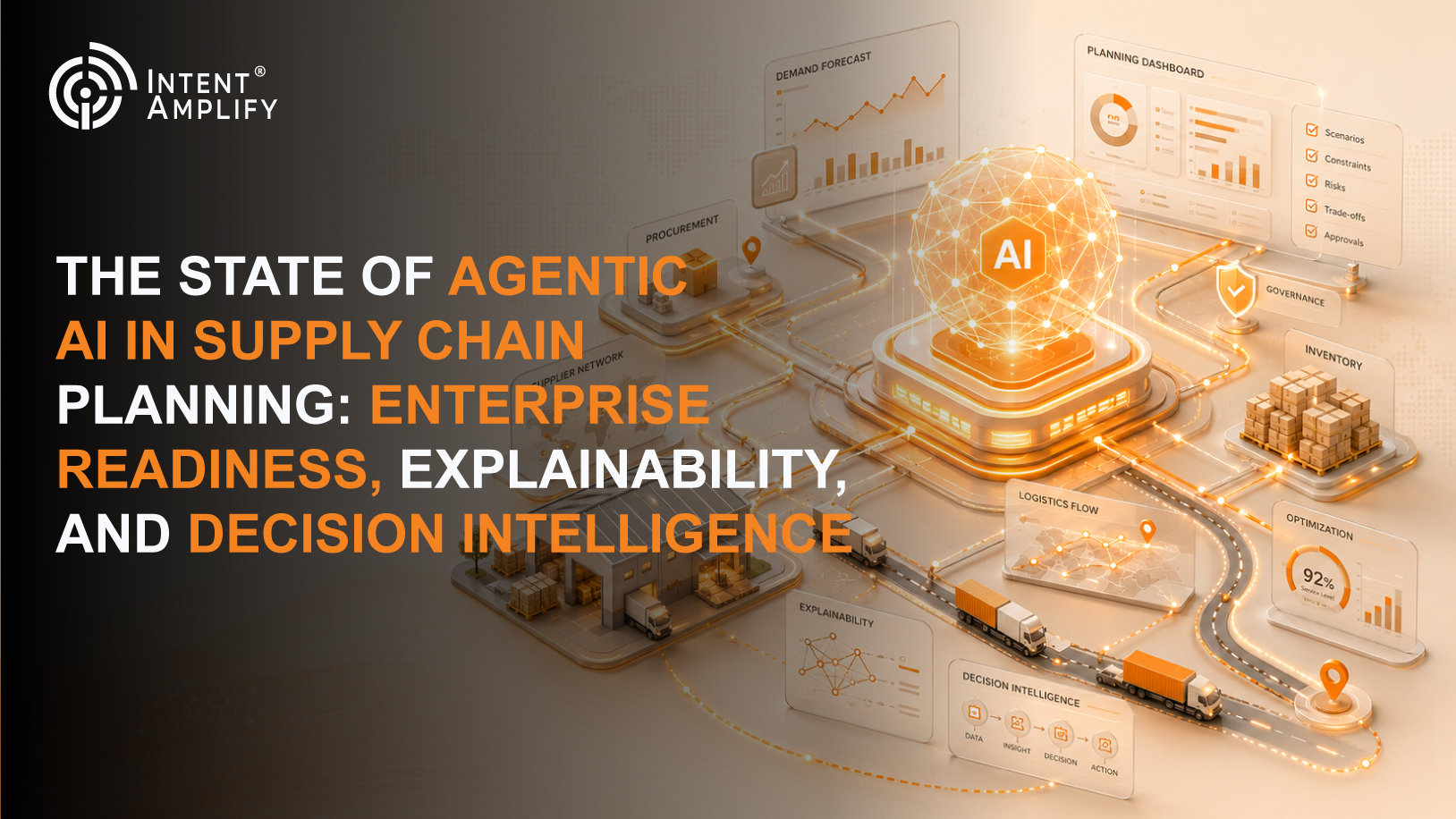
The State of Agentic AI in Supply Chain Planning: Enterprise Readiness, Explainability, and Decision Intelligence

REPORT

The State of Agentic AI in Supply Chain Planning: Enterprise Readiness, Explainability, and Decision Intelligence

Explore how enterprise leaders are adopting agentic AI, explainable AI, and decision-centric planning to improve supply chain resilience, governance, digital twins, and operational decision intelligence.

Executive Summary

Supply chain planning is moving from analytical support toward decision orchestration. The first wave of supply chain AI improved forecasts, alerts, and planning dashboards. The next wave is more operational. Agentic AI can monitor signals, interpret constraints, generate scenarios, recommend actions, and coordinate planning tasks across demand, supply, inventory, production, procurement, and logistics.

The conditions behind this shift are structural. The World Economic Forum reported in 2026 that 74% of business leaders view resilience as a growth driver, while 2025 tariff escalations reshuffled more than $400 billion in global trade flows, and major container shipping routes saw costs rise 40% year over year. These figures explain why planning leaders are redesigning processes around optionality, response speed, and decision quality rather than treating resilience as an after-action risk exercise. [1]

Enterprise AI adoption is broad, but maturity remains uneven. McKinsey's 2025 Global Survey found that 88% of organizations use AI in at least one business function, yet only about one-third have started scaling AI across the enterprise. The same research found 39% of organizations are experimenting with AI agents. [2]

For supply chain executives, the implication is direct. Agentic AI will not create a planning advantage by itself. The organizations most likely to benefit will combine explainable AI, digital twins, scenario planning, responsible governance, and human-AI collaboration into a decision-centric planning model. The strategic question is whether leaders can trust, explain, govern, and act on recommendations when service, cost, compliance, and customer commitments are at stake.

CyberTech Intelligence Perspective: Planning Advantage Depends on Governed Decision Quality

Enterprise planning competitiveness will increasingly depend on governed decision quality rather than automation maturity alone. Agentic AI, predictive planning, digital twins, and autonomous workflows can accelerate planning activity, but they do not automatically improve business outcomes unless recommendations are explainable, governed, and connected to accountable execution.

For supply chain leaders, the strategic issue is not simply whether AI can forecast, simulate, or recommend faster. The more important question is whether the organization can trust the recommendation, understand the assumptions behind it, evaluate trade-offs before action, and preserve human accountability where service, cost, compliance, inventory, and customer commitments are at stake.

This reinforces the central thesis of decision-centric planning. AI creates planning advantage only when it improves the quality, speed, transparency, and governance of operational decisions. Organizations that combine explainable AI, digital twin simulation, agentic orchestration, and human oversight into governed planning workflows will be better positioned than those measuring maturity primarily by automation volume.

Why Planning Is Becoming a Decision Architecture Problem

Supply chain planning has traditionally been organized around functional outputs: demand forecasts, inventory targets, production plans, replenishment schedules, procurement signals, and logistics constraints. That structure is familiar, but it often breaks down under volatility because each function optimizes within its own boundary.

Decision-centric planning changes the starting point. Instead of asking which forecast or model is most accurate, it asks which recurring decisions create the most operational and financial impact. Which orders should receive constrained supply? Where should inventory be held when lead times shift? When should planners override the statistical forecast or escalate supplier risk?

Across regulated, quality-sensitive, and asset-intensive sectors, planning decisions must account for release timing, perishability, capacity, safety, supplier reliability, and service commitments. A forecast may be statistically sound and still fail as a business decision if it ignores those constraints.

Agentic AI is relevant because it can support decision workflows rather than isolated analytics. A planning agent can monitor forecast deviation, retrieve context, test options through a digital twin, prepare a scenario summary, and recommend escalation. That is a meaningful shift from passive analytics, but any recommendation that influences inventory, production, allocation, or sourcing must be explainable before it becomes operationally acceptable.

Market Landscape: AI Adoption Is Rising Faster Than Planning Trust

AI adoption in supply chain planning is accelerating. ABI Research's 2025 survey of 490 supply chain professionals across the United States, Mexico, Germany, and Malaysia found that 64% of supply chain leaders consider AI or generative AI capabilities important when evaluating new technology investments. The strongest planned use case is decision support: 94% of surveyed companies plan to use AI or generative AI for decision support over the next two years. [3]

The same findings show that 91% of respondents plan to use AI or generative AI for demand forecasting, while 85% intend to apply it to inventory management. These are core planning functions because forecasting and inventory decisions affect service levels, margin, working capital, production stability, and customer trust. [3]

Agentic AI is also entering supply chain operations. ABI Research reported that 76% of professionals see potential for autonomous AI agents in supplier relationship management, including activities such as reordering and shipment rerouting. This indicates strong interest, but not readiness for fully autonomous supply chain planning. In most enterprises, the near-term path is supervised autonomy, not unchecked automation. [3]

Gartner's 2025 supply chain planning technology analysis reinforces that point. Gartner stated that autonomous planning has moved beyond inflated expectations and is becoming one of the most consequential supply chain planning trends, while also warning that limited transparency into algorithms, heuristics, and data outputs continues to slow implementation. [4]

That transparency issue is not cosmetic. Planners need to understand which constraint drove the recommendation, which assumptions changed, and what trade-off the system is asking the business to accept.

CyberTech Intelligence Research Desk Observation

1. Agentic AI Is Shifting Planning From Insight to Orchestration

McKinsey's 2025 research found that 23% of organizations are scaling agentic AI somewhere in the enterprise, but no more than 10% reported scaling AI agents in any individual business function. Agentic AI is spreading through experimentation, yet deep operational deployment remains limited. [2]

In supply chain planning, the difference between experimentation and scale is substantial. A conversational assistant that summarizes supplier emails is useful, but it is not the same as a workflow that evaluates demand signals, supply constraints, inventory exposure, production feasibility, and customer impact. Scaled agentic planning requires integration with planning systems, master data, approval workflows, and governance controls.

2. Explainability Is Becoming a Condition for Planning Adoption

Explainable AI is often framed as a compliance or model governance concept. In supply chain planning, it is also a day-to-day usability requirement. A planner needs to know why a model changed the baseline, altered replenishment, or ranked one supply option above another.

McKinsey's 2025 survey found that 51% of organizations using AI experienced at least one negative consequence from AI use, with inaccuracy among the most frequently reported issues. The same research notes that explainability is a commonly reported AI risk, yet it is not among the most commonly mitigated risks. [2]

That gap has practical consequences. An inaccurate or unexplained AI recommendation can become excess inventory, a missed production window, an unnecessary expedite, a service failure, or a compliance exposure. Trustworthy AI decision-making requires clear drivers, assumption visibility, scenario comparison, audit trails, and human accountability for high-impact decisions.

3. Human-AI Collaboration Is Becoming a Workforce Design Issue

Gartner's 2026 survey of 509 supply chain leaders found that 55% expect agentic AI to reduce the need for entry-level hiring, while 51% believe it will contribute to overall workforce reductions. Yet the more instructive figure is that 86% said agentic AI adoption will require new processes for developing future talent pipelines. [5]

The findings indicate a shift in workforce composition rather than workforce contraction alone. As AI assumes responsibility for routine data collection, information synthesis, and initial scenario preparation, human expertise becomes increasingly concentrated on exception governance, policy optimization, risk management, scenario interpretation, and model supervision.

Human-AI collaboration is emerging as an enterprise operating model. Effective adoption depends on clearly defined decision rights, coordinated planning processes, trusted data ownership, and shared accountability across supply chain, technology, data, and business leadership.

4. Digital Twins Are Becoming the Safe Test Bed for Autonomy

Digital twin technology gives planning teams a controlled environment to test decisions before execution. The value of a digital twin supply chain model is the ability to evaluate how disruption propagates through the network.

Yale's Critical Supply Chain Index reported that in April 2026, disrupted consumer-supply pairs were 0.65 percentage points(pp) above the pre-2020 average, with significant variation across sectors and stages of production. Disruption rarely appears uniformly across a supply chain, which is why static planning assumptions deteriorate quickly. [6]

Digital twins and supply chain simulation help planning teams convert uneven disruption into decision-ready scenarios. For executives evaluating autonomous supply chain planning platforms, simulation should be treated as a prerequisite for higher autonomy because it tests recommendations before service, cost, compliance, or customer commitments are exposed to AI-driven action.

CyberTech Intelligence Decision-Centric Planning Framework

The CyberTech Intelligence Decision-Centric Planning Framework provides a structured model for moving agentic AI from isolated planning experimentation to governed enterprise decision execution. The framework begins with the business decision, then connects intelligence, simulation, orchestration, and governance around that decision so AI can improve planning outcomes without weakening accountability.

Decision Layer
Defines recurring planning decisions by owner, cadence, business impact, required inputs, constraints, approval threshold, and risk level. This layer clarifies what is being decided, who owns the decision, and what level of review is required.

Intelligence Layer
Converts AI demand forecasting, predictive analytics, anomaly detection, supplier risk scoring, inventory optimization, and scenario modeling into decision-ready intelligence. Recommendations should include causal drivers, changed assumptions, confidence ranges, sensitivity factors, and potential business impact.

Simulation Layer
Uses Digital Twins to test planning options before execution. This layer helps planning teams evaluate how alternate decisions may affect service, inventory, production, supplier risk, working capital, and customer commitments.

Orchestration Layer
Coordinates AI agents, workflows, business rules, approvals, and system actions across demand, supply, procurement, production, logistics, and inventory. This layer ensures recommendations move through governed workflows rather than remaining isolated outputs.

Governance Layer
Manages responsible AI, transparency, auditability, access control, data lineage, model monitoring, exception escalation, and human oversight. This layer defines what AI agents can access, which actions they can initiate, which decisions require approval, and how outcomes are reviewed.

Outcome
Explainable, governed, and accountable planning decisions that improve operational performance without weakening human oversight.

Why Agentic AI Planning Programs Stall

The primary barrier to implementing agentic AI in supply chains is not model sophistication. It is operating-model readiness.

Many planning organizations still depend on fragmented data ownership, inconsistent master data, manual overrides, undocumented planning rules, and local workarounds. Agentic AI does not remove these issues. It exposes them. If planning inputs are stale or poorly governed, autonomous planning will scale the defect faster than a human planner would.

Trust is the second barrier. Planners often hold institutional knowledge that does not live cleanly in systems. If an AI-powered supply chain planning platform ignores that knowledge, planners will treat it as theoretical even when its statistical performance appears strong.

The third barrier is risk governance. Planning systems operate close to revenue, cost, service, working capital, and compliance. Autonomy must therefore be tiered: advisory for high-risk decisions, supervised execution for moderate-risk decisions, and automated execution only where controls, thresholds, and rollback mechanisms are clear.

Strategic Opportunities for Planning Leaders

The strongest near-term opportunities are decision acceleration, exception prioritization, and scenario compression.

In AI demand forecasting, agentic workflows can identify exceptions, retrieve relevant context, compare historical analogs, and recommend whether a planner should accept, adjust, or escalate the forecast. In inventory and procurement planning, agents can prepare risk-adjusted options while keeping high-impact decisions under human control.

Scenario planning is especially valuable. Traditional scenario modeling can be slow. Agentic AI can compress that cycle by generating scenario sets, testing constraints through digital twin technology, and presenting decision-ready trade-offs. It gives planning leaders a faster way to evaluate uncertainty without removing human judgment.

Regional priorities will vary, but the common requirement is the same: decision policies must reflect local risk, infrastructure, regulation, and market conditions rather than assuming one autonomy model fits every network.

From Explainable AI to Agentic Planning

As organizations move from predictive planning toward agentic workflows, the critical question is whether planning teams can trust, explain, govern, and operationalize recommendations across complex supply networks.

Download the ebook: Making AI Work for You - From Explainable to Agentic

Executive Planning Assessment

For executive teams, decision-centric planning readiness can be evaluated through a standardized scorecard that tests whether AI, digital twins, explainability, governance, and human oversight are connected to measurable planning outcomes.

Executive Planning Assessment

Maturity Question

Decision maturity

Are recurring planning decisions mapped by owner, cadence, risk level, approval path, and business impact?

Explainability readiness

Can planners understand why an AI recommendation was generated, which assumptions changed, and what trade-offs were evaluated?

Governance maturity

Are decision rights, escalation rules, audit trails, access controls, override paths, and approval thresholds clearly defined?

Digital Twin adoption

Can planning teams test service, inventory, supplier, production, cost, and customer-impact scenarios before execution?

Human oversight

Are human review requirements clearly defined for high-risk and medium-risk planning decisions?

AI orchestration

Are AI agents embedded into governed workflows rather than deployed as isolated assistants or disconnected pilots?

Operational performance

Are AI-supported decisions measured against decision latency, exception resolution, service impact, inventory exposure, resilience, and working capital outcomes?

Recommendations for Executive Planning Teams

1. Build a Decision Inventory Before Selecting Use Cases

Document recurring planning decisions by owner, cadence, inputs, constraints, risk level, approval path, and performance metric. This creates the foundation for decision-first supply chain planning.

2. Classify Autonomy by Decision Risk

Use autonomy tiers: advise, simulate, recommend, approve, execute, and monitor. High-risk decisions should require human approval, traceability, and post-decision review.

3. Require an Explanation With Every Recommendation

Every AI-generated recommendation should show the drivers, assumptions, confidence level, constraint logic, rejected alternatives, and business impact. This is the practical standard for trustworthy AI decision-making in planning.

4. Use Digital Twins Before Expanding Autonomy

Before scaling autonomous AI for planning operations, test recommendations in a digital twin supply chain environment. Simulation reduces operational risk and gives planners a shared language for evaluating trade-offs.

5. Create Fusion Teams Around Planning Domains

Fusion teams should include planners, process engineers, data owners, IT architects, risk leaders, and business sponsors. Their mandate should be planning transformation, not model deployment alone.

6. Measure Decision Quality, Not Only Forecast Accuracy

Forecast accuracy remains important, but it is not sufficient. Track decision latency, exception resolution time, override quality, inventory exposure, service impact, scenario cycle time, and planner adoption.

Conclusion

The state of agentic AI in supply chain planning is promising, but it is not mature enough for careless autonomy. Enterprises are already applying AI to decision support, demand forecasting, inventory management, supplier workflows, and planning operations. The deeper challenge is trust.

Agentic AI can improve supply chain resilience when it is embedded into decision-centric planning, supported by explainable AI, tested through digital twins, governed through responsible controls, and adopted through human-AI collaboration. Without those foundations, agentic AI becomes another planning technology that produces interesting recommendations but limited operational confidence.

The next planning advantage will belong to organizations that combine predictive planning, orchestration, scenario modeling, and planner judgment into a governed decision system. In that model, AI does not replace planning leadership. It gives leaders a faster, more transparent, and more resilient way to make decisions under uncertainty.

Build Stronger Demand Programs Around Supply Chain AI

As agentic AI moves from planning experimentation toward operational execution, leaders need a clearer way to assess whether their planning environment is ready for decision-centric AI. The question is not only whether the organization has forecasting tools, digital twins, AI agents, or automation initiatives. It is whether those capabilities are explainable, governed, orchestrated, and connected to measurable planning outcomes.

The Enterprise Decision-Centric Planning Readiness Assessment helps evaluate:

  • Planning maturity
  • Explainability readiness
  • Governance maturity
  • Digital Twin readiness
  • Workflow orchestration
  • Decision quality
  • Operational resilience

The assessment helps organizations identify where agentic AI can improve planning performance, where human oversight remains essential, and where governance must mature before autonomous workflows scale.

Start your Enterprise Decision-Centric Planning Readiness Assessment

References

  1. World Economic Forum (2026) Global Supply Chains Enter Era of Structural Volatility, World Economic Forum Report Finds. Available at: https://www.weforum.org/press/2026/01/global-supply-chains-enter-era-of-structural-volatility-world-economic-forum-report-finds/.
  2. McKinsey & Company (2025) The State of AI: Global Survey 2025. Available at: https://www.mckinsey.com/capabilities/quantumblack/our-insights/the-state-of-ai.
  3. ABI Research (2025) 2025 Supply Chain Survey Results-Artificial Intelligence (AI) Usage and Investment Plans. Available at: https://www.abiresearch.com/blog/artificial-intelligence-ai-in-supply-chain-survey-results.
  4. Gartner (2025) Gartner Says Autonomous Planning Has Passed the Peak of Inflated Expectations on Supply Chain Planning Technology Hype Cycle. Available at: https://www.gartner.com/en/newsroom/press-releases/2025-11-12-gartner-says-autonomous-planning-has-passed-the-peak-of-inflated-expectations-on-supply-chain-planning-technology-hype-cycle.
  5. Gartner (2026) Gartner Survey Shows 55% of Supply Chain Leaders Expect Agentic AI to Reduce Entry-Level Hiring Needs. Available at: https://www.gartner.com/en/newsroom/press-releases/2026-02-25-gartner-survey-shows-55-percent-of-supply-chain-leaders-expect-agentic-ai-to-reduce-entry-level-hiring-needs.
  6. Yale Jackson School of Global Affairs (2026) Critical Supply Chain Index. Available at: https://jackson.yale.edu/centers-initiatives/blue-center/critical-supply-chain-monitor/.
  7. IBM (2025) IBM Study: Businesses View AI Agents as Essential, Not Just Experimental. Available at: https://newsroom.ibm.com/2025-06-10-IBM-Study-Businesses-View-AI-Agents-as-Essential,-Not-Just-Experimental.
Prabhanshi   Singh

Prabhanshi Singh

Research Analyst

Contact us for Report

Agentic AI in Supply Chain Planning: 2026 Enterprise Guide