
Executive Overview: CLM Has Moved Beyond the Legal Department
Contract Lifecycle Management has entered a more serious investment phase because many organizations can no longer afford to treat CLM software as a legal operations tool that only helps with storage, approvals, and administrative contract work. Enterprise contracts now influence procurement performance, financial outcomes, compliance obligations, supplier governance, and executive decision-making.
In 2025, contract lifecycle management sits at the intersection of legal risk, procurement performance, finance visibility, compliance management, vendor management, AI readiness, and executive decision-making. Contracts are no longer static legal records that sit quietly after signature. They define supplier obligations, renewal dates, pricing rights, revenue commitments, liability positions, service levels, compliance terms, and operational dependencies that can directly influence business performance.
When contract information remains fragmented across systems, organizations operate with incomplete visibility into obligations, commitments, risks, and commercial exposure.
The business case for CLM investment has changed. A better repository and faster approvals still matter, but they are no longer enough. Enterprises require trusted contract data, governed workflows, and contract intelligence to reduce risk, control cost, protect negotiated value, and support AI-enabled contracting.
Investment Momentum: Why CLM Is Getting Executive Attention
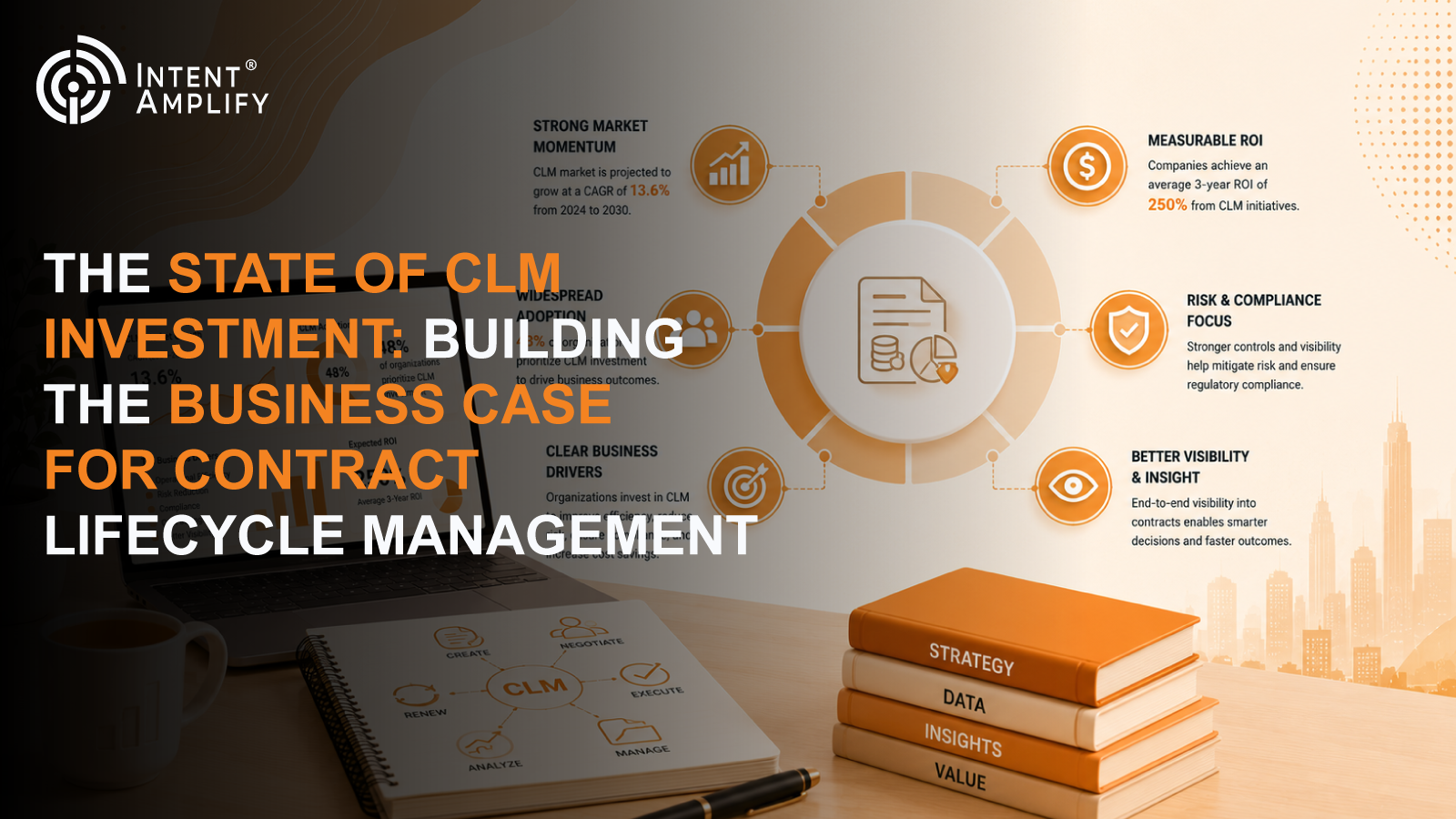
The CLM market is expanding because contract complexity is expanding across enterprise organizations. Research Nester estimates that the global Contract Lifecycle Management market surpassed USD 1.32 billion in 2025 and is projected to exceed USD 4.17 billion by 2035, growing at a CAGR of more than 12.2%. This growth reflects a broader shift in which CLM is maturing from a departmental workflow tool into an enterprise system of record for contract data management, contract analytics, and lifecycle visibility.[1]
North America is expected to remain a major center of CLM investment, with Research Nester projecting the region to hold 43% of the CLM market share by 2035. For large organizations in the United States and Canada, this reflects the pressure of high contract volumes, complex supplier networks, regulated operations, and the need for better contract risk management across legal, procurement, finance, and compliance functions.[1]
Gartner’s 2025 Magic Quadrant for Contract Life Cycle Management points to a more mature buying environment by highlighting the move toward cross-functional CLM strategies and the replacement of contract systems that no longer meet enterprise needs. Because the full Gartner report may sit behind gated access, the directional signal should be used carefully, especially since many companies already have contract tools that still cannot support enterprise search, dashboards, obligation tracking, legal analytics, and post-signature governance at scale.[2]
The real shift is not simply more spending. There is sharper buyer scrutiny around whether the current contracting environment can support automation, analytics, risk detection, AI-assisted review, vendor consolidation, and executive-level insight. Organizations that cannot support these requirements often evaluate CLM as a governance and control initiative rather than a technology upgrade.
The Problem Beneath the Process: Contract Data Is Still Too Fragmented
Most organizations maintain large contract portfolios but lack the visibility required to convert agreements into usable contract intelligence.
A signed agreement may contain the exact supplier commitment procurement needs to enforce, the renewal window finance needs to forecast, the liability language legal needs to monitor, and the compliance obligation risk teams need to evidence. Yet if that contract lives in a shared drive, an email attachment, a procurement platform, an ERP record, or a legacy repository with poor metadata, the information remains functionally hidden.
Consider a common enterprise scenario. Procurement negotiates supplier pricing protections during a high-value sourcing event, legal approves fallback terms after several review cycles, and finance expects those terms to support forecasted savings. Six months later, the supplier relationship has shifted, the renewal window is approaching, and no one has a clear view of the final pricing clause or the obligation owner. The contract exists. The value exists. The ability to act on it does not.
The result is operational uncertainty that slows decision-making and weakens governance. Teams search for documents instead of acting on insights, procurement misses chances to enforce negotiated terms, legal struggles to identify non-standard clauses, finance lacks renewal visibility, and compliance teams cannot always prove who approved what and why.
|
Contracting Gap |
Business Consequence |
CLM Capability That Addresses It |
|
Disconnected repository |
Slow search and poor visibility |
Centralized contract data management |
|
Manual approvals |
Delayed reviews and inconsistent governance |
Contract automation and routing |
|
Weak metadata |
Limited reporting and poor AI readiness |
Data extraction and enrichment |
|
Missed renewals |
Unplanned cost and lost leverage |
Renewal tracking and alerts |
|
Unclear obligations |
Compliance exposure and supplier leakage |
Post-signature obligation management |
|
Inconsistent clauses |
Higher legal and commercial risk |
Clause management and fallback governance |
|
Limited analytics |
Weak executive reporting |
Dashboards and legal analytics |
CLM investment increasingly supports enterprise governance, contract intelligence, and operational control. The organization does not simply need contracts stored somewhere. It needs agreement information that can be searched, analyzed, governed, queried, and trusted.
Legal Pressure: CLM as a Capacity and Risk Response
Legal teams are facing growing demand that manual processes and email-based workflows cannot efficiently support. CLOC’s 2025 State of the Industry Report found that 83% of legal departments expect demand to increase, while 63% identify workload and resource bandwidth as their top challenge. Standardized intake, automated routing, approved templates, clause management, and self-service contracting help legal reserve judgment for higher-risk work instead of drowning in repetitive administration. [3]
CLOC also found that 30% of legal teams are already using AI, while 54% plan to adopt AI within the next two years. Rising AI adoption increases the importance of structured contract data, consistent metadata, and governed contract language.[3]
EY’s 2025 General Counsel Study adds another layer to this pressure. It found that legal departments are facing three major external disruptors, with geopolitics at 76%, regulatory environment at 75%, and technological advancement at 74%. That combination creates a high-pressure environment for contract risk management because legal teams need to know where sensitive clauses sit, which obligations are active, which agreements contain unusual terms, and whether the available information can support risk reporting across jurisdictions.[4]
EY also reported that regulatory compliance is a priority for 93% of legal departments. That statistic makes the case for CLM especially direct because compliance depends on evidence, and evidence depends on visibility. A modern contract lifecycle management approach gives teams audit trails, approval history, obligation tracking, clause governance, and searchable records that support regulatory readiness.[4]
Procurement and Finance: Where the ROI Story Gets Sharper
Procurement leaders are increasingly involved in CLM investment because supplier contracts are where negotiated value is either protected or quietly lost after signature. Vendor management, supplier performance, contract renewals, pricing terms, rebates, service levels, and compliance obligations all depend on accurate post-signature visibility.
The EY Global CPO Survey 2025 found that 80% of global CPOs plan to deploy generative AI in some capacity over the next three years, with near-term focus areas including spend analytics, insights, and enhanced contract management. Procurement analytics cannot reach full value if supplier terms remain trapped in static documents, which is why CLM helps connect spend, suppliers, obligations, and agreement intelligence. [5]
The same EY survey found that only 36% of CPOs currently have GenAI deployed in a meaningful manner. That gap matters because many procurement teams want AI-enabled insights before they have the contract data foundation required to support them.[5]
Finance evaluates CLM through its ability to reduce cost, prevent value leakage, improve control, and generate measurable ROI. EY’s 2025 General Counsel Study found that 83% of responding legal departments expect budget increases, while 87% identify cost reduction as a top priority. The business case therefore depends on demonstrating how CLM improves efficiency, protects value, and strengthens financial performance.4]
EY also found that a limited budget is the most common challenge for legal department sourcing strategies at 61% and technology strategies at 65%. That means a CLM business case must be built with financial discipline and should quantify productivity savings, cycle-time reduction, value recovery, risk avoidance, and technology consolidation rather than relying on broad claims about transformation.[4]
For teams preparing to take CLM from internal discussion to stakeholder approval, a structured business case can make the difference between interest and action.
Explore the CLM Buyer’s Toolkit to help organize priorities, requirements, ROI logic, and implementation planning.
The Five Pillars of a Strong CLM Business Case
The strongest CLM investment cases usually rest on five connected value pillars.
1. Risk Reduction
CLM helps teams identify, manage, and report contractual risk before it becomes expensive. Risk detection, clause management, compliance management, and approval controls allow legal and risk teams to monitor non-standard language, missing clauses, unapproved exceptions, and obligations tied to regulatory or commercial exposure.
2. Efficiency and Contract Automation
Contract automation reduces unnecessary manual work across intake, drafting, review, approval, negotiation, signature, and renewal. The goal is not speed at any cost. The goal is a predictable contracting process where low-risk agreements move quickly, and high-risk agreements receive the right review.
3. Cost Control
Cost control comes from reduced administrative burden, lower duplicate effort, fewer manual handoffs, better vendor consolidation, and less time spent searching for agreement information. It also comes from avoiding preventable costs tied to missed renewals, poor obligation tracking, and unmanaged supplier commitments.
4. Value Protection
Procurement and finance teams should treat CLM as a value protection tool because a signed agreement does not automatically deliver savings. CLM helps organizations monitor pricing terms, rebates, SLAs, renewal windows, supplier obligations, and negotiated commitments after signature.
5. AI and Contract Intelligence
AI for contracts depends on structured and trustworthy information. AI contract review, contract summarization, predictive contracting, autonomous contract management, and risk detection all become more useful when powered by a governed lifecycle foundation. Without that foundation, AI is just guessing inside a messier filing cabinet.
AI Readiness: Ambition Is Not the Same as Data Readiness
PASA, reporting on World Commerce & Contracting’s 2025 AI Adoption in Contracting research, noted that 42% of organizations have adopted AI within their contracting practices. The same research highlights barriers, including security and data privacy, resistance to change, trust in AI outputs, lack of budget, integration challenges, lack of resources, and lack of policies. These barriers reinforce the need for governed CLM environments rather than loose AI experimentation around sensitive contract data.[6]
Agiloft and WorldCC’s vendor-published research on AI in contract management notes that AI is especially useful for high-frequency, lower-risk tasks such as metadata extraction, compliance checks, and template generation, while complex negotiation, risk assessment, and dispute avoidance still require human judgment. That positions AI not as a replacement for legal or procurement expertise, but as a force multiplier inside a controlled contract lifecycle.[8]
This is where a modern CLM approach becomes relevant without needing a loud sales pitch. The practical value is in connecting repository, automation, AI-assisted review, dashboards, and post-signature management into a governed lifecycle that business teams can actually use.
Stakeholder Alignment: The Business Case Must Speak Multiple Languages
CLM investment rarely succeeds when it is framed for only one department. Legal may care about risk and workload, procurement may care about supplier performance and contract renewals, finance may care about ROI and leakage, compliance may care about obligations and auditability, and executives may care about enterprise visibility and operational resilience.
|
Stakeholder |
Primary Concern |
CLM Business Case Message |
|
Legal |
Risk, workload, governance |
Improve clause control, approvals, audit trails, and legal service delivery |
|
Procurement |
Supplier value and obligations |
Protect negotiated savings and improve vendor management |
|
Finance |
ROI and cost control |
Quantify savings, leakage reduction, and exposure visibility |
|
Compliance and Risk |
Auditability and policy adherence |
Track obligations, exceptions, and approval history |
|
Operations |
Speed and accountability |
Standardize workflows and reduce contracting friction |
|
IT |
Integration and scalability |
Connect CLM with ERP, CRM, procurement, e-signature, and enterprise search systems |
WorldCC’s Benchmark 2025 found that 48% of respondents acknowledge no clarity over who is accountable for the quality and integrity of the contracting or commercial process, with its analysis suggesting the true accountability gap may be even higher. This is a governance warning because when no one clearly owns, contracting quality, value leakage, and risk exposure become predictable outcomes. [7]
From Business Case to Buying Case
A strong CLM business case should turn into a disciplined buying case. Before evaluating vendors, teams should assess contract volume, agreement types, approval complexity, repository fragmentation, metadata quality, search limitations, renewal management, obligation tracking, reporting needs, AI readiness, and integration requirements.
The business should also define measurable outcomes before implementation begins. Useful CLM KPIs include cycle-time reduction, template adoption, approval compliance, metadata completeness, search accuracy, dashboard usage, renewal visibility, obligation tracking coverage, and reduction in manual administrative work.
Agiloft’s CLM business case toolkit emphasizes organizational buy-in, stakeholder communication, technical and security requirements, and implementation planning [6].
CLM success is not achieved at purchase. It is achieved when the platform is adopted and measured against business outcomes.
Strategic Outlook: CLM as Contract Intelligence Infrastructure
The future of CLM investment will be shaped by a simple enterprise reality: contracts are becoming data assets. Organizations that treat them only as documents will struggle to manage risk, enforce obligations, control cost, and use AI responsibly.
The next stage of contract lifecycle management will focus on contract intelligence through searchable data, predictive insights, automated workflows, analytics, AI-assisted review, and executive-ready dashboards. Legal, procurement, finance, and compliance teams will increasingly share responsibility for contract outcomes because the business impact of contracts extends far beyond signature.
CLM investment is therefore best understood as a control case rather than only a technology case. It gives the enterprise a better way to understand what it has agreed to, what it owes, what it can enforce, where risk sits, and how contract data can support better decisions.
For legal, procurement, finance, and executive sponsors building the business case now, the most persuasive argument is clear. CLM is not only about faster contracting. It is about transforming contract data from locked files into living intelligence that supports risk reduction, cost control, procurement optimization, legal operations maturity, and AI-ready enterprise decision-making.
Strong content does more than explain a business challenge. It helps the right buyers understand why the issue matters now and what action should come next.
Contact Intent Amplify to discuss content strategies built for targeted B2B campaigns.
References
-
Research Nester (2025) Contract Lifecycle Management Market Size, Share & Industry Forecast 2035. Available at: https://www.researchnester.com/reports/contract-lifecycle-management-clm-market/3633.
-
Gartner (2025) Magic Quadrant for Contract Life Cycle Management. Available at: https://www.gartner.com/en/documents/7159730.
-
CLOC (2025) 2025 State of the Industry Report. Available at: https://cloc.org/newsdesk/2025-state-of-the-industry-report/.
-
EY (2025) 2025 General Counsel Study. Available at: https://www.ey.com/en_gl/newsroom/2025/04/ey-law-study-reveals-disruptors-prompting-the-evolution-of-legal-departments-and-the-key-barriers-to-change.
-
EY (2025) Global CPO Survey 2025 Outlook Report. Available at: https://www.ey.com/content/dam/ey-unified-site/ey-com/en-gl/services/consulting/documents/ey-gl-cpo-survey-2025-outlook-report-02-2025.pdf.
-
PASA (2025) Almost Half of Organisations Are Using AI in Their Contracting Processes. Available at: https://procurementandsupply.com/almost-half-of-organisations-are-using-ai-in-their-contracting-processes/.
-
World Commerce & Contracting (2025) Benchmark 2025. Available at: https://info.worldcc.com/benchmark-2025.