
Resilience is often discussed as a property of the supply chain network: more suppliers, more inventory, more capacity, or more geographic diversity.
Those choices matter. But resilience is also a property of the decision system.
When disruption occurs, how quickly can the enterprise determine what is affected, identify feasible options, make the trade-off,f and coordinate execution?
Agentic AI creates an opportunity to improve that response loop. The goal should not be autonomous disruption management on day one. The goal should be a governed system that can compress the time between a disruption signal and accountable action.
This executive research report examines how to build a bounded disruption-orchestration capability without making unsupported assumptions about enterprise readiness, adoption, performance, or business outcomes.
RESEARCH PURPOSE AND EVIDENCE BOUNDARY
This report examines supply chain resilience as a decision-system problem: how organizations detect disruption, assemble evidence, evaluate trade-offs, coordinate across function,s and move from signal to accountable action. It is an executive synthesis rather than a statistical market study.
The evidence base combines current SAP product and News Center materials, the campaign’s supplied keyword research, the campaign SOF, and NIST AI risk-management guidance. Statements about SAP Planning, Logistics, Manufacturing, and Business Network Assistants are grounded in SAP sources listed under Reference Links. Governance principles are informed by NIST. The disruption-decision model, resilience-loop framework, disruption orchestration canvas, executive scorecard,d and 90-day playbook are original analytical frameworks created for this campaign.
The report does not infer market share, adoption, resilience uplift, productivity improvement, ROI, pipeline impact, conversion performance,ce or implementation readiness where those outcomes are not verified. Product availability, licensing, prerequisites, regional support, and integration requirements must be checked against current SAP documentation before external or implementation claims are made.
RESILIENCE IS PARTLY A DECISION-LATENCY PROBLEM
Supply chain resilience is often framed as network redundancy: additional suppliers, buffers, alternate lanes, capacity options, and geographic diversification. Those levers remain important, but they do not determine how quickly the enterprise responds when disruption occurs.
Two organizations can have similar network options and very different disruption outcomes because one can assemble context, make the trade-off, and coordinate execution faster than the other.
That difference can be described as disruption decision latency: the elapsed time between a qualifying disruption signal and an approved, executable response.
The latency can be decomposed into five stages.
- Signal latency: how long before the event is detected and recognized as material?
- Context latency: how long before the organization understands which orders, customers, plants, suppliers, inventory positions, transportation movements,s or production schedules are affected?
- Option latency: how long before feasible response scenarios are generated?
- Decision latency: how long before an accountable owner selects an option?
- Execution latency: how long before approved actions are initiated in the relevant systems and workflows?
This decomposition is more useful than treating resilience as one abstract metric because each form of delay has a different root cause. Slow detection may reflect missing signals. Slow context assembly may reflect fragmented data. Slow option generation may reflect disconnected analytics. Slow approval may reflect unclear decision rights. Slow execution may reflect integration or workflow friction.
Agentic AI is relevant because it can potentially reduce several of these delays at once—especially context assembly, scenario preparation, and cross-functional routing. But improvement should be measured at the stage where the technology actually changes the process. A faster recommendation does not automatically mean a faster end-to-end response if approvals and execution remain unchanged.
Executive implication: resilience programs should measure where disruption response time is actually consumed before deciding where AI belongs.
CROSS-FUNCTIONAL CONTEXT IS THE REAL BOTTLENECK
Many disruptions are detected inside one function but cannot be resolved inside that function.
A material shortage may originate in planning but require inventory, procurement, manufacturing, logistics,s and customer-priority context. A delayed shipment may originate in transportation but affect production sequence, service commitments,ts and alternate sourcing. A supplier event may begin in procurement but change capacity, fulfillment, and working-capital decisions.
This makes cross-functional context assembly one of the highest-value orchestration opportunities.
The operating challenge is not merely data access. The organization must know which source is authoritative, whether the data is fresh enough for the decision, which business rules apply, and which information is mandatory before an action can proceed.
A mature disruption workflow should therefore assemble a context packet that contains at least:
- The triggering event and timestamp.
- The affected business objects.
- The business consequence if no action is taken.
Relevant demand, inventory, supply, capacity, and logistics evidence.
Customer, contractual, quality, safety,y or regulatory constraints where applicable.
- Feasible response options.
- The latest safe decision time.
- Required approvals and execution owners.
This is where an AI assistant can create practical value even before autonomous execution is considered. If the system can reduce the amount of manual searching, reconciling, and messaging required to prepare a decision, it can improve the response process while leaving material authority with people.
Executive implication: the first business case for orchestration may be decision preparation rather than autonomous action.
DISRUPTION RESPONSE SHOULD BE DESIGNED AS A LOOP, NOT A WORKFLOW
Traditional process design often treats disruption handling as a linear sequence: detect an issue, assign a task, approve responses,e and close the case. Real disruptions are more dynamic.
Conditions can change after the first recommendation. New supply may become available. The customer's priority may change. A shipment may recover. A plant may develop a new constraint. The best response at 10:00 may no longer be appropriate at 14:00.
The operating model should therefore be designed as a resilience loop:
- Sense the disruption.
- Assess consequence.
- Assemble authoritative context.
- Generate feasible responses.
- Select and authorize an action.
- Coordinate execution.
- Observe the result.
- Reassess if conditions have changed.
- Learn from the outcome.
The loop matters because agentic AI can support continuous coordination rather than one-time analysis. But continuous operation also increases governance requirements. The system must know when a previously approved action is no longer valid, when new evidence requires escalation, and when execution should stop.
This is especially important for high-velocity disruptions where the value of an option decays over time. Premium freight, alternate inventory deployment,t or production resequencing may be useful early and ineffective later.
Executive implication: disruption orchestration needs explicit re-evaluation triggers, not only initial decision logic.
AUTONOMY SHOULD FOLLOW REVERSIBILITY AND MATERIALITY
A disruption can create pressure to automate quickly because time is scarce. That is exactly when decision boundaries matter most.
Not every response should have the same level of autonomy. A useful model evaluates two characteristics: materiality and reversibility.
Low-materiality, reversible actions may be candidates for bounded execution after sufficient validation.
High-materiality but reversible actions may allow AI to prepare or recommend while retaining human approval.
Low-materiality but difficult-to-reverse actions still deserve stronger controls than their financial size might suggest.
High-materiality, difficult-to-reverse actions should remain human-led, even if AI performs most of the analysis.
Materiality should be defined broadly. It can include customer commitments, financial exposure, safety, quality, regulatory obligations, contractual consequences, production continuity, and reputational risk.
Reversibility should also include time. An action may be technically reversible but practically irreversible once a truck has departed, a production sequence has changed, or a customer commitment has been communicated.
Executive implication: autonomy is a decision property, not a system label.
THE QUALITY OF ESCALATION DETERMINES WHETHER HUMAN OVERSIGHT SCALES
A common concern about agentic AI is that people will become overwhelmed by exceptions the system cannot resolve. That outcome is possible if escalation is poorly designed.
A strong escalation should explain why the system stopped and should deliver the assembled evidence with the case. It should not simply hand the original problem back to the operator.
Useful escalation categories include missing evidence, conflicting data, policy conflict, materiality threshold, low reversibility, unusual scenario, cross-functionaltrade-offf,f and failed execution.
The escalation packet should state the decision required, the context already assembled, the unresolved uncertainty, the options considered, and the latest safe decision time.
This design changes human oversight from investigation to judgment. The person spends less time reconstructing the situation and more time deciding how to handle the ambiguity or consequence the system could not resolve.
Executive implication: escalation completeness should be measured alongside escalation frequency.
RESILIENCE IMPROVEMENT REQUIRES OUTCOME LEARNING, NOT JUST FASTER RESPONSE
A response can be fast and still be poor. This is why disruption orchestration must include an outcome-learning loop.
Every material response should generate evidence about whether the decision was executed correctly, whether the expected operating conditions improved,d and whether any new downstream problem was created.
The learning system should capture at least four signals.
- Recommendation qualityWasas the option technically and operationally feasible?
- Decision quality: Did the approved action protect the intended business objective?
- Execution quality: Was the action completed correctly and on time?
- Systemic learning: Did the disruption reveal a recurring data, policy, supplier, capacity, planning, or network problem that should be addressed at the root?
This distinction matters because organizations can become highly efficient at processing recurring disruptions without becoming more resilient. If the same shortage pattern appears every week, faster exception handling is useful but incomplete. The enterprise should also ask whether planning parameters, supplier policy, inventory positioning, master data, or network design should change.
Executive implication: resilience orchestration should reduce both response friction and avoidable recurrence over time.
SAP’S AUTONOMOUS SUPPLY CHAIN DIRECTION MAKES DECISION DESIGN MORE IMPORTANT
SAP’s 2026 supply chain direction places greater emphasis on Joule Assistants and specialized agents across planning, logistics, manufacturing,g and business-network processes. SAP describes these capabilities as part of a movement toward more autonomous supply chain management, with assistants coordinating specialized AI capabilities and business processes
For executives, the strategic question is not whether these capabilities exist in principle. It is which enterprise decisions are ready to use them.
A planning assistant may support shortage analysis and scenario preparation. A logistics assistant may help coordinate warehousing and transportation responses. A manufacturing assistant may support disruption analysis and corrective workflows. Business-network capabilities may contribute to the supplier and partner context.
The value emerges when those capabilities are connected to a defined decision with authoritative context, explicit policy, and measurable outcomes.
This means SAP-centered organizations should prepare an orchestration portfolio: a prioritized list of decisions that are candidates for assistance, recommendation, orchestration,n or bounded execution.
Executive implication: the architecture should be organized around decisions and outcomes, not around the number of assistants deployed.
THE RESILIENCE RESEARCH SCORECARD
Executives need a measurement model that does not over-attribute broad business outcomes to AI. A staged scorecard can separate process evidence from business evidence.
Process measures include signal-to-decision time, context-assembly time, approval wait time, escalation completeness, recommendation acceptance, override reasons, execution accuracy, and audit completeness.
Operating measures include disruption age, unresolved material exceptions, customer-commitment exposure, production interruption duration, premium-response actions,s and recovery time where those measures are already available and attributable.
Business outcomes may include service, inventory, cost, working capital,al or resilience indicators, but those should only be connected to the AI-supported workflow when the organization has a credible baseline and attribution method.
This staged approach prevents a pilot from claiming success because a broad KPI improved for unrelated reasons. It also prevents a useful orchestration improvement from being dismissed simply because a high-level KPI did not move within a short test window.
The strongest early evidence is often process evidence: did the organization assemble context faster, make the decision sooner, escalate more intelligently,tly and execute the approved response more reliably?
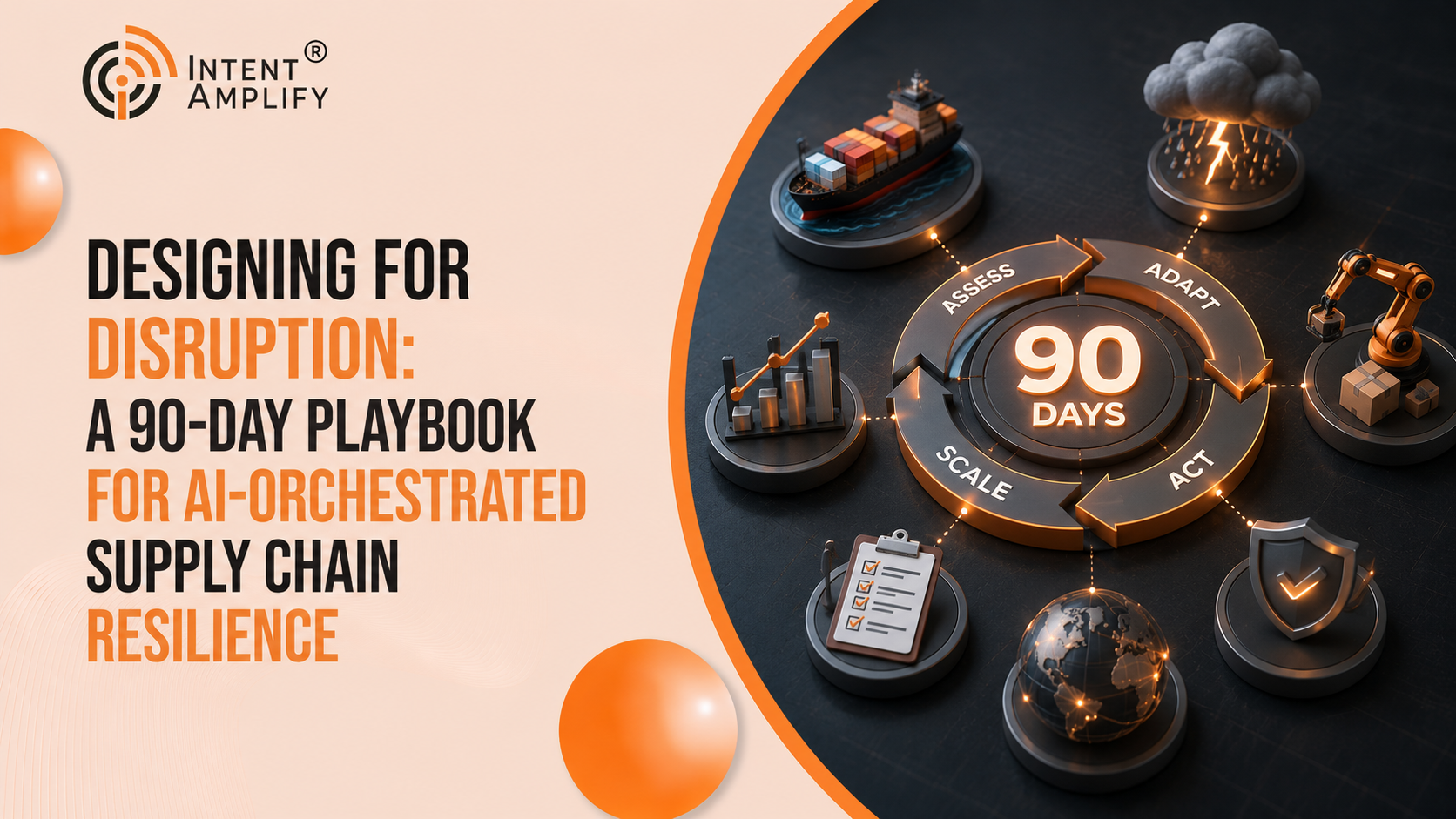
The 90-day playbook below converts these findings into an implementation sequence.
DAYS 1–30 — MAP THE DISRUPTION DECISION
Start with one recurring disruption class.
Good candidates have visible operational friction, cross-functional handoffs, and measurable elapsed time. Examples may include a component shortage, inbound logistics delay, capacity shortfall, or inventory deployment issue.
Do not select the use case because it sounds innovative. Select it because the current decision process is observable.
Week 1: Define the trigger.
Document exactly what starts the workflow. Is it a planning exception, shipment delay, supplier event, production constraint, or inventory threshold?
Define which system owns that signal and how quickly it becomes available.
Week 2: map the consequence chain.
Identify what the disruption can affect: orders, customers, plants, inventory, capacity, service commitments, and cost.
This step prevents the orchestration system from optimizing one application while damaging another outcome.
Week 3: map the human workflow.
Observe how the decision is made today. Which screens are open? Which spreadsheets are consulted? Who is messaged? Which approvals are required? Where does the process wait?
Measure the current signal-to-decision time if the evidence exists. If it does not, establish the baseline during the pilot rather than inventing one.
Week 4: Define authoritative context.
List the data required to make the decision and identify the authoritative source for each element. Mark missing, stale, or disputed sources explicitly.
Output of Day 30: a verified current-state decision map.
DAYS 31–60 — DESIGN THE ORCHESTRATION LOOP
The second month converts the current-state map into a governed target workflow.
Week 5: Define the AI role.
Choose one of four modes:
Assist — gather and summarize evidence.
Recommend — generate options and a proposed action.
Orchestrate — coordinate tools, agents, and approvals.
Execute — complete bounded actions automatically.
For a first pilot, recommendation or orchestration mode is usually easier to validate than broad autonomous execution.
Week 6: Define decision policy.
Specify the objectives and constraints.
For a shortage response, the system may need to consider customer priority, production impact, inventory availability, expedite cost, and policy thresholds. The exact priorities must come from the organization; they should not be inferred by the AI.
Week 7: Define authority.
Separate permissions into read, recommend, prepare, approve, and execute.
Set materiality thresholds. Define prohibited actions. Identify which decisions require planning, procurement, manufacturing, quality, finance,e or executive approval.
Week 8: design escalation.
Create explicit stop conditions for missing evidence, conflicting data, policy ambiguity, threshold breaches, or non-reversible actions.
An escalation should arrive with the assembled context, not as a generic error.
Output of Day 60: a target-state workflow with decision rights and controls.
DAYS 61–90 — PILOT, MEASURE AND LEARN
The final month should test the decision system before expanding authority.
Week 9: run in shadow mode.
Allow the AI to observe the same disruptions as the human team and generate recommendations without affecting the live process. Compare the recommendations with actual decisions.
Week 10: move to recommendation mode.
Present AI-prepared context and options to the decision owner. Capture whether the recommendation is accepted, modified, or rejected.
Record the reason for every material override.
Week 11: Introduce bounded orchestration.
If the recommendation quality is adequate, allow the system to prepare downstream workflow steps: draft the plan change, assemble the approval context, or route the case to the correct owner. Keep material execution behind the established approval boundary.
Week 12: review evidence.
Evaluate the pilot using operational measures:
- Signal-to-decision time.
- Context-assembly time.
- Exception age.
- Recommendation acceptance.
- Override reasons.
- Escalation frequency.
- Execution accuracy for any bounded automated actions.
- Audit completeness.
Connect these measures to service, inventory, cost, or resilience outcomes only where attribution can be supported.
THE DISRUPTION ORCHESTRATION CANVAS
Every pilot should fit on one page.
- Trigger: What event starts the workflow?
- Outcome: What business result is the decision protecting?
- Evidence: What authoritative data is required?
- Options: What responses can the system consider?
- Policy: What objectives and constraints apply?
- Authority: Who can recommend, approve, and execute?
- Escalation: What conditions stop automation?
- Measurement: How will the organization know the new workflow is better?
If the team cannot complete the canvas, the decision is not sufficiently defined for deeper automation.
WHERE SAP FITS
SAP’s 2026 Autonomous Supply Chain Management direction is relevant because the announced Planning, Logistics and Manufacturing Assistants are designed around the same kinds of cross-functional operational decisions.
Planning agents address exception management, shortages, inventory, and capacity. Logistics capabilities address warehousing and transportation. Manufacturing agents support disruption monitoring and corrective workflows. SAP describes assistants orchestrating across domains while specialized agents execute tasks.
Organizations using SAP environments can evaluate where these capabilities align with the decision map developed in the first 60 days. Product availability, licensing, prerequisites,s and integration requirements should be validated against current SAP documentation before implementation commitments are made.
WHAT NOT TO DO
- Do not begin with a vague goal such as “make the supply chain autonomous.
- Do not grant broad write access because the pilot needs cross-functional context.
- Do not use alert reduction as the only success metric.
- Do not treat human overrides as resistance; treat them as evidence.
- Do not convert roadmap announcements into implementation assumptions.
- Do not claim resilience improvement until the operational and business evidence supports it.
THE EXECUTIVE DECISION AT DAY 90
At the end of the pilot, leadership should make one of four decisions.
Expand: Evidence supports applying the workflow to a larger volume or adjacent decisions.
Hold: the workflow is useful, but authority should not increase yet.
Redesign: data, policy, or integration gaps are limiting performance.
Stop: the decision does not justify the complexity or risk.
All four outcomes are valid. A disciplined pilot exists to generate evidence, not to prove that automation was the right answer in advance.
CONCLUSION
Supply chain resilience depends partly on network design and partly on decision velocity.
Agentic AI can improve the second dimension when it is connected to trusted context, explicit policy, bounded authority,y and measurable outcomes.
Ninety days is enough to learn whether one disruption decision can be orchestrated more effectively. It is not enough to declare the entire supply chain autonomous—and it does not need to be.
Start with one consequential decision. Build the evidence. Expand from proof, not enthusiasm.
Join “SAP AI Inside the Supply Chain: From Silo to Orchestration” to explore how SAP’s AI and agentic supply chain direction can support a more coordinated disruption response.
Reference Links:
- SAP — Joule Agents and Joule Assistants for Supply Chain Management: https://www.sap.com/india/products/artificial-intelligence/ai-assistant/scm.html
- SAP — Planning Assistant: https://www.sap.com/india/use-cases/joule-assistant/supply-chain-planning-ai
- SAP — Logistics Assistant: https://www.sap.com/india/use-cases/joule-assistant/logistics-ai
- SAP — Manufacturing Assistant: https://www.sap.com/india/use-cases/joule-assistant/manufacturing-ai
- SAP — Business Network Assistant: https://www.sap.com/india/use-cases/joule-assistant/business-network-ai
- SAP News Center — Building the Autonomous Supply Chain: https://news.sap.com/2026/05/more-autonomous-supply-chain/
- SAP News Center — Autonomous Supply Chain: Why Agentic AI Is Rewriting the Operating Model: https://news.sap.com/2026/06/autonomous-supply-chain-why-agentic-ai-is-rewriting-the-operating-model/
- SAP News Center — Reimagining Supply Chain: From Strategic Vision into Operational Reality: https://news.sap.com/2026/06/reimagining-supply-chain-strategic-vision-into-operational-reality/
- SAP News Center — Blueprint for Supply Chain Resilience in 2026: https://news.sap.com/2026/02/blueprint-for-supply-chain-resilience-in-2026/
- NIST — Artificial Intelligence Risk Management Framework: https://www.nist.gov/itl/ai-risk-management-framework