

Executive Summary: A Clean Metric Can Still Tell the Wrong Story
Distribution leaders are under pressure to protect service while labor remains one of the largest controllable operating costs inside a warehouse. That tension makes labor management an executive issue rather than a floor-level productivity exercise. The useful question is no longer simply whether employees can move more units per hour. It is whether the network can understand what the work should cost, why actual labor differs from that expectation, and which operating decision will close the gap without creating new service, safety, or retention problems.
The September 15 Supply Chain Now webinar centers on a durable idea: labor is a margin decision. That framing matters because labor performance sits at the intersection of demand, process design, staffing, standards, supervision, technology, and customer commitments. A strong management system therefore needs both operational evidence and financial context. It should help leaders distinguish a harder workload from weaker execution, necessary indirect work from avoidable friction, and a temporary demand spike from a structural labor problem.
This asset is written for VPs and Directors of distribution, warehousing, logistics, fulfillment, supply chain, and operations across multi-site 3PL, wholesale distribution, manufacturing, retail and consumer brands, e-commerce fulfillment, and food-and-beverage networks. It does not treat a registration, dashboard, or isolated productivity gain as proof of business value. The objective is to create a decision framework leaders can use before the next staffing, cost, technology, or network review.
The content intentionally separates management principles from vendor-specific performance claims. Any ROI, savings, or customer outcome should be verified against the cited source and the organization's own operating baseline before publication or investment approval.
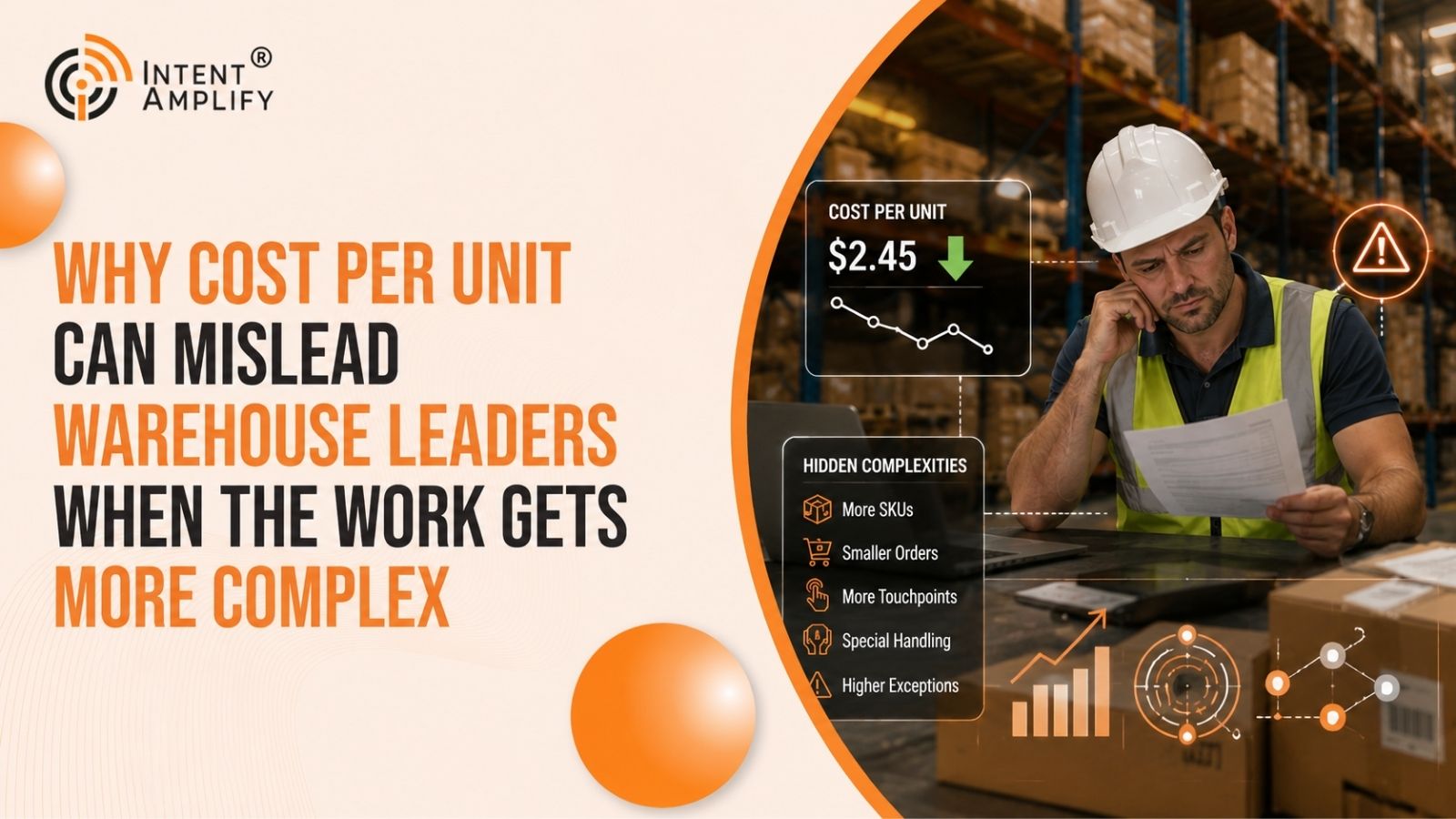
Easy Metrics' 2026 writing on Targeted Cost to Serve directly challenges the assumption behind simple cost-per-unit comparisons: actual warehouse work changes with order profiles, SKU complexity, and workflow variability. A higher observed unit cost can therefore reflect harder work, weaker execution, or both. The metric needs enough context to separate those explanations.
Why Cost Per Unit Became the Default
Cost per unit survives because it is easy to calculate, easy to explain, and easy to trend. Those are real advantages. The weakness appears when the denominator does not represent labor content. A unit can be a pallet, case, each, line, or order, and the handling requirement behind each can vary dramatically.
Instead of discarding cost per unit, leaders should define where it remains valid and add context where it does not. Stable, homogeneous processes can use a simple ratio. Variable processes need workload segmentation or a cost-to-serve method that reflects complexity.
The metric should be tested for sensitivity to mix. If a small shift in order profile changes cost per unit materially, leaders should add segmentation before using the metric for staffing or performance consequences.
That does not make cost per unit useless. It makes it conditional. The executive job is to know when the denominator is stable enough to support a decision and when workload-adjusted cost is required.
The Hidden Assumption: Every Unit Is Equally Expensive to Handle
Warehouse work is heterogeneous. Two orders can have the same unit count and radically different labor requirements because of lines, cases, travel distance, handling method, product dimensions, value-added services, or customer rules. Any fair comparison therefore needs a mechanism for representing complexity rather than averaging it away.
The executive test is simple: if two facilities swapped workloads tomorrow, would the current KPI still rank them the same way? If not, the metric is measuring both workload and execution without separating the two. That makes it weak evidence for staffing, performance management, or investment decisions.
Complexity does not excuse poor execution. Its purpose is to establish a fair expectation. Once the workload is represented, the remaining gap is more credible evidence for operational action.
Executive questions
- What changed in the work itself before performance changed?
- Can the current metric distinguish complexity from execution?
What Happens When Order Profiles Shift
Order profile changes can alter labor demand without changing headline volume. More lines per order, fewer units per line, longer travel, more special handling, tighter cutoffs, and higher exception rates all change the work. This is why a facility can look less productive while executing the demand it received correctly.
The diagnostic move is to compare like with like. Segment the workload into meaningful classes and ask whether performance changed within the class. If it did not, the cost increase may be structural rather than behavioral.
Use operational examples that managers recognize: full-pallet replenishment versus broken-case picking, store replenishment versus direct-to-consumer, normal orders versus value-added services. The more heterogeneous the work, the more dangerous an average becomes.
Separate Workload Complexity From Execution Efficiency
Warehouse work is heterogeneous. Two orders can have the same unit count and radically different labor requirements because of lines, cases, travel distance, handling method, product dimensions, value-added services, or customer rules. Any fair comparison therefore needs a mechanism for representing complexity rather than averaging it away.
The executive test is simple: if two facilities swapped workloads tomorrow, would the current KPI still rank them the same way? If not, the metric is measuring both workload and execution without separating the two. That makes it weak evidence for staffing, performance management, or investment decisions.
Complexity does not excuse poor execution. Its purpose is to establish a fair expectation. Once the workload is represented, the remaining gap is more credible evidence for operational action.
Executive questions
- What changed in the work itself before performance changed?
- Can the current metric distinguish complexity from execution?
Where Labor Standards Add Context
Labor standards establish an expected relationship between the work performed and the time reasonably required. In dynamic distribution environments, a credible standard usually needs more than one activity variable. Lines, orders, cases, travel distance, equipment type, or other workload drivers can change the time requirement. Easy Metrics' guidance on engineered and data-driven standards reflects this multi-metric reality.
Standards create value only when associates and managers understand them, exceptions are reviewable, and the measures feed real operating decisions. A standard that lives in an engineering workbook but does not influence staffing, coaching, or process improvement is documentation, not management infrastructure.
Revalidate after meaningful process changes. New slotting, equipment, automation, layout, packaging, or customer requirements can make yesterday's accurate standard today's distortion.
Why Cost-to-Serve Creates a Better Finance Conversation
Cost-to-serve extends labor analysis from time to economics. It asks what it actually costs to execute a process, fulfill a customer requirement, or operate a facility. Easy Metrics' 2026 Targeted Cost to Serve framing goes further by comparing actual cost with a workload-adjusted target, helping distinguish execution inefficiency from changes in the work itself.
For executives, the key value is decision clarity. When cost variance can be traced to customer mix, overtime, indirect time, productivity variance, or workflow complexity, the remedy becomes more specific: process improvement, staffing, pricing, contract review, or operating-model change.
Cost-to-serve is most useful when it can be drilled back to a process or workload driver. An enterprise number without a diagnostic path may be useful for reporting but weak for operations. Preserve the link from margin variance to the activity that created it.
Executive questions
- Can the cost variance be traced to a process, customer, or workload driver?
- What decision changes when complexity is included?
A Five-Question Executive Check Before Blaming Labor
A decision-ready framework should make the next action obvious. Define the business question, the eligible scope, the expected condition, the actual condition, the variance, the likely drivers, the accountable owner, and the review date. Keep contrary evidence visible. If a metric cannot tell the team what to investigate or who needs to act, it is a reporting metric rather than a management metric.
For an executive review, classify each issue into four routes: sustain what is working; remediate a known process or data gap; redesign the operating method where the model no longer fits; or defer action when evidence is insufficient. This prevents every variance from becoming a headcount or technology request.
Use the framework as a working decision record. The point is to make assumptions visible so another leader can challenge the recommendation with the same evidence.
|
Decision element |
What to establish |
|---|---|
|
Executive question |
What decision would this metric cause the team to make differently this week? |
|
Evidence owner |
Name the person responsible for the source, the interpretation, and the follow-through. |
|
Counter-signal |
Record the strongest fact that could overturn the initial conclusion. |
|
Decision date |
Set the operating forum where the variance will be reviewed and closed. |
See how a long-term labor management approach can connect warehouse performance more closely to margin.
|
Check |
Executive question |
|---|---|
|
1 |
Did order mix or handling complexity change? |
|
2 |
Is the denominator comparable across the periods/sites? |
|
3 |
What did standards say the work should have required? |
|
4 |
How much paid time was indirect, overtime, or unclassified? |
|
5 |
What changes when cost is viewed by process or cost-to-serve? |
Conclusion: Measure the Work Before You Judge the Workforce
Warehouse labor improvement becomes more durable when the organization stops treating labor as a monthly variance to explain and starts treating it as a daily operating system to manage. That requires trusted data, fair standards, workload context, visible indirect time, disciplined overtime review, and a common language between Operations and Finance.
References
- Easy Metrics (2026), Warehouse Performance Management Platform. https://www.easymetrics.com/
- Easy Metrics (2026), Targeted Cost to Serve: Why Warehouse Cost Management Starts with the Right Question. https://www.easymetrics.com/blog/targeted-cost-to-serve-why-warehouse-cost-management-starts-with-the-right-question/
- Easy Metrics (2026), Targeted Cost to Serve launch announcement. https://www.easymetrics.com/news/easy-metrics-launches-targeted-cost-to-serve-tcts-a-new-metric-for-measuring-warehouse-cost-performance/
- Easy Metrics, Warehouse Labor Management System. https://www.easymetrics.com/warehouse-performance-management-platform/warehouse-labor-management-system/
- Easy Metrics, Setting Accurate and Defensible Labor Standards. https://www.easymetrics.com/wp-content/uploads/2021/12/Setting-Accurate-and-Defensible-Labor-Standards.pdf
- Easy Metrics, Data-Driven Labor Standards. https://www.easymetrics.com/wp-content/uploads/2023/04/Data-Driven-Labor-Standards-v9.pdf
- Inbound Logistics / Easy Metrics (2026), The Unified Warehouse Data Playbook. https://www.inboundlogistics.com/whitepapers/the-unified-warehouse-data-playbook/
- Reyes Coca-Cola Bottling, Warehouse Supervisor role description. https://jobportal.reyesholdings.com/allbusinessunit/jobs/32521?lang=en-us