
logo
logo
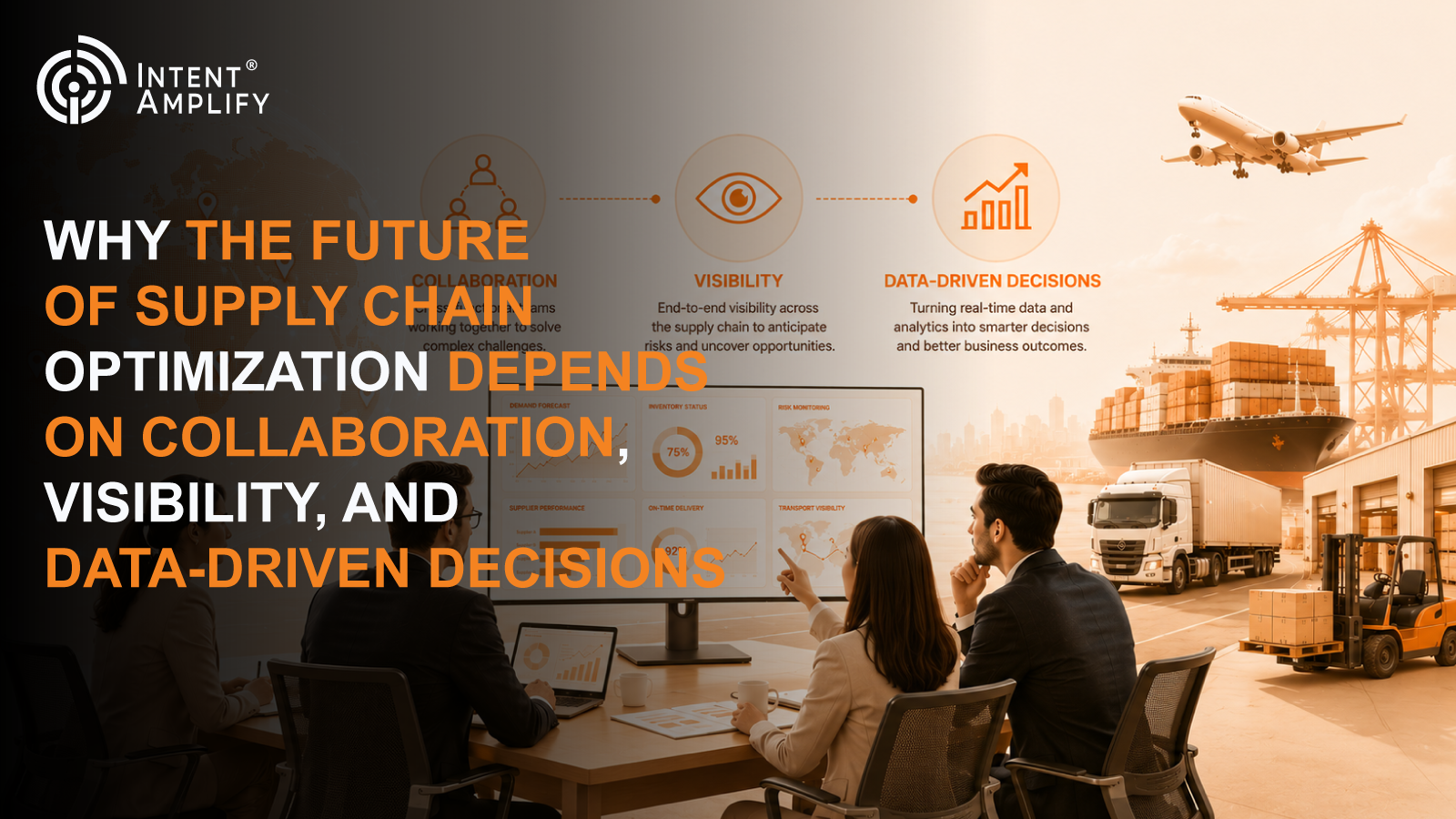
Why the Future of Supply Chain Optimization Depends on Collaboration, Visibility, and Data-Driven Decisions

EXPERT INSIGHT

Why the Future of Supply Chain Optimization Depends on Collaboration, Visibility, and Data-Driven Decisions

Discover why supply chain optimization now depends on collaboration, real-time visibility, and data-driven decision-making to improve resilience, efficiency, and business performance.

Executive Summary

Supply chain optimization is no longer a periodic modeling exercise. It is becoming a continuous business discipline.

For years, many organizations treated network design, transportation planning, inventory positioning, and capacity analysis as specialized projects. There would be a project team that studied a situation, came up with a solution, and handed their recommendation to the business community. It all worked fine in a world where change happened at a much slower pace. That approach is harder to defend in a market shaped by geopolitical tension, demand volatility, labor constraints, tariff uncertainty, and rising service expectations.

The future belongs to firms that optimize collaboratively, visibly, and through data.

That shift is already underway. Gartner forecasts supply chain management software with agentic artificial intelligence (AI) capabilities will grow from less than $2 billion in 2025 to $53 billion in spend by 2030.1

Gartner also predicts that 70% of large organizations will adopt AI-based supply chain forecasting to predict future demand by 2030.2

The investment signal is clear. However, technology alone can never bring about a difference. For groups, there is a need for a frame of reference, accurate information, coordination, and the ability to make decisions regarding trade-offs before investing anything.

Why Optimization Teams Are Moving Beyond One-Off Analysis

The modern operating environment has made isolated analysis too slow.

A sourcing change affects cost. A warehouse decision affects service. A transportation constraint affects inventory. A demand shift affects production. Transportation impacts inventory management, and changes in demand impact manufacturing output. Each decision influences some other area within the firm, and yet many organizations still depend on the passing around of spreadsheets for planning and interpreting such relationships.

Most operations teams are already operating at full capacity. The challenge is that planning processes built for stability are being applied in an environment defined by constant disruption.

Gartner has reported that by 2031, 60% of supply chain disruptions will be resolved without human intervention as AI enables increasingly autonomous operations.3

That prediction does not remove the need for human judgment. It raises the standard for it. Leaders will need systems that can sense change, compare options, and support decisions quickly, while still allowing people to evaluate context, risk, and business priorities.

Optimization teams, therefore, are becoming decision partners. They will no longer just provide answers to technical queries; they will also help in making the decisions that organizations are willing to make.

Visibility Is the Foundation for Better Decisions

Visibility has been viewed as a tracking activity. However, visibility is much more than this.

A business cannot improve what it cannot see. If leaders do not understand where inventory sits, how demand is changing, which lanes are constrained, where capacity is tightening, or where supplier risk is building, they are forced into reactive choices.

The survey conducted by Deloitte in 2025 on Global Chief Procurement Officer revealed that 64% of the respondents favored increasing supply chain transparency, whereas 61% were interested in improving supplier information exchange and collaboration.4

That pairing matters.

Visibility without collaboration becomes a dashboard exercise. Collaboration without shared evidence becomes opinion management.

Collaboration without shared evidence can become opinion management. The real value appears when teams can see the same facts, test the same scenarios, and align on the same decision logic.

Gartner's 2025 Supply Chain Symposium/Xpo Orlando highlighted that scenario planning can reduce disruption recovery times by 70% to 80%.5

Visibility creates value only when it helps organizations understand potential impact. A delayed facility, a constrained supplier, or a sudden shift in regional demand can quickly ripple across the network. Leaders who can see those connections early are better positioned to prepare responses before disruption becomes a business problem.

Collaboration Turns Analysis into Action

Optimization fails when the model is right, but the organization is not aligned.

That may sound blunt, but many teams recognize the pattern. Analysts identify savings. Planners worry about service. Finance questions assumptions. Commercial teams protect customer commitments. Operations sees execution limits that the model cannot fully capture. The result is not always a bad decision. Sometimes there is no decision at all.

Collaboration changes the operating rhythm. Instead of asking one team to deliver a final answer, organizations can bring planning, procurement, finance, logistics, sales, manufacturing, and executive stakeholders into a shared decision environment.

Deloitte's 2025 survey also found that 74% of respondents identified finding alternative supply sources as the most effective mitigation strategy.4

Alternative sourcing is not a procurement-only choice. It can affect landed cost, lead time, working capital, quality, customer service, and resilience. That is exactly why cross-functional decision-making matters. A lower-cost option may increase risk. A resilient design may raise near-term expense. A faster transportation mode may protect revenue but weaken the margin.

Optimization teams help make those trade-offs explicit. The value is not only in finding the mathematically best answer. It is in helping leaders understand what each path costs, protects, enables, or puts at risk.

Data-Driven Decisions Require More Than More Data

Most enterprises do not lack information. They lack usable decision intelligence.

Data is scattered across enterprise resource planning systems, transportation platforms, warehouse tools, demand forecasts, supplier records, spreadsheets, and external market signals. When teams cannot connect those sources, they may have plenty of information but limited clarity.

Gartner reported that only 23% of supply chain leaders had a formal AI strategy in place, based on a survey of leaders who had deployed AI in their organizations within the previous 12 months.6

That finding is a caution sign. Advanced analytics, AI, and autonomous planning require more than pilots. They require governance, quality controls, business ownership, and measurable use cases. Without that foundation, organizations risk creating impressive tools that struggle to scale.

A more pragmatic approach is called for. Begin with the important decisions. Establish robust information around such decisions. Ensure scenario processes are clear to business users. Compare outcomes across cost, service, resilience, capacity, and sustainability. Then make the decision path visible enough for stakeholders to trust it.

This is where optimization becomes more than analytics. It becomes a management capability.

From Reactive Support to Strategic Business Impact

The role of supply chain optimization teams is expanding because the questions they answer are becoming more central to enterprise performance.

Should the company add a distribution node? Where should inventory be positioned? Which lanes should be consolidated? How much redundancy is worth the cost? Which customers should be served from which locations? What is the operating impact of a tariff, disruption, or demand spike?

These are not narrow technical questions. They are business questions.

The Decision Spot and Supply Chain Now webinar, "The Expanding Role of Supply Chain Optimization Teams in Driving Business Impact," offers a timely discussion of this shift. The session examines how optimization teams are moving beyond one-off business requests and occasional network design studies toward a more proactive role in enterprise planning.

As supply chains become more dynamic, leading teams are supporting broader decision-making, becoming proactive decision partners, and helping businesses unlock greater value faster.

The webinar also explores how optimization, artificial intelligence, and modern decision-support technology can reduce time to value while helping teams create measurable impact across network, inventory, transportation, and capacity decisions.

This message is quite pertinent for the American leadership. Volatility in the markets means that time has become critical. However, making decisions hastily can lead to costly blunders. What is needed now is more accurate decision-making at a faster pace.

The Decision Spot Perspective: Making Trade-Offs Visible Before Commitment

Decision Spot's positioning is well aligned with this market need.

Decision Spot helps supply chain teams test scenarios, evaluate trade-offs, and align on the right path before committing capital or finalizing plans.

Its Foresta platform brings together mathematical optimization, artificial intelligence, and scenario management for network, inventory, and transportation decisions.

This matters because many leaders are not looking for another planning interface. They need a way to understand the consequences of options before they act. Decision Spot's solution focus includes network strategy, cost-to-serve, inventory and working capital, freight and transportation, and resilience.

The business benefits are practical. Teams can quantify savings before making changes. They can evaluate service impact before altering network flows. They can stress-test disruption scenarios before a crisis. They can compare resilience, cost, service, and sustainability in one decision context.

That is not promotion for its own sake. It reflects a broader market requirement: optimization must become usable by the people responsible for outcomes, not only by modeling specialists.

Benefits for Supply Chain and Business Leaders

Collaborative, visible, data-driven optimization can improve both operational performance and executive confidence.

Collaborative, visible optimization creates practical business value. Teams can move from question to recommendation faster, evaluate capital commitments with greater confidence, and prepare contingency plans before disruptions occur.

Gartner has noted that 88% of supply chain leaders agree on the positive impact of scenario planning, while only 19% fully integrate it into their strategies.5

That gap is an opportunity. Organizations that operationalize scenario planning can move beyond reactive firefighting. They can build repeatable decision muscles.

The Decision Spot and Supply Chain Now webinar reinforces the same point: optimization teams can scale impact when they become proactive decision partners rather than reactive request handlers.

What Leaders Should Do Now

Leaders should begin by identifying which decisions have the most significant business implications, such as network design, inventory policies, transportation approaches, alternative sources, capacity considerations, or cost-to-serve calculations.

Next, they should assess whether teams have the visibility needed to evaluate alternatives. If the underlying data is partial, outdated, or siloed across disconnected systems, improved optimization alone will not resolve the issue.

Third, leaders should create cross-functional forums for critical trade-offs. Optimization needs to integrate with finance, sales, operations, procurement, and executive management considerations and not remain in its own silo.

Finally, organizations should measure decision outcomes, not only planning activity. Useful metrics include time to decision, recovery speed, working capital impact, transportation savings, service performance, and adoption of scenario-based recommendations.

The goal is not to automate every judgment. The goal is to make each major choice more informed, more transparent, and more defensible.

Conclusion

The future of supply chain optimization will not be defined by better models alone. It will be defined by how well organizations turn analysis into coordinated action.

Collaboration, visibility, and data-driven decision-making reinforce one another. Together, they help organizations align stakeholders, compare alternatives with confidence, and respond to disruption before it becomes a business problem.

For enterprise leaders, this is the strategic shift. Optimization is moving from a specialist function to a business capability. It now influences growth, margin, service, resilience, working capital, and customer trust.

The companies that advance fastest will not simply invest in more technology. They will build the operating discipline to use optimization continuously, collaboratively, and transparently.

In a volatile market, the strongest supply chains will not be the ones that guess better. They will be the ones who decide better.

Learn More

Are your supply chain optimization teams still responding to one-off requests, or are they helping the business make faster, clearer, and more confident decisions?

The Decision Spot and Supply Chain Now webinar, "The Expanding Role of Supply Chain Optimization Teams in Driving Business Impact," explores how optimization teams are becoming proactive decision partners and helping organizations create measurable value across network, inventory, transportation, and capacity decisions.

Watch the webinar to hear how Decision Spot and Supply Chain Now frame the expanding role of optimization teams, and how modern decision-support technology can help organizations improve collaboration, evaluate trade-offs, and accelerate business impact.

Attend the webinar

About Intent Amplify

Intent Amplify helps B2B technology organizations engage high-value audiences through demand intelligence, content-led programs, and go-to-market strategies built around measurable business outcomes. By combining audience insights, editorial expertise, and intent-driven engagement, Intent Amplify supports technology brands in reaching decision-makers with content that educates, informs, and advances meaningful buyer conversations.

For organizations looking to turn market interest into qualified demand, Intent Amplify provides the strategic foundation to connect trusted content with the right audience at the right stage of the buying journey.

Contact us to learn how Intent Amplify can help your organization convert audience intent into qualified demand and stronger go-to-market outcomes.

References

  1. Gartner, Gartner Forecasts Supply Chain Management Software with Agentic AI Will Grow to $53 Billion in Spend by 2030, April 7, 2026

  2. Gartner, Gartner Predicts 70% of Large Organizations Will Adopt AI-Based Supply Chain Forecasting to Predict Future Demand by 2030, September 16, 2025

  3. Gartner, Gartner Predicts 60% of Supply Chain Disruptions Will Be Resolved Without Human Intervention by 2031, March 18, 2026

  4. Deloitte, 2025 Global Chief Procurement Officer Survey, 2025

  5. Gartner, Gartner Supply Chain Symposium/Xpo Orlando: Day 1 Highlights, May 5, 2025

  6. Gartner, Gartner Survey Shows Just 23% of Supply Chain Organizations Have a Formal AI Strategy, June 11, 2025

Yash Lad

Yash Lad

Research Analyst

Let us connect for more