
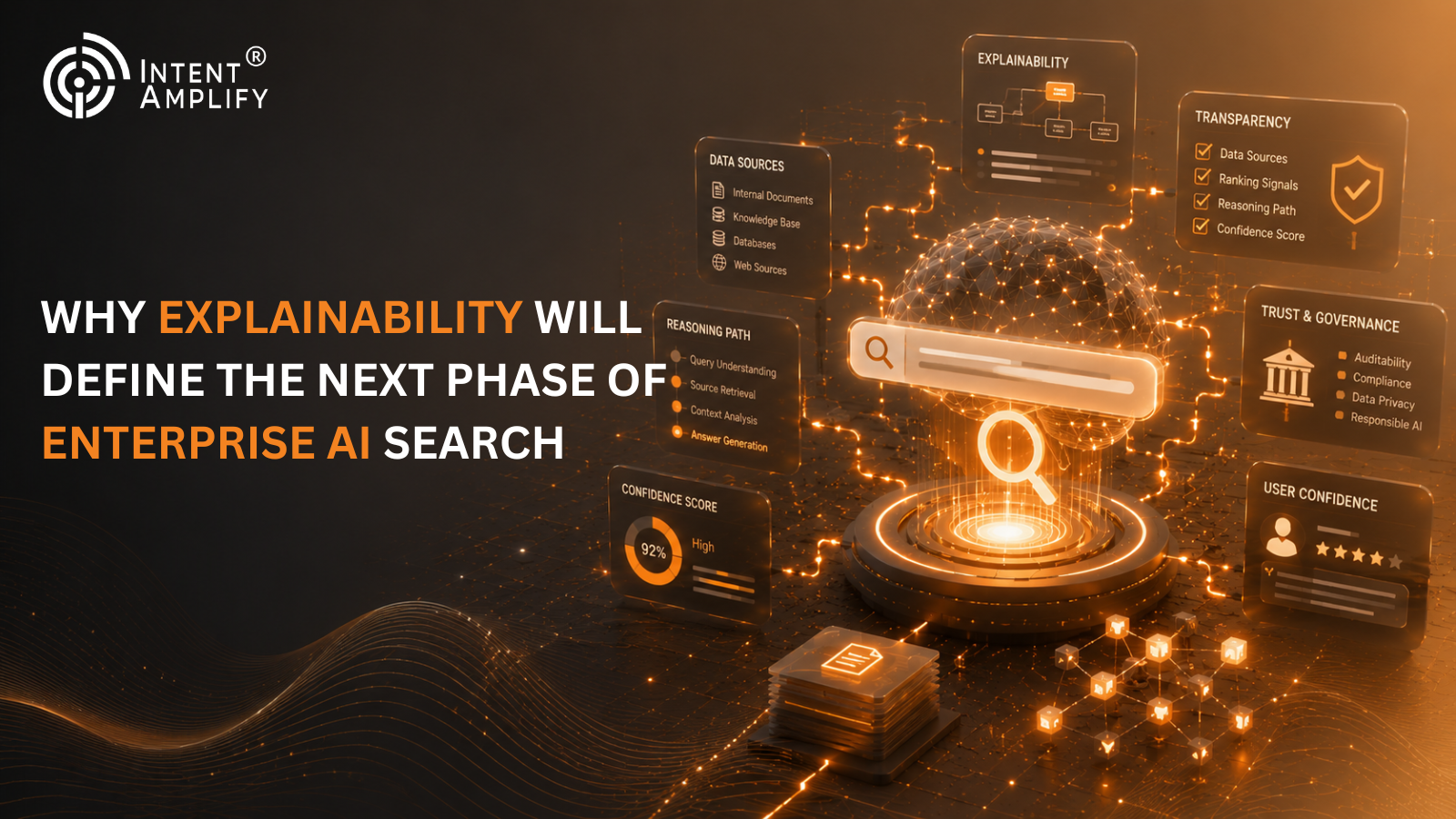
Executive Summary
Enterprise AI search is moving from speed-focused experimentation to trust-focused adoption.
The first phase was about speed. Could employees find information faster? Could generative artificial intelligence (AI) summarize long documents? Could retrieval-augmented generation (RAG) reduce the time wasted moving across knowledge bases, shared drives, portals, and document systems?
Those questions still matter. But they no longer go far enough.
The next phase of enterprise AI search will be defined by trusted, traceable answers. Business users do not simply want faster responses. They want to know where an answer came from, which source supports it, whether the information is current, who had permission to retrieve it, and whether the response can be defended in a client, compliance, legal, or executive setting.
That shift is arriving at the same time AI investment is accelerating. Gartner forecasts worldwide AI spending will reach $2.59 trillion in 2026, a 47% year-over-year increase.1
IDC reports that full-year 2025 AI infrastructure spending reached $318 billion, more than double the $153 billion recorded in 2024, and projects that spending will reach $487 billion in 2026.2
The direction of AI investment is clear. The question of enterprise trust remains far less settled. Organizations are no longer asking only whether AI can improve productivity; they are asking whether AI-generated answers can be trusted, verified, governed, and reused with confidence.
Why Enterprise AI Search Is Becoming a Trust and Traceability Issue
For years, enterprise search returned links rather than answers. Employees still had to open documents, compare versions, interpret context, and decide what mattered. AI search promised a better experience: direct, contextual answers instead of long lists of results.
That promise is powerful, but it’s also risky.
A polished AI response can create a false sense of certainty when it lacks visible sources, citation trails, access governance, auditability, and reasoning context. In legal, financial, healthcare, insurance, government, and professional services environments, the risk is not only an incorrect answer. It is an answer that cannot be verified, defended, or safely used in a high-stakes workflow.
McKinsey’s 2025 Global Survey on AI found that 88% of respondents report regular AI use in at least one business function, up from 78% a year earlier. Yet only about one-third say their companies have begun to scale AI programs.3
That gap between adoption and scaled value is where explainability becomes critical. Organizations are experimenting widely, but scale requires something more disciplined: clear sources, repeatable validation, governance controls, and user confidence.
The Business Cost of Answers Users Cannot Verify
The most dangerous AI search failure is not always an obviously wrong answer. It is an answer that looks credible but cannot be traced to authoritative source material, reviewed against supporting evidence, or explained to a client, auditor, regulator, or executive stakeholder.
That is where business trust breaks down. A legal team may ask for support on a regulatory question. A sales team may search for contract language. A compliance officer may request policy guidance. If the AI system responds confidently but cannot show its sources, the user is forced back into manual verification.
McKinsey reports that 51% of respondents from organizations using AI have seen at least one negative consequence from AI, with nearly one-third reporting consequences tied to AI inaccuracy.3
Accenture’s Pulse of Change research found that 86% of C-suite leaders plan to increase AI investment in 2026. Yet the same research signals a value gap, with only 32% of decision-makers reporting sustained, enterprise-wide AI impact.4
This is the practical challenge. AI is being funded aggressively, but enterprise users still need proof. Explainability provides proof by connecting AI-generated outputs to verifiable evidence.
Explainability, Traceability, and Governance Are Now Business Requirements
Explainability is often treated as a technical feature. In enterprise environments, AI search is becoming a business requirement.
A strong AI search experience should show the source documents used, the passages that informed the answer, the freshness of the content, the permissions applied during retrieval, and the evidence path behind the response. It should also make uncertainty visible. In high-trust environments, professionals need AI-generated answers they can inspect, challenge, validate, and refine before acting.
IBM defines AI transparency as clarity and openness in how AI systems operate and make decisions, while explainability focuses on understanding how a model arrived at a specific result.5
For enterprise search, transparency, explainability, and traceability work together. Transparency helps users understand the system. Explainability helps them understand the answer. Traceability helps them validate the evidence.
This combination matters because AI-related risk is already visible. IBM’s 2025 Cost of a Data Breach Report found that 13% of organizations reported breaches of AI models or applications, and 97% of those organizations lacked proper AI access controls.6
In other words, trust is not only about output accuracy. It is also about governance, access, security, and accountability.
Agentic AI Raises the Stakes
The rise of agentic AI makes explainability even more important.
Traditional enterprise search responds to a query. Agentic systems can plan steps, retrieve information, compare sources, generate drafts, and support multi-step workflows. That makes them more useful, but also harder to supervise.
McKinsey found that 23% of respondents say their organizations are scaling an agentic AI system somewhere in the enterprise, while another 39% have begun experimenting with AI agents. 3
Microsoft has stated that more than 80% of Fortune 500 companies use active AI agents built with low-code or no-code tools.7
As agents become more common, business leaders will need more than surface-level citations. They will need reviewable reasoning trails. What did the agent retrieve? Which sources did it prioritize? Which content was excluded because of permissions? Did it ignore outdated material? Did it preserve human review before action?
Without that visibility, agentic search becomes another black box. With it, AI search becomes a trusted layer in knowledge work.
Case Study Proof Point: Progress Agentic RAG and Trusted Legal AI Search
The Progress Software case study provides the practical proof point for this Expert Insight. It shows how trusted AI search must work when users need legal-grade answers rather than generic AI output.
The case centers on a European law firm serving thousands of clients. The firm needed to accelerate responses to complex legal and accounting questions while preserving explainability, traceability, and trusted accuracy under strict regulatory expectations, including the General Data Protection Regulation (GDPR).
Progress Agentic RAG helped the firm build custom AI legal research workflows grounded in internal legal and accounting knowledge, as well as selected external sources. The solution supported traceable responses, tailored retrieval strategies, curated knowledge sources, citation-backed draft findings, governance controls, and auditability for professional-services use cases.
A notable component was REMi, or RAG Evaluation Metrics intelligence, which was used to continuously measure and improve answer accuracy, relevance, and reliability.
The outcomes make the Progress-specific value proposition concrete. Approximately 300 legal and accounting professionals received traceable, cited draft findings that could be rapidly validated. The system also processed thousands of questions each month, reducing manual research effort while allowing professionals to focus on analysis, client strategy, and final judgment.
The lesson is not that AI replaces expertise. It is that explainable AI search gives experts a stronger starting point.
Benefits for Leaders in High-Trust Enterprise Environments
Trusted, traceable AI search can create measurable value across high-trust enterprise environments. It reduces time spent searching across fragmented systems, improves confidence by tying answers to cited sources, strengthens compliance through auditability, and turns static knowledge assets into usable intelligence that professionals can validate before acting.
For U.S. organizations, the business case is especially relevant. IDC reports that the United States accounted for $69.2 billion, or 77% of global AI infrastructure spending, in Q4 2025.2
That level of spending raises the standard for measurable enterprise outcomes. Leaders must prove that AI does more than produce impressive demonstrations. It must improve knowledge access, decision quality, operational efficiency, governance, and user trust.
It should also help teams reduce duplicated research, shorten response cycles, and make better use of institutional expertise already sitting inside contracts, policies, case files, technical documents, and customer records. When AI search can explain its outputs, employees are more likely to adopt it, and leaders are better positioned to connect AI investment with measurable business outcomes.
What Enterprise Leaders Should Do Now
Enterprise leaders should begin by identifying where unverifiable answers create business risk. The best starting question is not, “Where can we add AI search?” It is, “Where do our teams need trusted, traceable knowledge but still rely on manual research, fragmented repositories, or undocumented judgment?”
They should define and explain the requirements for explainability and traceability before scaling AI search. These requirements should include source citation, passage-level evidence, content freshness, permission-aware retrieval, audit logs, user feedback loops, retrieval evaluation, and quality metrics. In high-stakes functions, leaders should also clarify when human review is required, which content repositories are authoritative, and how answer quality will be tested over time.
Leaders should treat AI search as a knowledge governance initiative, not just an application upgrade. If repositories are outdated, fragmented, or poorly curated, AI will expose those weaknesses quickly. The organizations that move fastest will not simply connect AI to more data; they will improve the quality, ownership, and structure of the knowledge behind it. They will curate better knowledge, assign ownership, monitor quality, and build workflows where explainable outputs support, not replace, professional judgment.
Conclusion
The future of enterprise AI search will not be defined by how quickly a system can generate an answer. It will be defined by whether that answer can be trusted, traced to authoritative evidence, explained to stakeholders, validated by professionals, and governed at scale.
For enterprise leaders, this is the real inflection point. AI-powered knowledge discovery is moving from a productivity enhancement to a core knowledge infrastructure layer. Once it begins influencing legal research, client advisory, compliance interpretation, policy guidance, customer support, and strategic decision-making, speed alone becomes an insufficient measure of success. The higher standard is defensibility.
Explainability gives users the confidence to act. Traceability gives reviewers the evidence to verify. Governance gives executives the control to scale responsibly. Together, these capabilities determine whether the intelligent search layer remains an experimental interface or becomes an enterprise-grade system of intelligence.
As AI investment accelerates, black-box search experiences will become harder to defend. Employees will expect answers that reveal their sources. Compliance teams will expect systems that preserve audit trails and make decision pathways visible. Executives will expect AI programs to improve decision quality, reduce operational friction, and create measurable value without introducing unmanaged risk.
The next phase of enterprise AI search is not simply conversational. It is explainable, traceable, governed, secure, and human-accountable. Organizations that build around these principles will be better positioned to turn fragmented enterprise knowledge into trusted intelligence, helping teams move faster while preserving the judgment, accountability, and confidence that high-stakes business decisions require.
Learn More
Are your AI search experiences giving professionals answers they can verify, defend, and trust?
The Progress Agentic RAG case study shows what enterprise AI search can become when speed is matched with traceability, source visibility, governance, and professional oversight. For legal, professional services, and other high-trust industries, the value is not simply faster information retrieval. It is the ability to give experts a stronger starting point, connect every answer to supporting evidence, and preserve human judgment where it matters most.
The case study, Progress Agentic RAG Enables Trusted, Traceable Answers for a Leading Law Firm’s AI Search Experiences, examines how a leading law firm used Progress Agentic RAG to support approximately 300 legal and accounting professionals, process thousands of questions monthly, and deliver citation-backed draft findings that professionals could validate quickly. The result is a practical view of how trusted AI search can reduce research friction, improve answer validation, and help knowledge-intensive teams deliver traceable responses with greater confidence.
Download the case study to see how Progress Agentic RAG enables governed, auditable, and traceable AI search experiences for complex enterprise environments.
About Intent Amplify
Intent Amplify helps businesses engage high-value audiences through demand intelligence, content-led programs, and go-to-market strategies built around measurable business outcomes. By combining audience insights, editorial expertise, and intent-driven engagement, Intent Amplify supports technology brands in reaching decision-makers with content that educates, informs, and advances meaningful buyer conversations.
For organizations looking to turn market interest into qualified demand, Intent Amplify provides the strategic foundation to connect trusted content with the right audience at the right stage of the buying journey.
Contact us to learn how Intent Amplify can help your organization convert audience intent into qualified demand and stronger go-to-market outcomes.
References
- Gartner, Gartner Forecasts Worldwide AI Spending to Grow 47% in 2026, May 19, 2026
- IDC, AI Infrastructure Spending Caps Historic Year at $90 Billion in Q4 2025; 2029 Spending to Eclipse $1 Trillion, 2026
- McKinsey & Company, The State of AI: Global Survey, 2025
- Accenture, Pulse of Change, 2026
- IBM, What Is AI Transparency?, 2026
- IBM, IBM Report: 13% of Organizations Reported Breaches of AI Models or Applications, 97% of Which Reported Lacking Proper AI Access Controls, July 30, 2025
- Microsoft, 80% of Fortune 500 Use Active AI Agents: Observability, Governance, and Security Shape the New Frontier, February 10, 2026