Book a Demo
Home Platform Audience Accounts Intent Evidence Activation SignalAtlas Solutions Industries Programs Research Pricing About Careers Press Contact Brands Trust Privacy Accessibility Demo ABM Advertising Content Demand Intent Data Sales Blog Infographics Events Product Sheets Videos Webinars White Papers E-books Customer Stories Corporate Presentation Newsletters Expert Insights Expert Analysis Research Reports
Expert Insight

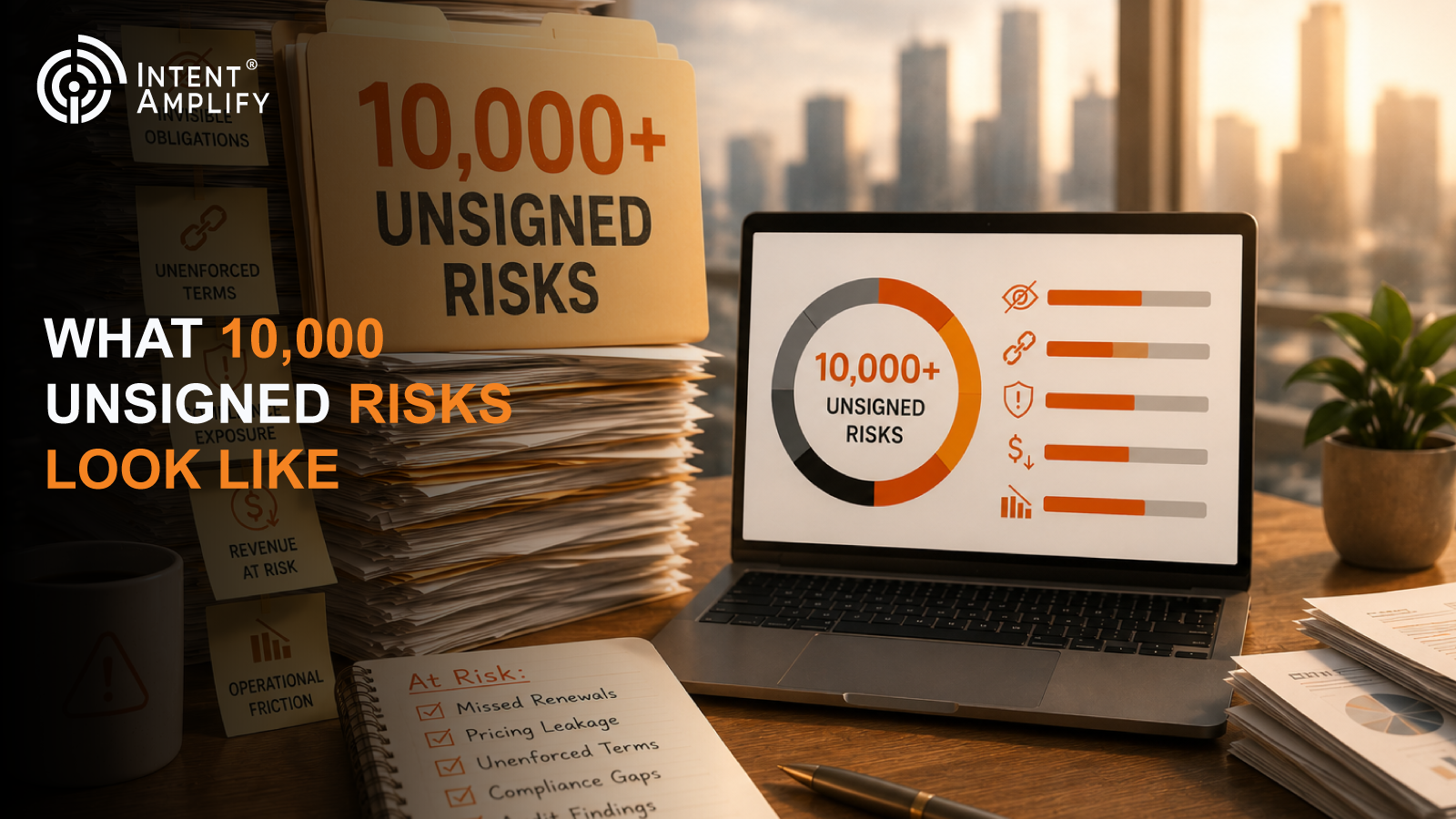
What 10,000 Unsigned Risks Look Like

Expert Insight
What 10,000 Unsigned Risks Look Like
June 11, 2026 7 min read

Quick Answer

Discover how AI-powered CLM helps uncover hidden contract risks, prevent value leakage, improve governance, and turn contract data into business intelligence.

There is a moment most legal and procurement leaders recognize. A contract dispute surfaces, a renewal auto-renews at the wrong rate, a supplier fails an SLA obligation the business never tracked, and someone in the room asks: "How long has this been happening?” The answer, almost always, is longer than anyone realized. The risk was there the entire time. It was just invisible.

That invisibility is not accidental. It is architectural. Most enterprise contract portfolios were not built to surface risk. They were built to store documents. And the distance between storing a contract and understanding what is inside it, at scale, across thousands of agreements simultaneously, is where enterprise risk lives and compounds quietly, year after year.

Legal operations teams rarely struggle to find contracts. Their challenge is understanding which contracts deserve attention before something goes wrong. The experts who work with it every day have a starker way of describing it. For every 10,000 contracts sitting in a typical enterprise repository, there are thousands of unsigned risks: auto-renewal clauses no one is monitoring, indemnification terms that exceed the organization's risk tolerance, SLA commitments that have already been missed, and price escalation mechanisms that are about to trigger without anyone being prepared.

The data make the financial consequence unavoidable. Organizations lose 9.2% of annual revenue to poor contract oversight. ¹ 

11% of contract value leaks through provisions that were negotiated and then never monitored. ² 

For a $500 million organization, that is not a rounding error. It is a material financial event hiding in plain sight inside documents the business already owns.

Getting Really Good Data Can Be a Challenge

IBM procurement expert Daniel Barnes put the root of the problem plainly in a recent episode of IBM's AI in Action: "Getting really good data can be a challenge. I've used AI to extract as much data from documentation, mainly contracts, because my view is that good contracts really contain all the information you need." ³

The significance of that observation is easy to miss. Most of the information needed to manage supplier performance, compliance exposure, pricing obligations, and renewal risk already exists inside executed agreements. 

However, most organizations still struggle to access this information quickly because of limitations in their contract management systems. The practical challenge is turning contractual language into operational intelligence. That is the gap modern CLM platforms are trying to close. 

Agiloft's approach centers on making that intelligence accessible across Legal, Procurement, Finance, and Operations. 

IBM's IBV research confirms that data access is worth it: organizations using AI in procurement achieve 40% to 70% reduction in procurement costs within six months, supplier onboarding is 10 times faster, and over $70 million is prevented in duplicate and mistaken payments through AI-driven contract compliance. 

These are not outcomes from better negotiators. They are outcomes from better intelligence, and better intelligence starts with a contract repository that actually tells you what is in it.

In many organizations, the assumption is that contract performance improves through better negotiation. The evidence increasingly suggests something different. Negotiated value is only realized when organizations can see, track, and operationalize what was agreed after the contract is signed.

Procurement leaders often describe the same frustration: the contract contains the answer, but finding it requires more effort than the business can justify. 

AI Is Non-Deterministic: Randomness Means Risk

Palo Alto Networks' Spencer Thellmann, Principal Product Manager for AI Runtime Security, framed the broader AI governance challenge in terms that apply directly to contract management: "AI is non-deterministic. You can't control what someone's going to ask your chatbot or agent, and you can't control what your chatbot or agent is going to say back to someone, which means that you have randomness on the input and the output, and that randomness means risk."

For legal leaders, that uncertainty creates an uncomfortable reality. AI can accelerate decision-making, but it can also accelerate mistakes when it operates on incomplete or poorly governed information. 

For enterprise CLM leaders, that insight reframes what AI-powered contract management actually requires. Not only must the AI have the ability to parse through contracts. The AI must operate from contract data that is authoritative and governed, so that every insight, alert, or obligation drawn from its analysis is based on facts and evidence within the contract itself, as opposed to conjectures derived from piecemeal data. This helps explain why governed contract data is becoming a prerequisite for enterprise AI rather than an optional enhancement.

According to Palo Alto Networks' report "State of Cloud Security Report 2025," which cited insights from 2,800 security experts, 99% of all enterprises were targets of cyber attacks against their AI systems last year.  ⁶ 

In an environment with fragments of sensitive pricing, confidentiality, and supplier agreements spread across unprotected file servers and emails, this is a very real problem. It is active. Agiloft's single governed repository reduces the surface from many disconnected exposure points to one auditable, continuously monitored platform.

Boards rarely ask whether AI is being deployed. Increasingly, they ask whether AI is being governed. 

AI Deployment Is Currently Outpacing AI Governance

Palo Alto Networks' April 2026 announcement with Google Cloud named the enterprise AI problem of 2026 directly: "AI deployment is currently outpacing AI governance." 

In the contract management context, that gap shows up in legal and procurement AI tools that generate speed without generating accountability. Fast contract drafting without clause standardization. Quick risk summaries without obligation tracking. AI-assisted redlining without a governed repository that captures what was agreed.

Agiloft closes that governance gap by design. Its AI is not a standalone tool operating in isolation from the CLM system. It is embedded within the platform, so that every action it takes, every risk it identifies, and every alert it generates is connected to the full lifecycle context of the contract it is analyzing. IBM's research confirms what governance delivers: organizations committed to orchestration-led governance are 13x more likely to scale their AI practice and experience 30% fewer operational irregularities, which, for a $20 billion company, translates to approximately $140 million saved annually.

Legal operations teams rarely lack documentation. What they often lack is a practical way to convert documentation into timely action.

What the Experts Know That Most Organizations Are Still Learning

The contract management conversation in 2026 has matured beyond the question of whether AI can help. The experts who have deployed it successfully, and the data from IBM, Palo Alto Networks, Microsoft, Google Cloud, and Cisco, all point to the same answer: it can, decisively, but only when the AI operates inside a governed, data-first platform rather than as a point tool layered onto a fragmented repository.

The 10,000 unsigned risks in a typical enterprise contract portfolio are not waiting to be discovered. They are actively accumulating. Every auto-renewal that triggers without review, every SLA deviation that goes unmonitored, every indemnification clause that exceeds the organization's risk tolerance without anyone knowing, is a financial and legal event in slow motion.

The organizations getting the most value from AI-powered CLM are not necessarily those with the largest legal teams or the most advanced AI programs. They are the ones who have created visibility into contractual obligations before those obligations become financial events. That visibility is ultimately what contract intelligence delivers: fewer surprises, faster decisions, and greater confidence in the commitments already shaping the business. Agiloft is the platform that makes that intelligence accessible, in real time, before the next quiet cost becomes a loud problem.

Different organizations enter the CLM journey from different starting points. Some are focused on governance. Others are focused on risk reduction, AI readiness, or building a business case for investment. The resources below are designed to support those different priorities.

Explore Agiloft's Full Expert Resource Suite:

CLM + AI: From Locked Files to Living Intelligence: Get the Executive Briefing

About Intent Amplify

Intent Amplify helps organizations move from market insight to measurable growth through GTM strategy, demand intelligence, pipeline activation, executive roundtables, sponsored research, targeted content, webinars and panels, vendor intelligence, and strategic consulting. For teams that need sharper positioning, stronger executive engagement, and more effective activation, Intent Amplify connects strategy, content, and market intelligence into a practical growth engine.

Contact Us


References

  1. ContractSafe. Every Contract Tells a Story in Numbers: These Are the 2026 Statistics Worth Knowing. May 2026

  2. ContractSafe. 30 Top Contract Management Trends and Stats You Need to Know in 2026. May 2026

  3. IBM. Optimizing Contract Management in Procurement with AI. 26 March 2026

  4. IBM. The Future of Procurement: Moving Beyond Cost Savings to AI-Driven Value Creation. 18 November 2025

  5. BankInfoSecurity. Unpredictable by Design: The Challenges of Autonomous AI. 2 January 2026

  6. Palo Alto Networks Blog. Where Cloud Security Stands Today and Where AI Breaks It. 16 December 2025

  7. Palo Alto Networks Blog. Palo Alto Networks and Google Cloud Expand Strategic Collaboration to Secure AI Enterprise. 22 April 2026

  8. IBM. Managing Agentic AI's Speed, Scale, and Sprawl: Insights from Think 2026. May 2026

Contact
Sales