
By the time an enterprise starts building a case for contract lifecycle management, the symptoms are usually already visible across the business. Legal is buried in review cycles, procurement is chasing supplier terms, finance is questioning contract value leakage, operations is waiting on approvals, and compliance is hoping obligations are tracked somewhere more reliable than an inbox or shared drive.
CLM success depends on executive buy-in before software evaluation begins.
For large organizations, CLM software is no longer a narrow legal productivity tool. It is an enterprise system for contract visibility, risk control, business intelligence, and operational discipline because contracts define pricing, obligations, renewals, supplier performance, compliance commitments, liability, service levels, and revenue terms across the organization. When that data is fragmented across disconnected documents and systems, decision-making becomes fragmented too.
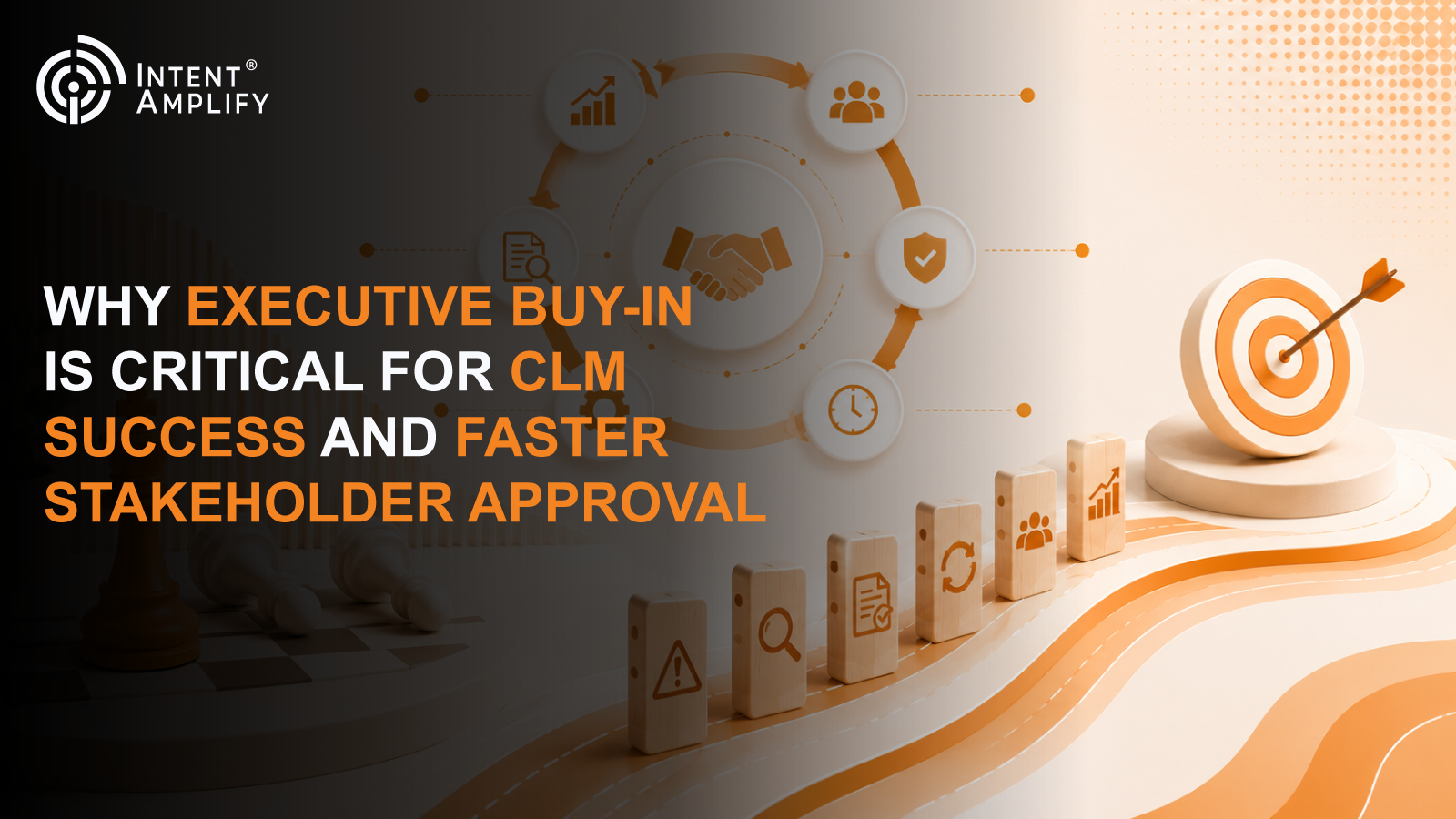
Executive sponsorship is essential because contract lifecycle management spans legal, procurement, finance, compliance, IT, and operations. Without leadership alignment, CLM becomes “Legal’s workflow problem,” or “Procurement’s supplier issue,” or “IT’s integration burden.” With executive backing, it becomes a shared business capability that turns contract data into trusted, searchable contract intelligence to support stronger business decisions.
Stakeholder Alignment Determines Approval Success
Most stakeholders already know contracting is inefficient. That is not the difficult part. The real challenge is getting everyone to agree on the same business case.
The CFO wants measurable ROI, while the Chief Legal Officer wants stronger contract risk management and compliance management, and the Chief Procurement Officer wants supplier performance visibility supported by better procurement analytics. IT wants secure data integration with clean implementation requirements and scalable governance, while operations want faster approvals without creating new chaos.
Each stakeholder views the same contract lifecycle from a different angle. That is where CLM approval slows down because everyone sees the value, but no one agrees quickly enough on ownership, funding, metrics, or urgency.
The pressure is rising. CLOC’s 2025 State of the Industry Report found that 83% of legal departments expect demand to increase, while 63% identify workload and resource bandwidth as their top challenge. Therefore, rising demand and constrained resources increase the urgency of legal technology investment. 1
Executive Buy-In Reframes CLM as a Business Capability
Successful CLM business cases position the initiative as a business transformation and governance program rather than a software purchase.
Executives do not approve AI-powered CLM simply because teams want cleaner templates or faster document routing. They approve it when the initiative connects to financial control and risk reduction while also improving confidence in compliance, supplier governance, contracting speed, and enterprise search across agreements.
That reframing matters. CLM is not simply about getting contracts signed. It is about knowing what has been agreed and where risk sits while understanding which obligations are active and which renewals are approaching, so the business can see how contract data supports better decisions after signature.
The financial case is already visible. World Commerce & Contracting and Icertis found in 2025 that 70% of organizations acknowledge a disconnect between contracts and financial oversight, while financially connected contracts deliver an average of 5.4% higher contract value. For CFOs, that makes CLM less of a legal operations project and more of a value-protection strategy. [2]
What Each Stakeholder Needs to Hear
A strong CLM business case does not repeat one message to every stakeholder. That would be tidy, which is exactly why enterprise buying committees naturally resist it. The core argument should remain consistent, but each leader needs to see their own priority reflected clearly.
|
Stakeholder |
Priority |
CLM Value Message |
|
CFO |
Cost control, leakage, ROI, forecasting |
CLM improves renewal visibility and protects contract value while connecting commercial terms to financial outcomes. |
|
CLO / General Counsel |
Risk, compliance, legal control |
CLM supports contract risk management, clause management, obligation tracking, and audit readiness. |
|
CPO |
Supplier governance, procurement speed |
CLM strengthens supplier performance tracking, vendor consolidation, and procurement analytics. |
|
COO |
Operational speed, accountability |
CLM reduces approval bottlenecks and creates more consistent cross-functional execution. |
|
Compliance / Risk |
Auditability, obligations, policy proof |
CLM helps track obligations, approval history, exceptions, and evidence needed for audits or regulatory review. |
|
IT / Security |
Integration, access, governance |
CLM requires secure data integration, role-based controls, clean implementation planning, and scalable architecture. |
Broad value propositions are rarely sufficient for enterprise buying committees.
The better message is that CLM helps each stakeholder solve a specific business problem while creating a shared layer of contract intelligence across the enterprise.
Sponsorship Changes: What Happens After Approval
Executive buy-in is often treated as a gate to pass before buying technology. That is too small a view. Sponsorship should shape how the CLM initiative is funded and implemented while also influencing how it is governed, measured, and adopted across the business.
A strong executive sponsor creates urgency and aligns funding across departments that benefit from the platform. They clarify ownership so Legal, Procurement, Finance, IT, and Operations do not orbit the problem forever, and they resolve conflicts when stakeholder requirements compete because enterprise alignment apparently needs adult supervision.
This governance role is critical. WorldCC and Sirion’s 2025 benchmark findings indicate that 70% to 80% of organizations lack clear accountability for contracting performance. In that environment, executive sponsorship is not symbolic. It is the difference between buying CLM software and building a managed contract lifecycle discipline. [3]
The Business Case Bridge: From Pain to Approval
The best CLM business cases begin with the current-state reality. Organizations need clear visibility into where contracts are stored, how long approvals take, and how much manual effort still sits behind AI contract review alternatives that remain largely human-led.
They must know which agreements carry the greatest risk, which obligations are being missed, which renewals are unmanaged, and whether the contract repository can be trusted as a reliable source of truth.
Teams should be able to search across agreements with confidence. When every contract request becomes a scavenger hunt, the result is not just inefficiency. It is legal, financial, and operational exposure.
From there, the case should translate operational pain into executive value.
Slow reviews become delayed revenue, while inconsistent clauses become risk exposure, and poor contract visibility becomes weak compliance oversight. Untracked obligations become supplier and customer performance issues, while disconnected contract data creates unreliable forecasting, and a fragmented repository becomes a barrier to enterprise search, contract analytics, and contract dashboards that leaders can actually trust.
The external environment makes this even more urgent. EY’s 2025 Law General Counsel Study found that legal departments cite geopolitics at 76%, regulatory environment changes at 75%, and technology advancements at 74% as major disruptive forces. Legal and contracting teams are managing greater workload complexity and business volatility.[4]
For teams preparing to take CLM from internal discussion to stakeholder approval, a structured business case can make the difference between interest and action. Explore the CLM Buyer’s Toolkit to help organize priorities, requirements, ROI logic, and implementation planning.
Metrics Make or Break the Case
Executives need more than pain points. They need measurement. That is where many CLM proposals struggle.
A mature business case should define expected improvements in cycle time and contract automation while also showing gains in legal review efficiency, renewal control, supplier performance, compliance reporting, contract data extraction, and risk visibility. Practical CLM KPIs may include average contract cycle time, template adoption, approval compliance, renewal notice coverage, obligation tracking coverage, metadata completeness, dashboard usage, supplier performance visibility, and reduction in manual review effort.
The measurement gap is real. Thomson Reuters’ 2025 Legal Department Operations Index found that only 8% of legal departments routinely track savings from using legal technology. That is a problem for any team trying to win approval for modern CLM, especially when AI capabilities are part of the proposal, because executives cannot defend investment with vague confidence and a hopeful slide deck. [5]
This is where a structured CLM business case toolkit becomes valuable. It helps teams document pain points, map stakeholder priorities, define technical requirements, prepare implementation plans, and connect contract lifecycle management to measurable business outcomes. For enterprise buyers evaluating platforms such as Agiloft, that structure can move the discussion from “we need better contract management” to “here is how CLM improves risk control, efficiency, cost discipline, and stakeholder approval.”
Hidden Risk Makes Executive Involvement Non-Negotiable
Some of the most damaging contract risks do not appear during negotiation. They surface after signature when obligations, renewals, pricing terms, service commitments, compliance clauses, and supplier responsibilities begin to matter.
Without a connected CLM, those details often remain buried in static documents, scattered systems, or manual reminders. That weakens contract visibility and makes it harder to detect risk before it becomes expensive. AI-powered CLM, contract analytics, contract data extraction, and searchable contract repositories can help enterprises move from reactive contract management to proactive governance.
This is where a modern CLM approach fits the enterprise reality. Contracts are not just files to store. They are living sources of data, obligations, risk signals, commercial commitments, and operational insight. When executives understand that, stakeholder approval becomes easier because CLM is no longer framed as a tool for one department. It becomes a business intelligence layer for the agreements that shape enterprise performance.
From Stakeholder Approval to Contract Intelligence
Executive buy-in does more than accelerate CLM approval. It changes what the organization believes CLM is for.
Executive sponsorship expands CLM from a tactical contracting tool into a strategic capability for contract intelligence, compliance management, legal analytics, procurement visibility, and business control.
Effective CLM proposals connect contract management to enterprise risk, governance, financial performance, and operational control. Contracts contain critical information on obligations, commitments, commercial terms, and risk exposure. Organizations that can govern and operationalize that intelligence are better positioned to improve decision-making, strengthen oversight, and protect value across the enterprise.
The next step is to align executive sponsors around ownership, funding, measurable outcomes, and the contract risks the business can no longer afford to manage manually.
Strong content does more than explain a business challenge. It helps the right buyers understand why the issue matters now and what action should come next. Contact Intent Amplify to discuss content strategies built for targeted B2B campaigns.
References
- CLOC (2025) 2025 State of the Industry Report. Available at: https://cloc.org/newsdesk/2025-state-of-the-industry-report/.
- World Commerce & Contracting and Icertis (2025). Smarter Contracts, Better Margins. Available at: https://www.icertis.com/research/analyst-reports/smarter-contracts-better-margins-report/intro/.
- Sirion and World Commerce & Contracting (2025) Contract Management AI Governance Gap. Available at: https://www.sirion.ai/press/sirion-worldcc-contract-management-ai-governance-gap/.
- EY (2025) 2025 Law General Counsel Study. Available at: https://www.ey.com/en_gl/newsroom/2025/04/ey-law-study-reveals-disruptors-prompting-the-evolution-of-legal-departments-and-the-key-barriers-to-change.
- Thomson Reuters (2025) 2025 Legal Department Operations Index. Available at: https://www.thomsonreuters.com/en-us/posts/wp-content/uploads/sites/20/2025/09/Legal-Department-Operations-Index-2025.pdf.