
The supply chain visibility problem has changed.
For many enterprises, the challenge is no longer detecting that something moved, slipped, spiked, or failed. Planning systems, logistics platforms, control towers, supplier feeds, and operational applications generate signals continuously.
The challenge is deciding what to do next.
A delayed shipment can trigger a transportation alert, a planning exception, a production risk,k and a customer-service issue at the same time. Each system may correctly identify its part of the problem. Yet the organization can still respond slowly because the decision crosses functional boundaries.
That is the orchestration gap.
Explore the Orchestration Model
EDITOR’S NOTE — THE ISSUE IS NO LONGER VISIBILITY
The most useful way to read this month’s supply chain AI discussion is through one question: are we improving the number of signals the enterprise can see, or are we improving the quality and speed of the decisions the enterprise can make?
Those are not the same objective. Visibility systems can surface an event early and still leave the organization dependent on manual coordination. The executive opportunity now is to redesign the path between signal and accountable action.
EVIDENCE BOUNDARY
SAP product-direction statements in this newsletter are grounded in current SAP materials listed under Reference Links. The orchestration loop, executive signal test, control model, and quarterly action agenda are original campaign frameworks. They are recommendations for operating-model design, not claims that SAP or NIST prescribe the same structures.
The newsletter does not assert verified ROI, productivity uplift, alert reduction, market adoption, pipeline impact,t or implementation readiness. Product availability, licensing, region support,rt and prerequisites should be validated against current SAP documentation before implementation decisions.
WHY MORE ALERTS CAN MAKE OPERATIONS WORSE
Every alert creates a claim on human attention. When alerts are not prioritized by consequence, experienced operators become the integration layer.
They open applications. They message colleagues. They reconcile conflicting data. They decide which signal matters. They build the story manually before they can make the decision.
Adding another dashboard can improve visibility while increasing cognitive load.
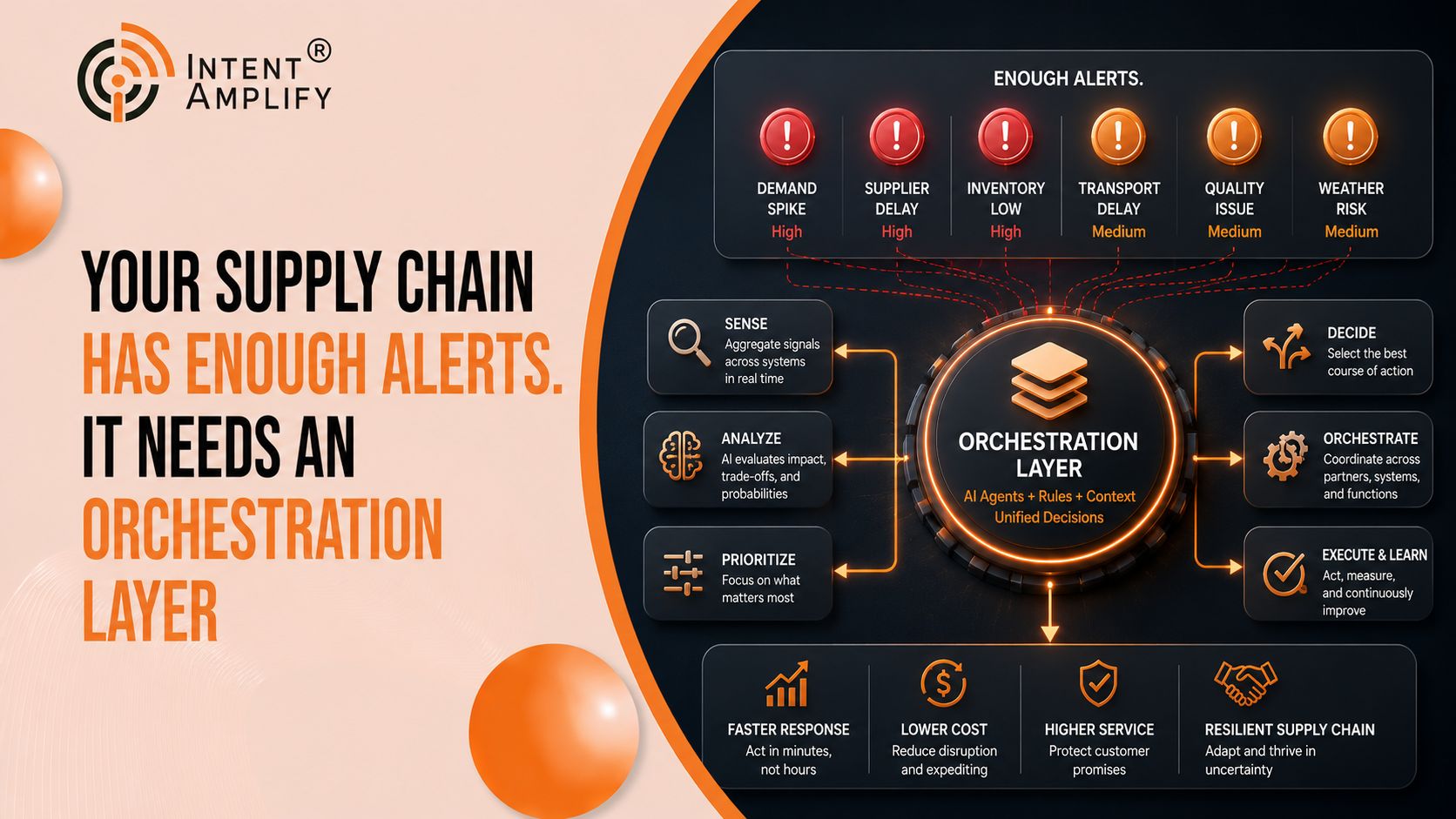
An orchestration layer takes a different approach. Instead of asking a person to interpret every signal independently, it assembles the operational context around a defined decision.
For example, if an inbound shipment is delayed, the relevant question is not “How late is the shipment?” It is “What business outcome is at risk, what alternatives exist, and who has authority to choose among them?”
That question requires planning, inventory, production, logistics,s and possibly customer context.
WHAT AGENTIC AI ADDS
Agentic AI is well suited to this coordination problem because agents can pursue objectives, use tools, and sequence multi-step work.
SAP’s 2026 supply chain direction demonstrates the model. Its Planning Assistant is positioned around exception management and planning decisions. Its Logistics Assistant addresses warehousing and transportation. Its Manufacturing Assistant coordinates disruption-related work across production domains. SAP describes Autonomous Supply Chain Management as an environment in which people define goals, assistants orchestrate across domains,s and agents execute specialized tasks inside governed processes.
The strategic idea is not “one AI replaces the supply chain team.”
It is “specialized intelligence coordinated around an enterprise outcome.”
THE EXECUTIVE SIGNAL TEST
If every system can raise an alert, executives need a way to determine which signals deserve orchestration. A useful test evaluates four dimensions.
Consequence. What enterprise outcome could be affected if nothing changes? The answer should be expressed in operational terms such as customer commitment, production continuity, inventory exposure, working capital, supplier risk,sk or service performance—not simply the severity assigned by one application.
Time window. How long does the organization have before the available response options become materially worse? A delay that can be addressed over several days is different from a constraint that will affect today’s production schedule.
Coordination load. How many functions, systems, EMS, or external partners are needed to resolve the issue? High coordination load is a strong signal that orchestration may create value because manual handoffs often dominate response time.
Decision materiality. Is the likely response routine and reversible, or does it create a major customer, financial, contractual, safety, or compliance consequence? Materiality determines how much human authority should remain in the loop.
Using these four dimensions gives leaders a disciplined way to separate “interesting signals” from “enterprise decisions.” It also reduces a common automation mistake: giving the same workflow to every alert that shares a technical category.
FROM CONTROL TOWER TO DECISION TOWER
The control-tower metaphor helped supply chain leaders organize visibility. It made distributed events easier to monitor. But the next design challenge is different. A decision tower would not merely display where disruption exists; it would assemble the evidence required to resolve it.
Consider a supplier shipment that is delayed by 36 hours. A visibility layer may show the delayed shipment, affected lane, and estimated arrival. A decision layer goes further. It identifies which production orders depend on the material, how much inventory exists at each location, whether substitute components are approved, which customer commitments are exposed, whether an alternate transport mode is feasible, and which decision owner has authority to choose among the options.
The distinction matters because most executive value is created after detection. The quality of the response depends on how quickly the enterprise can assemble context and make a trade-off.
This is where agentic AI becomes more than another interface. Agents can potentially coordinate specialist tasks—planning analysis, logistics options, inventory checks,s and workflow preparation—around one defined business decision.
THREE ORCHESTRATION PATTERNS TO WATCH
Pattern 1: Planning-to-logistics orchestration.
A planning exception identifies a shortage that threatens a customer commitment. The orchestration layer checks inventory across locations, evaluates deployment alternatives, reviews transportation options,ns and prepares a recommendation. The planner approves the trade-off; the approved workflow is then passed to logistics for execution.
The value is not that planning and logistics each use AI. The value is that the decision is coordinated across them.
Pattern 2: Manufacturing-disruption orchestration.
A production event creates a material or capacity constraint. The orchestration process identifies affected schedules, available inventory, labor implications, quality requirements,nts and downstream commitments. AI can prepare scenarios, but decisions that affect safety, quality, or major customer commitments remain explicitly human-controlled.
Pattern 3: Supplier-risk orchestration.
A supplier event triggers risk signals. The orchestration process connects that signal to open orders, production exposure, alternate suppliers, lead times,s and commercial policy. The system can prepare sourcing alternatives and route the evidence to the accountable procurement or supply-chain leader. External commitments remain constrained by contractual and approval rules.
These patterns share the same architecture: sense, assemble context, prioritize by consequence, generate options, authorize, execute,te and learn.
THE GOVERNANCE QUESTION HIDING INSIDE EVERY ALERT
When AI only summarizes a dashboard, governance questions are relatively narrow. When an agent can prepare or execute an operational action, governance becomes part of workflow design.
Every orchestrated decision should therefore define five controls.
Data authority. Which source is considered authoritative when systems disagree?
Action authority. Can the agent read, recommend, prepare, approve, or execute? These rights should be separated rather than granted as one broad permission.
Materiality threshold. At what point does a financial, service, customer, safety, compliance,e or contractual consequence require human approval?
Stop conditions. Which uncertainty, missing evidence,e or conflicting policy forces the workflow to pause rather than improvise?
Audit trail. Can the enterprise reconstruct the signal, context, recommendation, approval, execution, and outcome after the event?
NIST’s AI Risk Management Framework is useful here because it emphasizes governance, mapping, measurement,ent and management of AI risk. For supply chain leaders, the practical takeaway is simple: governance is not a separate review after the orchestration system is built. It is part of the system itself.
WHAT THIS MEANS FOR THE OPERATIONS LEADER
The rise of agentic AI does not eliminate the operations leader’s role. It changes where leadership attention should be applied.
Less time should be spent manually moving information between systems. More time should be spent defining operating policy, decision rights,ghts and escalation logic.
Less emphasis should be placed on the number of alerts detected. More emphasis should be placed on the age and consequences of unresolved decisions.
Less attention should be given to how many AI agents are deployed. More attention should be given to whether one material workflow actually became faster, safer,r and more accountable.
This is a better executive scorecard because it measures operating change rather than technology activity.
THE ORCHESTRATION SCORECARD
A quarterly review can track five metrics before connecting AI activity to larger business outcomes.
Decision-cycle time: elapsed time from qualifying signal to approved action.
Context-assembly time: time spent collecting the evidence needed to decide.
Escalation rate: percentage of workflows that stop because evidence, policy,cy or authority is insufficient.
Override pattern: why human owners change or reject AI-prepared recommendations.
Execution confirmation: whether approved actions are completed correctly and within the required window.
These measures are deliberately close to the workflow. They give leadership evidence about whether orchestration is improving the decision process before making broader claims about service, inventory, cost, or working capital.
A QUARTERLY PLAYBOOK FOR MOVING FROM ALERTS TO ORCHESTRATION
Month 1 — Choose the right decision.
Identify one cross-functional exception that repeatedly consumes senior planner or operator time. Document the current signal, owners, systems, handoffs, approval points, and business consequences. Establish a baseline for decision-cycle time and context-assembly time.
Month 2 — Build the governed decision package.
Define authoritative data, permitted recommendations, decision rights, materiality thresholds, and stop conditions. Use AI to assemble the decision package and generate options, but keep execution with the human owner. Capture every override and classify the cause.
Month 3 — Automate bounded steps.
Where recommendation quality is consistent and the workflow is reversible, automate routine preparation or execution steps. Preserve human approval for material decisions. Review escalation, overrides,s and execution quality before expanding scope.
The objective is not maximum automation by the end of the quarter. The objective is to provide evidence that one cross-functional decision loop works better than it did before.
WHAT TO ASK IN YOUR NEXT EXECUTIVE REVIEW
- Which five alert categories consume the most expert attention today?
- Which of those alerts routinely requires more than one function to resolve?
- Where does context assembly take longer than the analytical calculation itself?
- Which decisions rely on unwritten policy known only by experienced operators?
- Which low-materiality, reversible decisions could move toward bounded automation?
- Which decisions should remain human-led because the consequence is strategic, ambiguous,s or irreversible?
- What evidence would prove that orchestration improved the operating model?
If leadership cannot answer these questions, the organization may have an AI deployment plan without an orchestration operating model.
THE SIX-STEP ORCHESTRATION LOOP
A useful operating pattern is:
1. Sense. Detect a material event or emerging constraint.
2. Contextualize. Identify affected customers, orders, plants, inventory suppliers,rs and commitments.
3. Prioritize. Determine the consequence using enterprise policies rather than application-specific urgency.
4. Generate options. Evaluate feasible responses and trade-offs.
5. Authorize. Route the decision according to materiality and decision rights.
6. Execute and learn. Trigger the approved workflow, record the result, and capture overrides.
This loop turns a collection of alerts into a decision system.
THE EXECUTIVE DESIGN QUESTION
The most important leadership question is not whether the enterprise needs another AI tool.
It is whether the organization has defined how a material exception should travel from signal to accountable action.
If that path is unclear today, AI will not magically create it. The organization must define authoritative data, decision owners, policies, thresholds,s and escalation conditions.
Once those elements exist, agents can help compress the coordination work.
WHAT TO DO THIS QUARTER
Pick one cross-functional exception that regularly requires several teams to resolve. Map the handoffs. Measure the time from signal to decision. Identify the evidence each participant needs. Then design a target workflow in which AI assembles context and prepares the response before the issue reaches the decision owner.
Start in recommendation mode. Capture every override. Use those overrides to improve the policy and data model before expanding automation.
BEFORE THE NEXT ISSUE: THREE THINGS TO WATCH
First, watch whether agent announcements are tied to specific operational decisions or remain broad capability statements. The more clearly a product maps to a governed workflow, the easier it is to evaluate operational relevance.
Second, watch the boundary between recommendation and execution. Enterprises will need clarity about which actions can be automated safely, which require approval,l and which should remain outside autonomous workflows.
Third, watch the measurement model. Claims about “more autonomous” operations become useful only when organizations can connect them to decision-cycle time, exception aging, override patterns,ns and execution quality. Technology adoption alone is not evidence of operating improvement.
For executive teams, these are better signals than the raw number of agents, copilots, or AI features announced in the market.
THE BOTTOM LINE
Supply chains do not need unlimited alerts. They need a disciplined way to turn the right signals into the right decisions.
That is the role of orchestration: not replacing the applications that sense and execute work, but connecting them around an outcome with explicit authority and governance.
For leaders evaluating AI in supply chain operations, that may be the more important architectural decision.
Explore the orchestration model in the webinar “SAP AI Inside the Supply Chain: From Silo to Orchestration.”
Reference Links:
- SAP — Planning Assistant: Autonomous Supply Chain Management: https://www.sap.com/india/use-cases/joule-assistant/supply-chain-planning-ai
- SAP — Logistics Assistant: Autonomous Supply Chain Management: https://www.sap.com/croatia/use-cases/joule-assistant/logistics-ai
- SAP — Manufacturing Assistant: Autonomous Supply Chain Management: https://www.sap.com/india/use-cases/joule-assistant/manufacturing-ai
- SAP News Center — Building the Autonomous Supply Chain: https://news.sap.com/2026/05/more-autonomous-supply-chain/
- SAP — Supply Chain Management and AI: https://www.sap.com/products/scm/ai.html
- NIST — Artificial Intelligence Risk Management Framework: https://www.nist.gov/itl/ai-risk-management-framework