

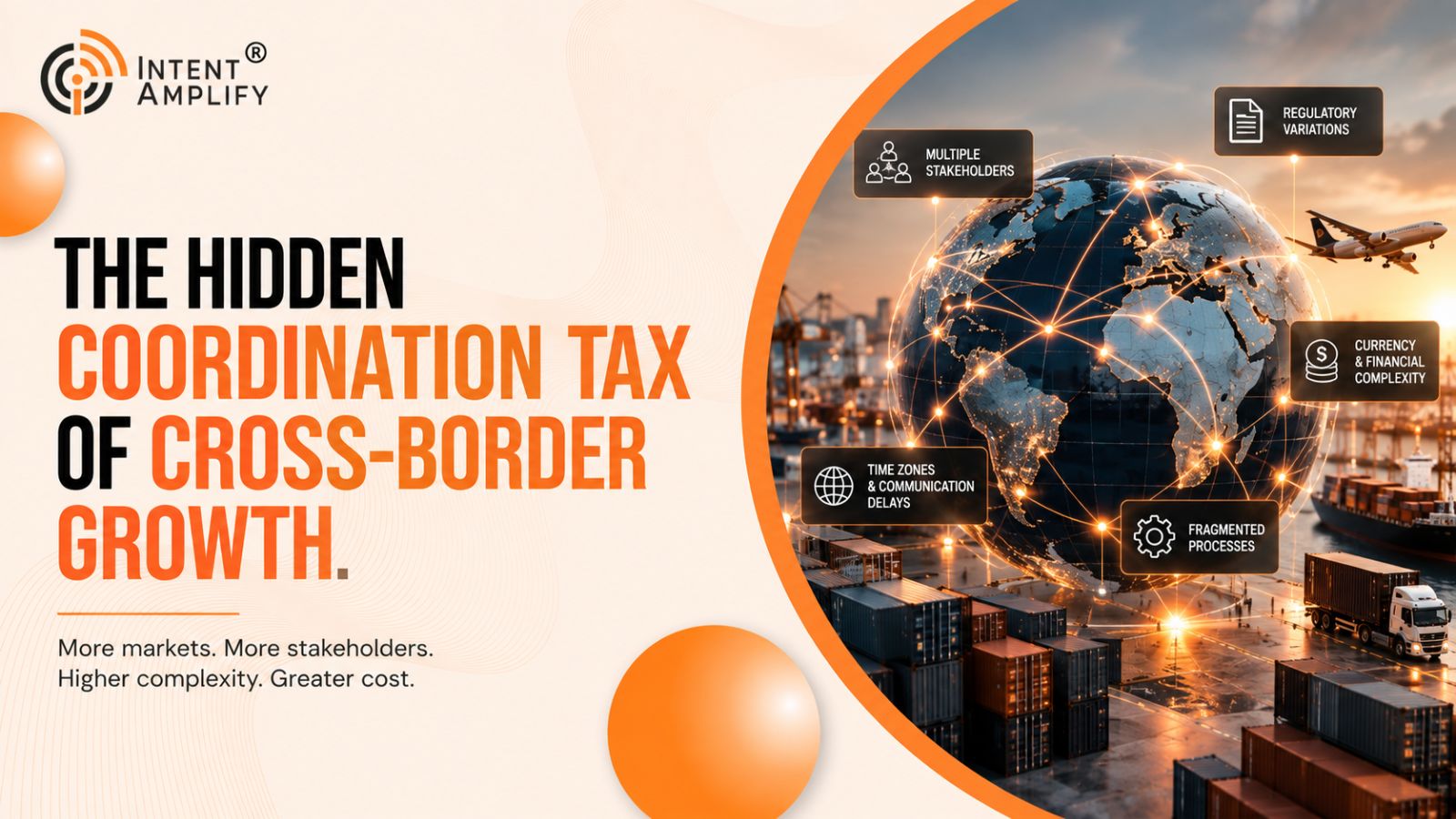
Cross-border ecommerce growth creates visible commercial opportunity and less-visible operating work. New markets add customers, but they can also add payment methods, tax rules, customs processes, logistics partners, service policies, reporting definitions, and exception paths.
That hidden workload is the coordination tax of global ecommerce.
The problem is not localization itself. Local relevance is essential. Mastercard’s 2026 analysis argues that global commerce is increasingly dependent on local payment relevance, with digital wallets, account-to-account transfers, buy now pay later, and other methods becoming central to how customers transact in different markets. [1]
The operating challenge begins when each necessary local difference becomes a separate process, integration, data definition, or manual workaround. Market by market, those decisions can appear reasonable. Across a portfolio, they can make expansion harder to govern and more expensive to operate.
Why Coordination Can Grow Faster Than Revenue
Every new provider or workflow creates interfaces with the rest of the organization. Finance needs settlement and reconciliation data. Customer service needs order and shipment visibility. Operations needs exception handling. Technology needs monitoring. Tax and compliance teams need controls. Analytics needs comparable definitions.
The cost is therefore broader than platform or partner spend. It includes the human effort required to keep those interfaces aligned.
This becomes especially visible when external rules change. In June 2026, FedEx highlighted the European Union’s removal of the de minimis duty exemption from July 1, 2026, noting new customs requirements and cost implications for cross-border shipments into Europe. FedEx said it had engaged more than 5,000 businesses across 12 Asia-Pacific markets with guidance ahead of the change. [2]
A regulatory change like this does not touch only customs. It can affect landed cost, checkout communication, documentation, fulfillment, customer service, finance, and margin assumptions. That is exactly why global expansion needs an operating model rather than a sequence of isolated market launches.
Productive Complexity and Accidental Complexity Are Different
Some complexity creates customer or regulatory value. A locally preferred payment method may be necessary. A different carrier model may reflect infrastructure. A tax process may be mandatory. A market-specific return flow may be justified by economics.
Other complexity is accidental. Different teams may use different definitions for the same transaction. Temporary spreadsheets may become permanent translation layers. A launch workaround may remain long after the original constraint disappears. A provider status may need manual interpretation because no common event model exists.
The leadership task is not to eliminate local differences. It is to distinguish deliberate localization from unmanaged fragmentation.
Avalara’s June 2026 midyear tax update illustrates why this distinction matters. The company highlighted rapid policy change, including international scrutiny of de minimis import thresholds and increasing customs and documentation obligations for cross-border sellers. [3]
When the external environment changes quickly, organizations with a clear global core can adapt a controlled configuration. Organizations built on one-off processes may have to discover every dependency manually. Where seller-of-record obligations are a major source of duplicated work, a Merchant of Record model can be evaluated as a way to abstract localized tax, compliance, payment, and logistics responsibilities behind a more consistent interface.
The Coordination-Tax Diagnostic
Leaders can make hidden operating effort visible by examining recurring cross-functional work.
- Diagnostic — Executive Question — What It Reveals
- Manual Touches — Where do employees intervene to complete ordinary orders or exceptions? — Processes that have not been operationalized end to end.
- Cross-Functional Escalations — Which issues repeatedly require several teams? — Unclear ownership or weak interfaces.
- Reconciliation Work — Where do teams manually align order, payment, shipment, refund, or tax data? — Conflicting systems of record or definitions.
- Local Workarounds — Which market-specific processes sit outside the standard model? — Accumulating architecture and governance debt.
- Exception Recurrence — Which “one-off” issues keep returning? — Missing reusable capability in the global core.
- Retirement Discipline — Which temporary processes no longer have a current rationale? — Capacity that can be released by simplification.
The objective is not to turn every coordination activity into a financial allocation. It is to identify work that growth is repeatedly creating and decide whether that work should be standardized, automated, redesigned, or deliberately retained.
Logistics Makes the Cost of Fragmentation Visible
Cross-border logistics shows how commercial expansion creates operating dependencies. FedEx’s July 2026 coverage of Alibaba.com sellers described Chinese ecommerce businesses pursuing markets such as Europe and South America while navigating cross-border logistics, customs clearance, and fulfillment requirements. [4]
For enterprise ecommerce teams, the lesson is broader than shipping. A new market changes more than the carrier label. It can alter documentation, delivery promises, tracking events, duties, returns, customer communication, and escalation processes.
A scalable operating model should therefore make the logistics interface reusable. Teams need common definitions for shipment state, service promise, exception severity, ownership, customer communication, and financial impact, even when the underlying providers differ by market.
Payments Add Another Layer of Market-Specific Operating Logic
Payments create similar complexity. Mastercard and Checkout.com reported in May 2026 that tokenization transactions processed through Mastercard in the MENA region had increased 344.9% year over year, while tokenized transactions delivered a reported 3–6 percentage-point improvement in approval rates compared with conventional card transactions. [5]
The strategic implication is not that every market should use the same payment stack. It is that payment localization has downstream operating consequences.
Every additional method or optimization layer creates questions about authorization, fraud, settlement, refunds, disputes, reporting, provider failure, customer support, and finance reconciliation. Those consequences should be designed before the capability becomes part of the live customer journey.
Build a Global Core Without Forcing Uniformity
A stronger global model standardizes what benefits from consistency and configures what genuinely needs to vary.
The global core can include customer-promise principles, transaction-state definitions, data ownership, financial controls, observability, escalation, measurement, provider-governance standards, and core technology interfaces.
Local configuration can then cover evidence-based differences in payments, logistics, tax, language, pricing, returns, or service.
This approach gives leadership a better decision test. When a market asks for a new capability, the question is not simply whether it can be launched. Teams should ask whether the requirement is genuinely local, whether an existing module can handle it, whether the capability is likely to recur elsewhere, and what permanent operating burden it creates.
Where the Global Expansion Guide Fits
Global Expansion: The New Operating Model for Global Ecommerce addresses the central operating question behind cross-border growth: how can a business preserve local relevance without allowing each market to become its own operating architecture?
The guide provides a useful frame for separating the global core from local configuration, clarifying decision rights, making exceptions visible, considering Merchant of Record abstraction where appropriate, and ensuring the back end can turn demand from AI search and global marketplaces into a transaction the business can reliably fulfill.
FAQs
1. What is the coordination tax in global ecommerce?
It is the recurring human, process, data, and technology effort required to keep market-specific capabilities aligned across functions and systems.
2. Is local variation always a problem?
No. Local variation is often necessary. The risk comes from variation that is not deliberately designed, owned, measured, or reviewed.
3. How can leaders identify accidental complexity?
Look for repeated escalations, manual reconciliation, inconsistent data definitions, permanent spreadsheets, duplicate integrations, and temporary workarounds that have no retirement date.
4. What is the purpose of a global core?
The global core creates reusable standards and capabilities so markets can localize where necessary without rebuilding the operating model each time.
Conclusion
Cross-border growth should increase commercial reach faster than it increases coordination burden. When the opposite happens, expansion may still produce revenue, but the operating model becomes progressively harder to understand and control.
The answer is not rigid standardization. It is controlled complexity: a reusable global core, evidence-based local configuration, explicit ownership, common data definitions, visible exceptions, and regular retirement of unnecessary workarounds.
That is how global ecommerce creates operating leverage rather than simply adding more work with every market.
Next Step for Global Ecommerce Leaders
Use the RETHINK Retail guide to evaluate the operating-model decisions behind hyper-local checkout, one connected global model, back-end simplification, and AI-ready commerce.
The priority is to preserve local customer relevance while reducing duplicated systems, manual coordination, and compliance burden as the market portfolio expands.
References
1. Mastercard, How Local Payment Methods Are Reshaping Global Commerce, 2026
2. FedEx, FedEx Helps APAC Businesses Adapt Confidently to EU De Minimis Changes, June 17, 2026
3. Avalara, Avalara Tax Changes 2026 Midyear Update Reveals States Getting Creative as Tax Policy Shifts at Record Speed, June 11, 2026
4. FedEx, How Alibaba.com Sellers Are Unlocking New Markets With FedEx’s Cross-Border Logistics Solutions, July 8, 2026
5. Mastercard, Checkout.com and Mastercard Report Reveals MENA Emerges as One of the Fastest Growing Regions to Adopt Tokenization, May 7, 2026