

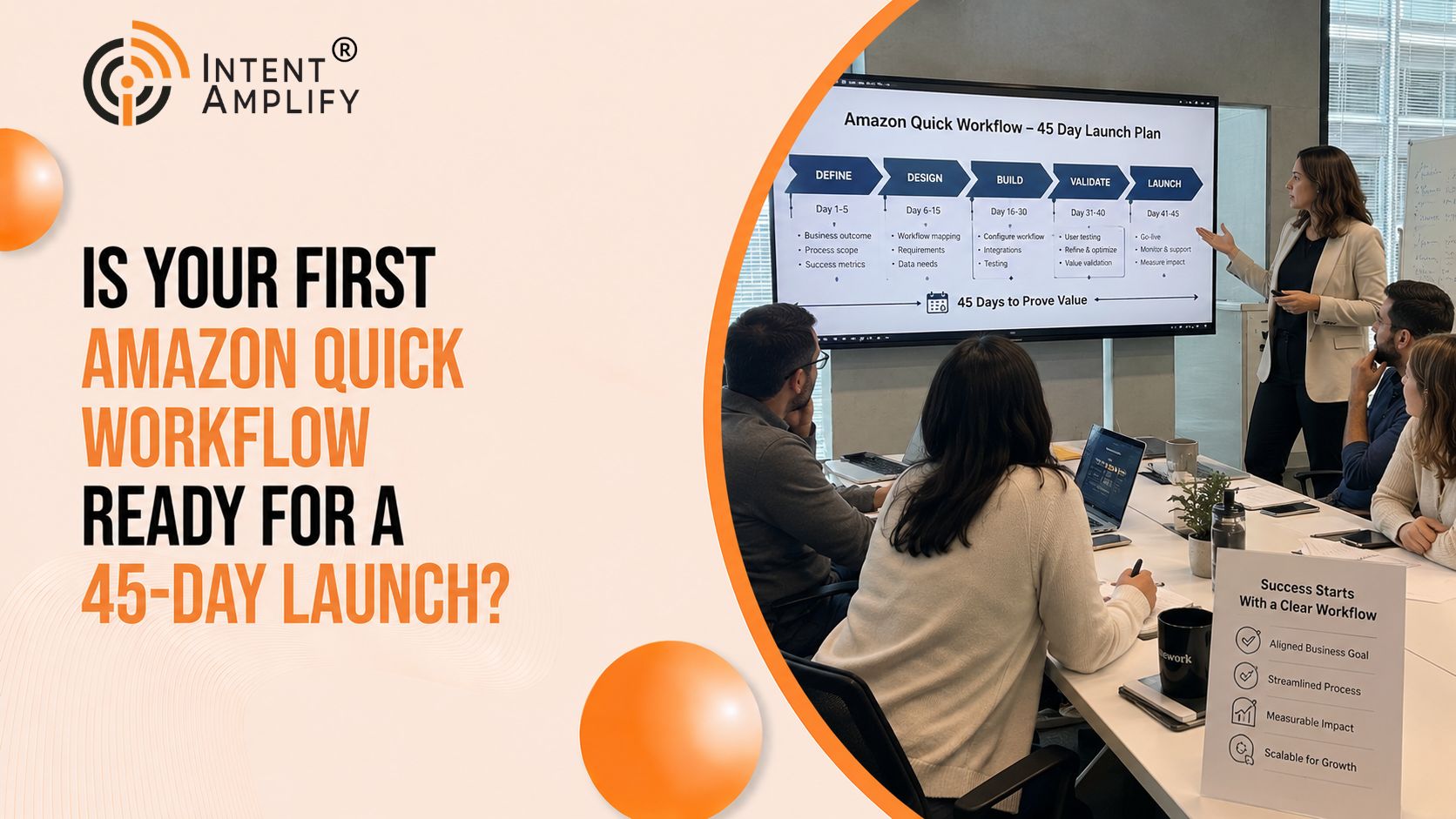
Executive Summary: Readiness Comes Before Speed
A 45-day Amazon Quick initiative can create useful evidence when the first workflow is specific, sponsored, observable, and bounded. It becomes much harder when the use case is broad, the governing information is unclear, users are not available, or leadership has not agreed what decision the evidence is supposed to support.
For enterprise leaders, readiness is therefore less about whether the technology can be configured and more about whether the organization can put a real business workflow under disciplined observation. The first evaluation should be small enough to control, important enough to matter, and measurable enough to support a decision at the end of the cycle.
The seven tests below are designed for Director-level and executive leaders in U.S. and Canadian Insurance, Manufacturing, Retail, and CPG organizations using AWS Cloud and evaluating agentic AI. They do not certify production readiness or guarantee value. They help determine whether a workflow is ready to enter a structured 45-day value cycle—or whether a specific dependency should be fixed first.
The Seven-Test Readiness Scorecard
|
Test |
Executive question |
Pass signal |
If missing |
|
1 |
Is the decision specific? |
Named decision, owner, and end state |
Narrow the use case |
|
2 |
Does the workflow matter now? |
Current operating consequence and decision date |
Clarify urgency |
|
3 |
Is the context usable? |
Known sources, owners, freshness, and conflicts |
Remediate context |
|
4 |
Is authority clear? |
Read/recommend/ approve/execute boundaries are explicit |
Resolve permissions |
|
5 |
Can users absorb the change? |
Representative cohort and workflow touchpoint are available |
Rework adoption plan |
|
6 |
Can value be observed? |
Baseline and downstream status can be measured |
Instrument the workflow |
|
7 |
Can leadership decide at day 45? |
Sponsor, decision date, and evidence thresholds are set |
Define the decision gate |
Interpretation: A strong launch candidate does not need seven perfect answers. It does need a credible business decision, an accountable sponsor, usable context, observable evidence, and a clear remediation path for any remaining gaps.
Test One: Is the Decision Specific?
Broad goals such as “improve productivity,” “use generative AI,” or “create an enterprise assistant” are too wide for a meaningful 45-day evaluation. A launch-ready workflow starts with a recurring business decision that can be described in operational terms.
Ask these questions:
- Who makes the decision today?
- What event triggers the work?
- Which system or case record shows the final disposition?
- How often will the workflow occur during the evaluation window?
Pass signal: The team can describe one recent case from trigger to final action and name the business owner responsible for the result.
Remediate when: The discussion stays at the level of features, productivity, or enterprise-wide transformation without a specific decision path.
Executive implication: specificity is what makes a 45-day window useful. A bounded decision gives the team a denominator, an observable end state, and a way to distinguish product activity from business contribution. For example, a claims team might evaluate whether approved policy and prior-case context can improve one class of claims decision, while a manufacturer might focus on one maintenance decision for a defined equipment family. The point is not to make the use case artificially small. It is to make the evidence interpretable enough that leadership can decide what deserves expansion.
Test Two: Does the Workflow Matter Now?
A technically suitable workflow may still be a weak first candidate if the organization has no reason to act. Urgency does not require a guaranteed financial benefit, but it should connect to a real operating consequence—delay, rework, service pressure, knowledge friction, a roadmap commitment, or another dated business decision.
Ask these questions:
- What happens if the workflow stays unchanged for the next six to twelve months?
- Which roles experience the friction?
- What funding, roadmap, service, or operating decision could the 45-day evidence inform?
Pass signal: The sponsor can explain why the workflow matters now and identify a real decision window.
Remediate when: Interest is genuine but there is no near-term business consequence or decision forum.
Executive implication: a real decision window disciplines both scope and evidence. Without it, every new capability can become another reason to extend the evaluation, and the organization can accumulate activity without learning what should happen next. A credible trigger might be a service-level issue, a planned operating-model change, a budget or roadmap review, or a recurring work bottleneck that leadership has already chosen to address. The business consequence does not need to be expressed as guaranteed ROI. It does need to be important enough that a sponsor will act on the findings when the evidence window closes.
Test Three: Is the Context Usable?
Amazon Quick value depends on the enterprise context available to the workflow. Before a launch, the team should know which sources govern the decision, who owns them, how freshness is determined, and what happens when information conflicts or should not be exposed to a role.
Ask these questions:
- Which sources are authoritative?
- Who owns freshness and correction?
- Which regional, product, policy, or role variants matter?
- Which sources or fields must be excluded?
Pass signal: The first source set is bounded, owned, permission-aware, and good enough to support representative cases.
Remediate when: Source ownership, version control, permissions, or confiicting content are still unknown.
Amazon Quick capability lens: AWS describes Quick as an AI-powered service that works with connected data sources and applications, using agents to answer questions, automate work, analyze data, and conduct research. That makes context readiness part of the implementation itself, not a separate data-cleanup project that can be postponed. Before testing, the team should identify which repositories are authoritative, how access is inherited or constrained, who resolves source conflicts, and what the workflow should do when required context is unavailable. A fluent response should never be treated as proof of readiness if the underlying source authority is uncertain. [1][2]
Test Four: Is Authority Clear?
Agentic AI raises a second question beyond information access: what may the workflow actually do? Read, recommend, approve, and execute are different authorities. Treating them as one permission can create unnecessary risk or force the evaluation into an unrealistic all-or-nothing design.
Ask these questions:
- Who may read the underlying context?
- Who may receive a recommendation?
- Which actions require human approval?
- Which exceptions must always escalate?
Pass signal: A simple role matrix defines the first action boundary and escalation path.
Remediate when: Teams cannot distinguish what the system may suggest from what it may execute. Amazon Quick capability lens: this distinction is increasingly important because AWS announced
autonomous agents for Amazon Quick in June 2026 with configurable autonomy levels ranging from step-by-step approval to broader goal-based execution. The practical readiness question is therefore not simply whether an agent can perform an action. Leaders should decide which actions may be suggested, which require an accountable human approval, which can be executed automatically, and how an incorrect action can be contained or reversed. A 45-day evaluation should test those boundaries under representative and exception cases before broader exposure is considered. [3]
Test Five: Can Users Absorb the Change?
A workflow is not ready merely because access can be provisioned. The organization needs representative users who encounter the target work often enough to test it, understand when to use the new path, and have a clear way to report failures or exceptions.
Ask these questions:
- Which cohort will actually use the workflow?
- At what point in the work does assistance appear?
- Who reinforces participation?
- Who owns feedback and remediation?
Pass signal: The business owner sponsors a defined cohort and integrates the evaluation into a real work moment.
Remediate when: The launch relies on voluntary experimentation by users who do not own or regularly perform the target workfiow.
Executive implication: adoption should be measured against eligible work, not against curiosity. A small but representative cohort is usually more useful than a broad voluntary audience because leadership can see whether the new path fits an actual work moment and why users return, bypass, or abandon it. The cohort should know when Amazon Quick is expected to be used, when human judgment remains primary, and where to report a source, permission, or workflow failure. This creates evidence that can inform enablement and operating-model decisions rather than merely reporting activation or login volume.
Test Six: Can Value Be Observed?
Usage is useful evidence of access and interest, but it is not the same as business value. Before configuration, leaders should decide which signals will show whether the workflow changed in a meaningful way.
Ask these questions:
- What is the pre-change baseline?
- Did the assistance confirm, change, accelerate, escalate, or not affect the decision?
- What downstream action followed?
- What review, correction, or exception effort was required?
Pass signal: The team can compare eligible cases, decision influence, action status, and control burden using an authoritative record.
Remediate when: Success is defined only by logins, prompts, output volume, or subjective enthusiasm.
Executive implication: the value model should follow a case from eligibility through decision influence and downstream completion. A useful early evidence set can combine baseline cycle time or effort, whether Quick confirmed or changed a decision, whether an action was completed in the system of record, and how much review or correction work was added. This is deliberately different from claiming enterprise ROI. It tells leadership whether the workflow is contributing in a way that is observable and whether the control burden is likely to remain manageable as volume increases.
Test Seven: Can Leadership Decide at Day 45?
A bounded launch is useful only if it ends in a decision. Before the first case is observed, the sponsor should know what evidence would justify expanding, repairing, redesigning, or stopping the initiative.
Ask these questions:
- Who owns the day-45 decision?
- Which evidence must be present?
- What would block expansion?
- What is the smallest remediation that could change the decision?
Pass signal: Leadership has a dated review forum and agreed decision options: expand, remediate, redesign, or stop.
Remediate when: The evaluation has a start date but no defined executive close.
Executive implication: the day-45 meeting should be designed before day one. The sponsor should know the available outcomes - expand, remediate, redesign, or stop - and the evidence required for each. That prevents a technically successful pilot from continuing by inertia. It also makes negative or mixed findings useful: a source problem can trigger remediation, an unsuitable action boundary can trigger redesign, and weak contribution can justify stopping before more budget and organizational attention are committed. Decision discipline is one of the main reasons to keep the first scope bounded.
Amazon Quick Readiness Is a Business-and-Control Question
Amazon Quick broadens the readiness conversation because AWS positions the service as more than a conversational assistant. Current documentation describes Quick as an AI-powered service for automating tasks, analyzing data, building applications, and conducting research against connected data sources and applications. Quick Flows can automate repetitive work, while Quick Automate supports business-process automation with AI agents that can make contextual decisions and execute actions across applications. [1]
For an executive team, those capabilities raise a practical sequencing rule: do not test autonomy before the organization has defined the business decision, governing context, permission boundaries, human review points, and observable end state. AWS documentation explains that agents operate with instructions, knowledge sources, and tools; integrations connect Quick to enterprise systems; and the service can take action in external applications. The readiness framework in this blog is therefore intentionally business-first. It asks whether the organization can govern and interpret the workflow before asking how much of it can be automated. [2]
This also protects the quality of the buying decision. If the first evaluation produces strong usage but weak source authority, the correct answer may be remediation. If the workflow is valuable but action boundaries are unclear, the correct answer may be redesign. If the evidence shows repeatable contribution under acceptable controls, leadership has a defensible basis for expanding the next scope. In each case, the 45-day cycle creates value by improving the next decision rather than by forcing every initiative toward scale.
How to Interpret the Seven Tests
The tests should not be converted into a simplistic maturity score. A workflow can look strong overall and still be blocked by one material dependency. The better approach is to identify the weakest dependency that could invalidate the evaluation.
|
Readiness pattern |
Recommended route |
Why |
|
Strong across all material tests |
Proceed to structured mapping |
The organization can generate decision-useful evidence inside a bounded scope. |
|
Strong business case, weak context or permissions |
Remediate first |
Source and authority gaps could make the 45-day sample misleading. |
|
Strong technology fit, weak sponsor or urgency |
Nurture / align sponsor |
The initiative may not have enough business authority to sustain the evaluation. |
|
Strong interest, weak measurement |
Instrument before launch |
Activity would be observable, but business contribution would remain unproven. |
|
No specific workflow or decision |
Return to use-case discovery |
The organization is still defining the problem rather than evaluating a bounded solution. |
Industry Application Lens
|
Industry |
Good first-workflow candidates |
Readiness issue to test early |
|
Insurance |
Claims research, underwriting support, service, policy knowledge |
Source authority, regulated boundaries, case disposition |
|
Manufacturing |
Maintenance, engineering knowledge, quality, field service |
Approved instructions, local variants, action ownership |
|
Retail |
Store operations, merchandising, product knowledge, customer service |
Seasonality, content freshness, regional variation, bypass reasons |
|
CPG |
Commercial planning, sales support, quality, supply-chain knowledge |
Brand/regulatory context, owner access, decision cadence |
Across all four sectors, the best first workflow is not necessarily the largest opportunity. It is the workflow that combines material friction with accessible context, a committed owner, representative cases, reversible boundaries, and an observable end state.
Conclusion: Readiness Is the Ability to Learn Credibly
The purpose of a 45-day Amazon Quick launch is not to prove an enterprise-wide ROI case in six weeks. It is to create a disciplined environment in which leadership can observe one workflow, challenge the evidence, and make a better next decision.
That is why readiness depends on more than technology access. A credible first cycle needs a specific decision, a real business reason to act, usable context, clear authority, participating users, observable value, and an executive close.
If a workflow passes those tests—or has only narrow, remediable gaps—it may be ready for structured value mapping. If it does not, the failed test is useful information: it identifies the dependency that should be fixed before the organization spends time scaling an evaluation that cannot yet produce trustworthy evidence.
Next Step: Live in 45 with Amazon Quick
Use the executive guide to align your team around workflow, evidence, boundaries, and the day-45 decision.
For an active initiative, request a 20-minute First-Value Mapping Session. Bring one workflow, the accountable owner, known source or permission constraints, AWS context, and the date of the next investment decision. The desired output is a fit classification, evidence gaps, and the next best action—not a generic demo.
References
- Amazon Web Services (AWS), What is Amazon Quick? - Amazon Quick User Guide
- Amazon Web Services (AWS), How Amazon Quick works - Amazon Quick User Guide
- Amazon Web Services (AWS), Amazon Quick announces autonomous agents, multi-dataset analytics, and redesigned activity feed (June 17, 2026)
- Amazon Web Services (AWS), Getting started with Amazon Quick - Amazon Quick User Guide