
Supply chain organizations rarely suffer from a total absence of data. They suffer from data that arrives in different systems, at different times, with different identifiers, definitions, and levels of trust. During a disruption, that fragmentation becomes decision latency.
The strategic alternative is not necessarily another dashboard. It is a data layer designed to create shared operational context.
FOUNDATIONAL ANALYSIS
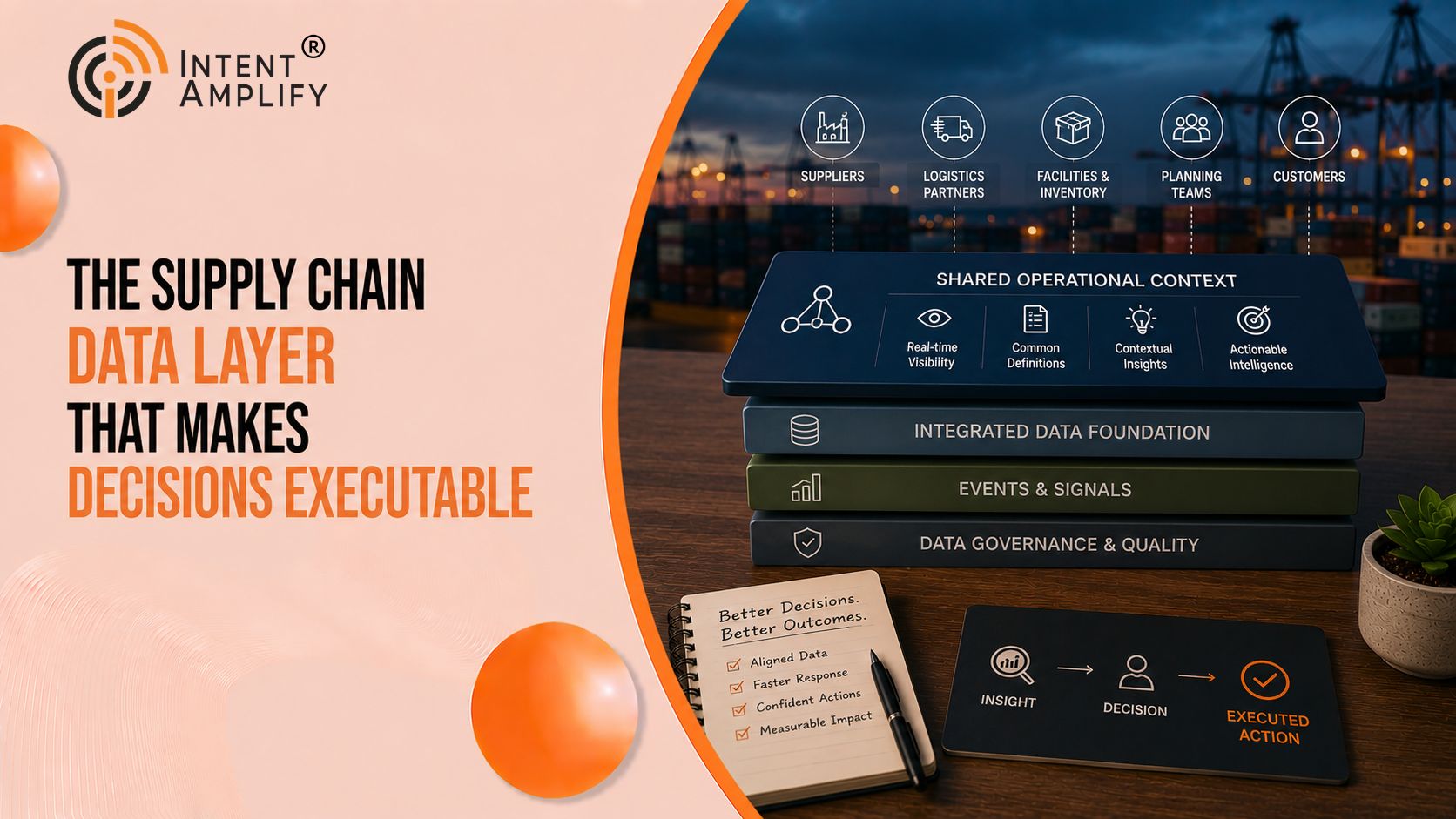
A decision-ready supply chain depends on more than visibility. It needs trusted operational context that connects events to the orders, inventory, suppliers, customers, commitments, and response options they affect. When that context is current, understandable, and connected to accountable execution, teams can move from awareness to action before the option window closes. The purpose of the supply chain data layer is therefore not to centralize data for its own sake, but to make faster, clearer, executable decisions possible under volatility.
ARCHITECTURE PRINCIPLES FOR DECISION-READY DATA
A decision data layer should be designed around operating contracts rather than a promise to centralize everything. For each priority decision class, define the business objects that must be related, the authoritative source for each critical field, the acceptable freshness window, and the identifiers used to join records. This creates a bounded architecture that can be tested against real decisions.
The first principle is semantic consistency. A status, milestone, location, customer priority, or inventory position must mean the same thing to the teams using it for a decision. Where source systems use different definitions, the data layer should make the translation explicit rather than hiding disagreement behind a common dashboard.
The second principle is temporal clarity. Decision owners need to distinguish when an event happened, when the enterprise received the event, when a value was last refreshed, and when the value was used in the decision. Those timestamps are not technical metadata; they determine whether context is still reliable enough to support action.
The third principle is provenance. Material fields should preserve a path back to their authoritative source. When a value has been transformed, estimated, or derived, that treatment should be visible. Provenance reduces reconciliation time and gives AI-assisted workflows a stronger foundation for traceable summaries and recommendations.
A DECISION-CONTEXT CONTRACT
A practical implementation can define a decision-context contract for each recurring decision class. The contract specifies the minimum fields that must be available before the issue is considered decision-ready, which fields may remain unknown, and which missing fields require escalation or a different response path.
For a routing decision, the contract might require the affected shipment or order, current milestone, required delivery date, available routing alternatives, customer or production priority, capacity status, decision deadline, and the owner authorized to choose. For an inventory reallocation decision, the contract may require current stock, demand exposure, replenishment timing, substitute availability, service commitments, and cross-location constraints. The exact fields should come from verified operating needs, not a generic data model.
This contract creates a measurable definition of context readiness. Teams can track whether the required evidence was available at first review, which fields repeatedly caused delay, and whether data improvements reduced the time between signal validation and accountable decision-making.
INTEGRATION SHOULD FOLLOW DECISION VALUE
Integration priorities should be set by the decisions they unlock. A connection between shipment events and customer orders may deserve priority when it repeatedly removes material context latency. A technically attractive dataset that does not change a priority decision may be lower value even if it is easy to ingest.
This approach helps control scope. Instead of funding a broad program to connect every system before business value can be demonstrated, leaders can build a sequence of decision-focused integrations. Each release should make a defined decision class easier to understand or execute and should be evaluated against a verified baseline.
The same logic applies to partner data. External milestones, capacity signals, supplier readiness, or port information should be assessed by whether they arrive early enough and with enough reliability to change a response. More feeds are not automatically more awareness. The useful feed is the one that preserves a meaningful option.
DATA QUALITY NEEDS DECISION-LEVEL SERVICE EXPECTATIONS
Traditional data-quality programs often use enterprise-wide targets for completeness or accuracy. Decision readiness benefits from more specific service expectations. A field that is critical to a time-sensitive allocation decision may require tighter freshness and validation than a field used primarily for retrospective reporting.
For each decision class, leaders can define which data elements are decision-critical and what evidence standard they require. If a critical value is stale, conflicting, or missing, the workflow should surface that condition immediately. The system should not silently substitute an assumption simply to make the brief look complete.
This creates a disciplined relationship between speed and confidence. Teams can act with incomplete information when governance allows it, but they can do so knowingly. The data layer supports judgment by making evidence quality visible rather than pretending uncertainty has disappeared.
FROM DATA PRODUCT TO OPERATING PRODUCT
A decision-ready data layer should be managed as an operating product. Its users are decision owners and execution teams; its outcomes are reduced context latency, clearer evidence, fewer reconciliation loops, and a more reliable path from signal to action. Technical uptime remains important, but it is not the complete measure of value.
Product ownership should therefore include both data and business responsibilities. Data teams can manage pipelines, models, identity resolution, lineage, and freshness. Business owners define the decisions, evidence requirements, authority rules, and acceptable operating trade-offs. Neither side can create decision readiness alone.
A useful operating review asks whether the data layer supported the decisions it was designed for. Which material exceptions arrived with complete minimum context? Which fields repeatedly required manual lookup? Which identifiers failed to connect records? Which values were too stale to use? Which decisions still required parallel spreadsheets or message threads to reconcile the facts? These observations create the improvement backlog.
AI READINESS STARTS WITH CONTEXT READINESS
AI can accelerate synthesis only when the context it receives is sufficiently governed. Before introducing a copilot into a decision workflow, leaders should test whether the underlying data contract is stable enough to support traceable outputs. If the organization cannot explain the source, freshness, and meaning of the fields used in a recommendation, adding a model can make ambiguity harder to see.
A strong architecture separates retrieval and evidence from generated interpretation. The copilot can summarize verified fields, highlight missing evidence, compare documented options, and explain constraints. Generated analysis should remain distinguishable from authoritative operational facts. This separation supports human review and makes errors easier to detect.
NIST's AI risk-management guidance reinforces the importance of governance, transparency, and accountability for AI-supported processes. In a supply chain context, those principles translate into practical controls: trace material outputs to evidence, make uncertainty visible, define the human authority boundary, and test the workflow under difficult data conditions before scaling.
THE EXECUTION INTERFACE MATTERS
The data layer should not end at a decision brief. Once an owner selects a response, the relevant identifiers and context should travel with the action into execution. A route change should retain the shipment and order context that justified it. An inventory decision should carry the affected demand and allocation logic. A supplier response should preserve the constraint and commitment it addresses.
This continuity reduces re-entry and reinterpretation. It also creates a better audit trail: the organization can connect the original signal, the evidence available at decision time, the chosen response, the execution event, and the eventual outcome. That history becomes valuable for post-event learning and for refining future decision rules.
Where full automation is inappropriate, the execution interface can still provide structured handoffs. The objective is not to remove people from the process. It is to prevent the chosen action from becoming a new information-reconstruction exercise for the team that must implement it.
A 90-DAY DATA-LAYER ROADMAP
In the first 30 days, select one high-value decision class and reconstruct several recent cases. Define the minimum decision context, authoritative sources, identifiers, timestamps, and recurring evidence gaps. Establish a baseline for context-assembly time and manual reconciliation.
In days 31–60, build or improve the highest-value connections. Resolve identity issues that prevent records from joining, expose freshness and provenance, and create a decision-ready view or service that assembles the minimum context. Test missing and conflicting data deliberately rather than only validating ideal cases.
In days 61–90, connect the context to the decision and execution workflow. Measure whether the accountable owner receives the issue earlier with more complete evidence, whether manual searches decline, and whether the chosen response reaches execution with less re-entry or ambiguity. Use those results to decide whether to scale to the next decision class.
The roadmap should remain evidence-driven. A successful first release does not prove that every decision requires the same architecture. Each expansion should begin with the decision, the operating friction, and the evidence required to improve it.
EXECUTIVE QUESTIONS FOR DATA-LAYER INVESTMENT
Executives evaluating a data-layer initiative should ask: Which decisions will become faster or clearer? Which business objects must be connected for those decisions? What are the authoritative sources? How current must each field be? Which identity gaps create manual reconciliation? How will users see provenance and uncertainty? How will the chosen decision move into execution? What operating evidence will prove that the investment reduced friction?
These questions keep architecture tied to business behavior. They also create a more credible business case than broad claims about a single source of truth. The enterprise may continue to operate multiple systems; the requirement is that priority decisions can access a trusted, shared context when it matters.
Download The Decision-Ready Supply Chain
CONCLUSION
The supply chain data layer becomes strategic when it protects decision time. Its purpose is to connect the right evidence, at the right freshness, to the right owner, while preserving a path into execution. That requires disciplined identity, timing, meaning, provenance, and governance—not simply more centralized data.
Organizations should therefore judge the architecture by what changes in the operating system. If teams recognize material exposure earlier, spend less time reconciling facts, see uncertainty more clearly, and execute approved responses with fewer handoffs, the data layer is doing its job. If those behaviors do not change, the organization should revisit the decision design before expanding the technology footprint.
REFERENCES
1. Port of Los Angeles. “Port Optimizer™.” Digital infrastructure integrating supply-chain data to improve cargo-flow visibility and operational planning. https://www.portoflosangeles.org/business/supply-chain/port-optimizer
2. APL Logistics. “Supply Chain Visibility: What Does It Really Mean?” April 26, 2023. Perspective on visibility, event context and actionable supply-chain information. https://www.apllogistics.com/2023/04/supply-chain-visibility-what-does-it-really-mean
3. Gartner. “Supply Chain Leaders Should Prioritize Advanced Data Visibility and Scenario Planning to Drive Competitive Advantage Amid Global Uncertainty.” May 19, 2025. https://www.gartner.com/en/newsroom/press-releases/2025-05-19-gartner-says-supply-chain-leaders-should-prioritize-advanced-data-visibility-and-scenario-planning-to-drive-competitive-advantage-amid-global-uncertainty
4. NIST. “Artificial Intelligence Risk Management Framework (AI RMF 1.0).” January 2023. Framework supporting data provenance, transparency and accountable AI use. https://www.nist.gov/itl/ai-risk-management-framework
5. McKinsey & Company. “Supply chains: Still vulnerable.” October 14, 2024. Research on supply-chain visibility, resilience and operating response. https://www.mckinsey.com/capabilities/operations/our-insights/supply-chain-risk-survey-2024
6. IntentTechPub. “The Decision-Ready Supply Chain.” Campaign page for APL Logistics, IA-168 - 26-08-001. https://intenttechpub.com/ebook/the-decision-ready-supply-chain/?mtm_campaign=APL_logistics&mtm_kwd=supply_chain_now&mtm_source=website&mtm_medium=cta_download_now&mtm_content=website&mtm_cid=IA_168_26_08_001&mtm_group=ebook&mtm_placement=marketing