
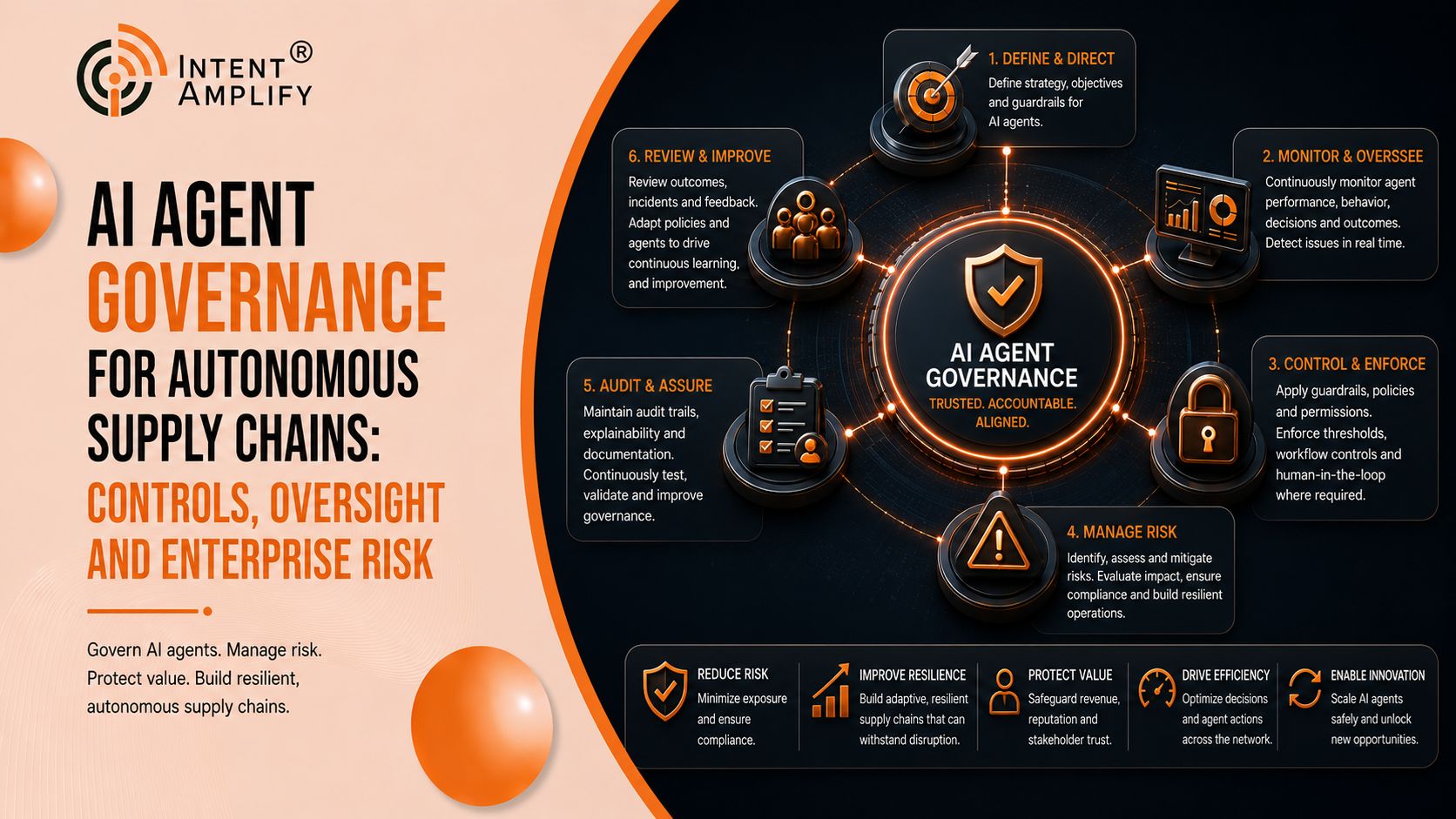
Autonomous supply chain systems introduce a governance problem that conventional analytics did not have to solve at the same scale: an AI system may be able to do something, but should it be allowed to do it?
That distinction becomes critical when AI moves from generating insight to preparing and executing operational actions.
A forecasting model can be wrong and create a poor recommendation. An agent with write permissions can be wrong and create a transaction. The risk surface changes when intelligence is connected to authority.
For that reason, AI governance in supply chain operations cannot live only in policy documents. It must be implemented in the architecture of decisions, permissions, thresholds, and escalation.
SAP AI Inside the Supply Chain: From Silo to Orchestration
FROM MODEL RISK TO DECISION RISK
Traditional AI governance often concentrates on the model: training data, bias, explainability, validation,n and monitoring. Those concerns remain important. Agentic systems add another layer.
The enterprise must govern the decision system around the model.
A supply chain agent may use several models, retrieve enterprise data, call applications,ns and coordinate with other agents. Even if each component behaves as designed, the combined workflow can create risk if the decision boundaries are unclear.
The governance unit should therefore be the business decision.
For every agent-supported decision, leaders should be able to answer:
- What triggers the workflow?
- Which data is authoritative?
- What is the agent allowed to infer?
- What actions may it recommend?
- What actions may it execute?
- What threshold requires human approval?
- What happens when evidence conflicts?
- How is the action reversed?
- Who is accountable for the operating policy?
If these questions do not have explicit answers, the use case is not ready for broad autonomy.
A FIVE-LAYER CONTROL MODEL
Layer 1 — Identity and scope.
Every agent should have a defined operational identity and purpose. A logistics agent should not inherit unrestricted enterprise access simply because cross-functional context is useful.
Layer 2 — Data authority.
The system should know which sources are authoritative for inventory, demand, supplier, production, customer, mer, and financial context. Retrieval access is not the same as truth. Conflicting sources need resolution rules.
Layer 3 — Decision policy.
The organization should express acceptable options, prohibited actions, and business priorities. Policy must be specific enough to shape the recommendation.
Layer 4 — Action permissions.
Read, recommend, prepare, approve, and execute should be separate rights. A system may be trusted to prepare a production change without being trusted to post it.
Layer 5 — Monitoring and audit.
The enterprise should record the evidence used, the recommendation produced, the approval obtained, the action taken, and the observed result. Overrides should be captured as governance evidence, not treated as noise.
HUMAN-IN-THE-LOOP IS NOT ONE THING
Organizations frequently state that a system will have “human oversight.” That phrase is too vague for operational governance.
There are several different human-control patterns.
- Human-in-command: a person defines the objective and policy but does not review every action.
- Human-in-the-loop: a person must approve a defined decision before execution.
- Human-on-the-loop: the system acts within limits while a person monitors and can intervene.
- Human-on-exception: the system acts routinely but escalates ambiguous or material cases.
- Human-only: the AI may support analysis, but the decision remains reserved for a person.
The correct pattern depends on materiality, reversibility, data quality,y and policy clarity.
SAP’S AUTONOMOUS SUPPLY CHAIN MODEL MAKES THIS PRACTICAL
SAP’s 2026 supply chain announcements describe people defining goals and priorities, Joule Assistants orchestrating across domains,ns and AI agents executing specialized tasks. Planning, logistics, manufacturing, and business-network assistants are positioned around different operational workflows.
That architecture reinforces the need for layered governance. An orchestration assistant may need broad read context to coordinate work, while a specialized execution agent may require narrow write permissions. Giving both the same authority would weaken control.
Manufacturing makes the point especially clear. SAP describes a Manufacturing Assistant that can coordinate corrective processes and next-best-action scenarios. In physical operations, the organization should distinguish actions that are safe to automate from those requiring quality, engineering, safety, or supervisor approval.
THE REVERSIBILITY PRINCIPLE
One of the most useful governance tests is reversibility.
If an incorrect action can be detected quickly and reversed with limited consequence, the organization may tolerate a higher level of autonomy.
If an action creates a contractual commitment, customer impact, safety consequence,e or irreversible physical change, the threshold for human approval should be much higher.
Reversibility does not replace risk analysis, but it helps executives distinguish candidate automation from decisions that should remain tightly controlled.
THE ESCALATION CONTRACT
Every autonomous workflow should have an escalation contract.
The contract defines when the AI must stop acting and ask for human authority.
Common triggers include:
- Missing authoritative data.
- Conflicting policies.
- Low confidence in the evidence.
- A financial or service threshold is exceeded.
- A safety, quality,ty or compliance condition is present.
- A new action type is required.
- The proposed action is not reversible.
- The system encounters a scenario outside its validated operating envelope.
Escalation is not failure. It is a designed control mechanism.
MEASURING GOVERNANCE
Governance should be measurable.
Useful operational measures include the percentage of decisions with complete audit evidence, escalation frequency, override frequency, unauthorized action attempts, execution errors, time to detect incorrect actions, and time to reverse them.
A rising escalation rate may indicate deteriorating data quality, policy gaps, or a changing operating environment. A falling override rate may indicate better recommendations—or it may indicate inadequate human review. Metrics require interpretation.
NIST AND TRUSTWORTHY AI
The NIST AI Risk Management Framework provides a useful foundation for managing AI risk and trustworthiness across the lifecycle. NIST’s broader work emphasizes governance, mapping context, measuring risk, and managing identified risks.
Supply chain leaders can translate those principles into the operational controls described here: define the decision context, measure the risk of the action, govern permissions, and manage outcomes through monitoring and escalation.
IMPLEMENTING GOVERNANCE AS AN OPERATING SYSTEM
Governance becomes effective when control requirements are translated into routine operating mechanisms rather than left as principles. For each autonomous workflow, the enterprise should maintain a decision record that identifies the accountable business owner, approved purpose, authoritative data sources, permitted actions, prohibited actions, approval thresholds, escalation route,e and rollback method. The record should be version-controlled and reviewed whenever the workflow, underlying model, connected application, or business policy materially changes.
A practical deployment sequence begins with observation. The agent produces recommendations while humans continue to execute the work. Teams compare recommendations with actual decisions, investigate disagreements, and establish an evidence baseline. The next stage is assisted execution: the agent prepares an action, but a named operator approves it. Limited autonomy should follow only for bounded, reversible decisions with stable data and explicit thresholds. Higher-impact decisions should remain approval-gated until operating evidence demonstrates that broader authority is justified.
This staged approach also creates a better audit trail. Instead of asking whether an agent is generally trustworthy, leaders can evaluate whether a specific decision class has earned a specific level of authority. Expansion of autonomy then becomes a governed business decision supported by observed performance, exception patterns, and control effectiveness.
CONTROL OWNERSHIP ACROSS THE ENTERPRISE
Autonomous supply chain governance is cross-functional. Business process owners should define the objective, materiality thresholds, and acceptable outcomes. Data owners should establish authoritative sources and quality rules. Technology teams should enforce identities, permissions, logging,g and integration boundaries. Risk, legal, compliance, quality,ty or safety functions should define mandatory approval conditions where applicable. Internal audit or an equivalent assurance function can test whether the documented controls operate as intended.
The operating owner remains accountable for the decision policy. Technical teams can implement a control, but they should not silently determine the business risk appetite. Likewise, business teams should not grant execution authority without confirming that technical controls can enforce the intended boundaries.
A useful governance review therefore asks three separate questions: Is the policy appropriate? Is the control implemented correctly? Is the control producing the intended outcome? Treating those as distinct questions prevents a well-written policy from being mistaken for an effective control.
A 90-DAY GOVERNANCE ACTIVATION PLAN
- Days 1–30: inventory agent-supported decisions and classify them by materiality, reversibility,ity and current authority. Identify the accountable owner and authoritative data for each decision. Remove ambiguous or excessive permissions before expanding use.
- Days 31–60: define approval thresholds, prohibited actions, escalation triggers,gers and rollback procedures. Instrument decision logs so evidence, recommendation, approval, action, and outcome can be reconstructed. Run exception scenarios, including missing data, conflicting policy, unavailable systems, and low-confidence evidence.
- Days 61–90: review observed recommendations, overrides, escalations, and execution errors. Approve only the autonomy levels supported by evidence. Establish a recurring governance review for policy changes, new action types, permission changes,s and material shifts in exception patterns.
This plan does not assume that every workflow should progress to autonomous execution. The objective is to make authority explicit and evidence-based. Some decisions may remain human-only because their consequences,uncertaintyn,ty or irreversibility justify that boundary.
EXECUTIVE READINESS QUESTIONS
Before authorizing broader agent execution, executives should require clear answers to five questions. First, can the organization reconstruct why an action was proposed and which evidence supported it? Second, can permissions technically prevent actions outside the approved scope? Third, is there a named human owner for policy and exceptions? Fourth, can the organization detect and reverse an incorrect action within an acceptable window? Fifth, is there observed evidence—not vendor capability alone—that the decision class is suitable for the proposed level of autonomy?
If any answer is unknown, the correct status is not failure; it is an unresolved governance requirement. The organization should keep the relevant authority constrained until the missing evidence is available.
CONCLUSION
The safest autonomous supply chain is not the one with the fewest humans. It is the one with the clearest authority.
AI agents should operate inside explicit decision boundaries, with trusted data, narrow permissions, materiality thresholds, escalation rules,les and auditable outcomes.
When governance is embedded into the operating architecture, autonomy can expand through evidence. When governance is left as a policy statement, the enterprise risks giving systems more authority than its controls can support.
Join “SAP AI Inside the Supply Chain: From Silo to Orchestration” to explore the operating and governance implications of Joule Assistants and AI agents in supply chain environments.
Sources:
- NIST AI Risk Management Framework
- SAP News Center
- Building the Autonomous Supply Chain,
- May 2026 SAP Manufacturing Assistant
- SAP Planning Assistant