
Book a Demo
Home Platform Audience Accounts Intent Evidence Activation SignalAtlas Solutions Industries Programs Research Pricing About Careers Press Contact Brands Trust Privacy Accessibility Demo ABM Advertising Content Demand Intent Data Sales Blog Infographics Events Product Sheets Videos Webinars White Papers E-books Customer Stories Corporate Presentation Newsletters Expert Insights Expert Analysis Research Reports
Expert Insight

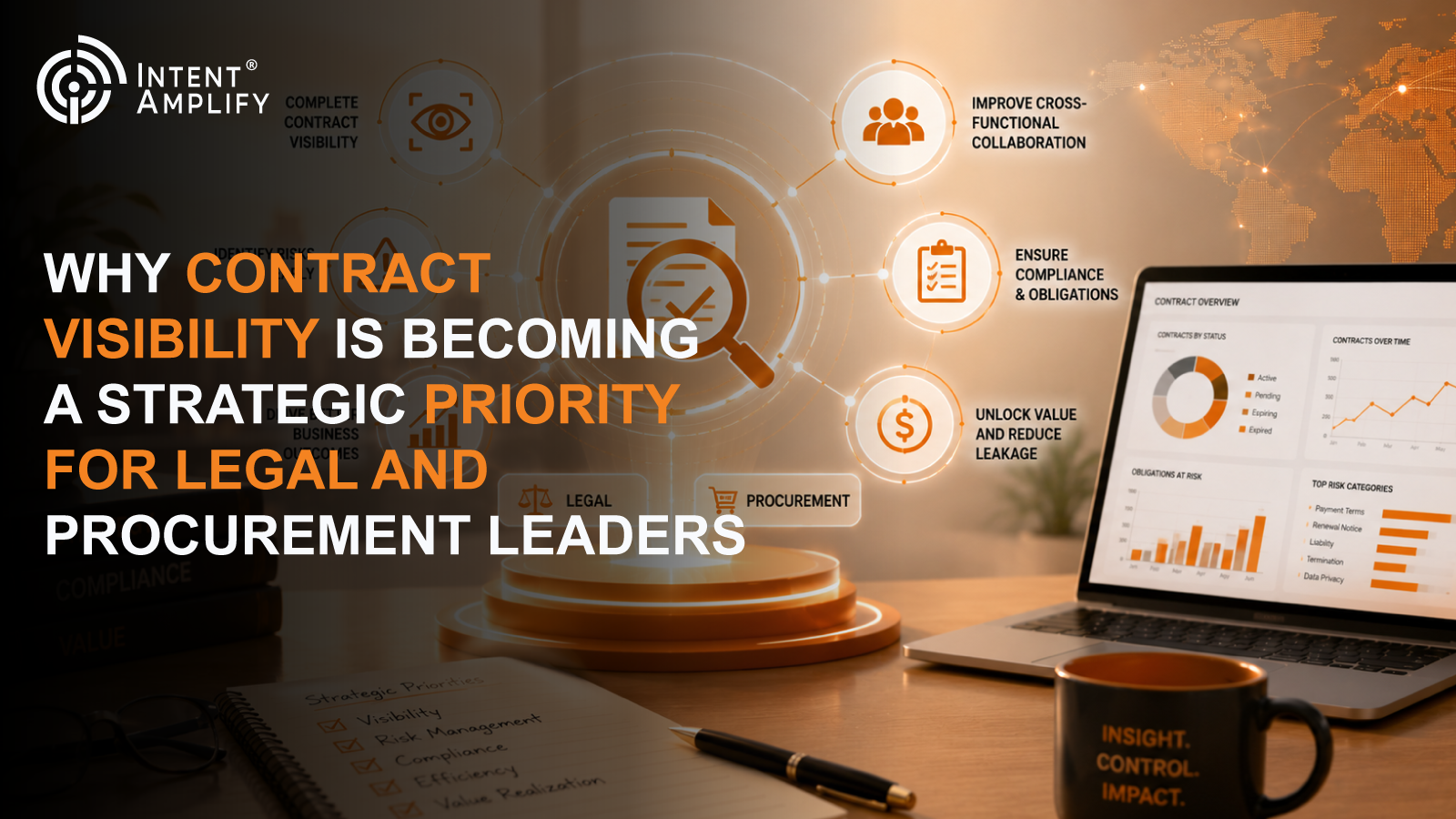
Why Contract Visibility Is Becoming a Strategic Priority for Legal and Procurement Leaders

Expert Insight
Why Contract Visibility Is Becoming a Strategic Priority for Legal and Procurement Leaders
June 18, 2026 10 min read

Quick Answer

Learn how contract visibility helps legal and procurement teams improve compliance, reduce risk, manage renewals, and unlock contract intelligence.

Contract visibility is no longer a back-office improvement project. It is becoming a strategic priority for legal, procurement, supply chain, finance, and executive leaders because contracts define how the enterprise spends, sells, complies, renews, performs, and absorbs risk. Every supplier relationship, customer commitment, service level, pricing term, data protection requirement, and renewal clause eventually becomes an operating reality. The problem is that many organizations still manage those realities through static documents, disconnected repositories, and manual searches that only begin after a question becomes urgent.

Agiloft’s CONTRACTING DATA YOU CAN TRUST report speaks directly to this enterprise challenge. The campaign is built around a practical idea: contracts should not remain locked files that teams search only when something goes wrong. They should become living sources of contract intelligence that surface obligations, track renewals, flag risk, and give leaders a trusted view of what the business has actually agreed to.

Download Now

That shift matters because contract lifecycle management is now under pressure from three directions at once. Legal teams need better contract risk management and compliance visibility without adding a manual review burden. Procurement teams need supplier contract intelligence, renewal alerts, and spend commitment data without relying on spreadsheets. Executives need faster answers to board, audit, and governance questions without waiting days for contract research.

For all three groups, contract visibility has become the bridge between agreement and action.

Why Contract Visibility Now Matters

The enterprise contract portfolio has become more complex than many legacy processes can support. Contracts are spread across contract repositories, sourcing systems, ERP platforms, inboxes, shared drives, and legal archives. Even when the documents are technically stored, the information inside them may not be visible, validated, or connected to the systems where business decisions are made.

This creates a visibility gap that affects both speed and confidence.

A general counsel may need to know which agreements contain nonstandard liability language. A procurement leader may need to identify upcoming renewals across critical suppliers. A CFO may need to understand contractual spend commitments before a planning cycle. A compliance leader may need to confirm whether obligations are being tracked across business units. If each answer requires manual document review, the enterprise is not managing contracts strategically. It is recovering contract information after the fact.

Modern contract lifecycle management must therefore move beyond contract storage. A centralized contract repository is useful, but it cannot be the end state. The real objective is trusted contract data that can support contract analytics, AI contract review, clause management, contract compliance monitoring, procurement analytics, and executive dashboards.

KEY FIGURES AT A GLANCE

Enterprise AI adoption is accelerating, with 88% of organizations reporting regular AI use in at least one business function, which helps explain why legal and procurement teams are now evaluating AI contract management and AI-powered CLM with greater urgency. McKinsey also found that 62% of respondents say their organizations are experimenting with AI agents, while only about one-third report that their companies have begun scaling AI programs across the enterprise, reinforcing that data readiness, governance, and workflow design remain the difficult parts of enterprise AI transformation.²

Microsoft’s 2026 Work Trend Index surveyed 20,000 workers using AI across 10 countries and analyzed trillions of anonymized Microsoft 365 productivity signals, underscoring that AI value increasingly depends on how organizations redesign work around reliable data, governed workflows, and human oversight.³

NIST’s AI Risk Management Framework emphasizes trustworthy AI design, development, use, and evaluation, which is directly relevant when enterprises apply AI to sensitive contract data, compliance obligations, and legal risk analysis.⁴

The Repository Gap: Finding a Contract Is Not the Same as Understanding It

Many enterprise teams believe they have contract visibility because the signed agreements are stored somewhere. That assumption is understandable, but incomplete. A repository can help a team locate a document. It does not automatically explain what the contract requires, which clauses create risk, which obligations are due, which renewals are approaching, which suppliers are underperforming, or which commitments create financial exposure.

This is the repository gap.

For legal operations, the gap appears when attorneys or contract managers spend time manually searching for clauses, comparing terms, or reconstructing contract risk before a leadership review. For procurement, it appears that when supplier obligations are tracked manually, renewal windows are missed because contract data is not surfaced automatically. For executives, it appears that board-level questions about contractual commitments require several teams to gather information from different systems.

Contract visibility best practices now require a different operating model. The enterprise needs contract data extraction, contract search, contract monitoring, clause management, and contract dashboards that make the information inside agreements usable. Storage answers where the document sits. Contract intelligence answers what the document means for the business.

AI Contract Management Needs Trusted Data

AI contract management is becoming more attractive because it promises faster contract review, better contract summarization, more efficient contract data extraction, and stronger contract analytics. Yet AI cannot create reliable intelligence if the underlying contract data is fragmented, outdated, or poorly governed.

If metadata is inconsistent, AI may surface incomplete results. If clause libraries are not standardized, AI contract review may struggle to distinguish routine variation from real risk. If contract ownership is unclear, automated renewal alerts may reach the wrong team. If data from the contract management system does not connect with ERP, CRM, or procurement systems, contract intelligence remains trapped in a legal workflow rather than becoming enterprise intelligence.

This is why trusted contract data matters. AI-powered CLM depends on clean, governed, and accessible information. The stronger the data foundation, the more useful AI becomes for contract risk detection, contract compliance, vendor contract management, and legal analytics.

For legal leaders, this means AI can help identify nonstandard clauses, flag risk patterns, and reduce repetitive review. For procurement leaders, AI can help surface renewal windows, supplier obligations, and vendor performance terms. For executive sponsors, AI can support contract dashboards that show exposure, commitments, and governance issues before they become urgent.

Procurement Visibility Is Now a Performance Lever

Procurement organizations face growing pressure to improve supplier governance, control spend, support vendor consolidation, and strengthen resilience. Visibility into agreement data is central to each objective because supplier commitments, pricing terms, renewal windows, compliance requirements, and service obligations are defined in contracts.

When agreement data is fragmented across disconnected systems, procurement is forced to operate reactively. Teams search for terms after a supplier dispute emerges, discover auto-renewals after deadlines have passed, or assemble spend-commitment reports manually when finance requests them. The result is lost time and reduced strategic capacity.

A mature contract intelligence platform changes that dynamic. With trusted agreement data, procurement can identify duplicate vendor relationships, monitor supplier commitments, manage renewals proactively, support consolidation initiatives, and use analytics with greater confidence. Contract information becomes a tool for commercial discipline rather than a collection of stored documents.

The challenge becomes even greater in large enterprises where supplier relationships span regions, business units, and categories. At that scale, visibility cannot depend on individual memory or spreadsheet discipline. It must be embedded in the CLM environment and connected to the systems where procurement decisions are made.

Legal Operations Needs Visibility Before Risk Escalates

Legal departments often carry the burden of contract visibility because they are expected to answer questions about risk, obligations, clauses, and compliance. The consequences of those answers, however, extend far beyond the legal function.

Risk management becomes more effective when clause deviations, obligation status, and compliance exposure can be viewed across the agreement portfolio. Compliance improves when commitments are monitored before deadlines pass. Analytics become more valuable when structured data reveals patterns rather than isolated documents. AI-assisted review becomes more reliable when approved clause libraries and validated data sources support the analysis.

The strategic advantage is time. Less effort spent searching through documents allows legal professionals to focus on advising the business. Earlier visibility into emerging issues creates opportunities to address risk before it becomes a dispute, audit finding, or commercial loss.

This is the practical value of AI-powered CLM. It does not replace professional judgment. It provides the visibility needed to apply that judgment earlier, with better context, and greater strategic impact.

Executives Need Contract Intelligence, Not Contract Summaries

For executive sponsors, agreement visibility is fundamentally a governance and performance concern. Contracts define commitments that influence revenue, cost, compliance, vendor performance, customer obligations, and enterprise risk. Yet many leadership teams still lack a real-time understanding of the obligations, exposures, and actions embedded across the contract portfolio.

The result is a significant management gap.

CEOs, CFOs, COOs, chief compliance officers, and chief risk officers do not need to review every agreement. They do need confidence that the organization can identify commitments, assess exposure, and respond to obligations as they arise. During audits, acquisitions, regulatory reviews, supplier disruptions, or market expansion initiatives, that capability becomes increasingly important.

The most effective CLM strategies provide a reliable view of obligations, renewals, risks, and commitments across the business without requiring days of manual investigation.

Governance Makes Visibility Dependable

Contract visibility without governance can create false confidence. If AI extracts contract data but the organization does not validate sources, control access, maintain audit trails, or define ownership, leaders may receive faster answers without knowing whether those answers are reliable.

NIST’s AI Risk Management Framework is useful for CLM leaders because it emphasizes trustworthy AI design, development, use, and evaluation.⁴

In contract lifecycle management, that principle should translate into approved data sources, role-based permissions, human review for high-risk clauses, validated extraction rules, clear accountability for AI-assisted outputs, and auditability across contract intelligence workflows.

This matters because contract data is sensitive. It contains supplier pricing, customer obligations, liability language, regulatory commitments, renewal terms, and commercial exposure. The enterprise cannot treat contract AI as a casual search tool. It needs governance that makes contract intelligence dependable enough for legal, procurement, and executive decision-making.

What Agiloft Brings to the Conversation

Agiloft is positioned for this conversation because its campaign is not about storing contracts more neatly. It is about turning contract data into living intelligence. That distinction matters for enterprises that already have repositories but still lack visibility into obligations, renewals, risks, and supplier commitments.

For legal and contract leaders, Agiloft’s value centers on reducing manual review, improving contract risk visibility, and helping teams act before issues escalate. For procurement and supply chain leaders, the value is supplier contract intelligence, automated renewal alerts, and clearer visibility into what has been committed across the supply base. For executive sponsors, the value is a more dependable view of contract governance, compliance exposure, and business commitments.

Modern CLM software must serve all of these audiences because contract visibility is no longer owned by one function. It is a shared enterprise requirement.

Access CONTRACTING DATA YOU CAN TRUST

Agiloft’s guide provides legal, procurement, and executive leaders with a practical framework for transforming agreement data into trusted business intelligence. It examines how AI-enabled CLM can surface obligations, monitor renewals, identify risk, and deliver the visibility required to support informed decisions without increasing manual review effort.

Download Now

About Intent Amplify

Intent Amplify helps organizations move from market insight to measurable growth through GTM strategy, demand intelligence, pipeline activation, executive roundtables, sponsored research, targeted content, webinars and panels, vendor intelligence, and strategic consulting. For teams that need sharper positioning, stronger executive engagement, and more effective activation, Intent Amplify connects strategy, content, and market intelligence into a practical growth engine.

Learn More

Executive Takeaway

Contract visibility is becoming a strategic priority because enterprises can no longer afford to manage obligations, renewals, risks, and supplier commitments through static documents and manual searches. Legal teams need earlier risk insight. Procurement teams need proactive supplier intelligence. Executives need a trusted view of contractual exposure and governance.

The next phase of contract lifecycle management will be defined by how effectively organizations turn contract data into dependable intelligence. When that foundation is in place, AI contract management, contract analytics, compliance monitoring, and procurement optimization become easier to scale. When it is missing, contracts remain locked files, and the business continues to discover risk only after it becomes expensive.

Presented for Agiloft
Published and Distributed by Intent Amplify

References

  1. Agiloft and IntentTechPub (2026). Contracting Data You Can Trust. Available at: http://intenttechpub.com/POC/agiloft/contracting-data-you-can-trust.html
  2. McKinsey and Company (2025). The State of AI in 2025: Agents, Innovation and Transformation. Available at: https://www.mckinsey.com/capabilities/quantumblack/our-insights/the-state-of-ai
  3. Microsoft (2026). 2026 Work Trend Index: Agents, Human Agency and the Opportunity for Every Organization. Available at: https://www.microsoft.com/en-us/worklab/work-trend-index/agents-human-agency-and-the-opportunity-for-every-organization
  4. National Institute of Standards and Technology (2026) AI Risk Management Framework. Available at: https://www.nist.gov/itl/ai-risk-management-framework
Contact
Sales