
Executive Insight
For many enterprises, contract risk does not emerge at the moment of signature. It surfaces later when obligations are missed, service-level agreements are interpreted differently across business units, renewal dates pass without commercial review, data protection provisions become outdated, or supplier commitments no longer align with operational realities. The post-signature phase determines whether contractual value is preserved or gradually eroded.
Evidence suggests responsibility for contract risk is expanding beyond legal operations. Gartner’s 2025 Contract Life Cycle Management Magic Quadrant notes organizations are pursuing cross-functional CLM strategies and replacing solutions no longer aligned with enterprise requirements. 1
The evolution reflects broader expectations for contract management. Mature CLM platforms provide executives with a governed, searchable, analytics-ready view of obligations, risk exposure, commercial commitments, and compliance dependencies throughout the post-signature lifecycle.
The greatest strategic value comes from helping leaders answer three questions: Where is contractual risk accumulating? Which obligations require immediate attention? What does the agreement portfolio reveal about future exposure?
Readers seeking a deeper perspective on how CLM transforms contractual risk into business opportunity can explore the related report, Listening for the Silent Threat: How Contract Lifecycle Management (CLM) Transforms Risk into Opportunity.
Download Now
Why Post-Signature Risk Often Remains Invisible
Many enterprises struggle with visibility after agreements move from negotiation to execution. Contract information is frequently dispersed across legal repositories, procurement systems, customer relationship management platforms, shared drives, email attachments, and regional databases. The result is a fragmented operating environment where legal, procurement, finance, sales, compliance, and business stakeholders each see only a portion of the risk landscape.
McKinsey’s recent analysis of corporate legal management argues that procurement discipline, data transparency, and AI are reshaping the function, with visibility across matters, vendors, and outcomes emerging as a strategic priority for general counsel and procurement leaders. 2
This is directly relevant to contract risk management. When leaders cannot see obligations, renewal windows, termination rights, limitation-of-liability thresholds, pricing commitments, regulatory clauses, or supplier dependencies in one governed environment, contract oversight becomes reactive.
Teams discover risk through disputes, audit findings, missed savings, operational failures, or regulatory scrutiny. By that point, the enterprise is no longer managing risk; it is absorbing the consequences of weak contract monitoring.
A modern CLM platform changes the operating posture. It creates a centralized contract repository, applies metadata discipline, supports contract search, and enables structured reporting on risk-bearing terms. This gives leaders a portfolio-level view rather than a document-by-document view.
CLM Turns Contract Data into Risk Intelligence
Post-signature visibility depends on the ability to convert agreement language into usable contract intelligence. That requires more than storing PDFs. Leaders need structured data on obligations, clause deviations, approval exceptions, counterparty exposure, renewal timelines, service commitments, and compliance requirements.
Gartner’s 2025 CLM research highlights that CLM solutions support contract creation, negotiation, storage, search, reporting, compliance monitoring, updates, and renewals, while generative AI use cases are emerging within CLM platforms.1
The strategic implication is clear: CLM is evolving from workflow automation into a contract intelligence layer. For executives, this means contract analytics can reveal patterns that were previously difficult to detect. Which suppliers regularly negotiate non-standard liability terms? Which customer contracts contain inconsistent data protection obligations? Which business units have the highest concentration of auto-renewing agreements? Which obligations are approaching breach risk?
These questions shape enterprise risk exposure, revenue protection, compliance readiness, and business continuity. A strong contract dashboard can give leaders a real-time view of contract risk across regions, business units, contract types, and counterparties. That visibility supports earlier intervention and better decision-making.
This is where CLM becomes relevant beyond legal operations. Finance can assess commercial leakage. Procurement can monitor supplier commitments. Sales can understand customer obligations. Compliance can track regulatory clauses. Security and privacy teams can identify contractual dependencies tied to data handling, third-party access, breach notification, and audit rights.
The Compliance Value of Continuous Contract Monitoring
Contract compliance has traditionally been treated as a post-fact review activity. Regulatory expectations, AI governance requirements, cyber risk dependencies, and third-party obligations now change too quickly for periodic manual reviews to provide sufficient oversight. Continuous monitoring has become a core requirement of effective compliance management.
Microsoft’s 2025 Responsible AI Transparency Report notes rapid AI adoption has renewed focus on practical governance, including defined policies, clear accountability, risk management processes, and operational controls. ³
Contract governance follows the same operational logic. Effective oversight requires clear ownership, documented policies, accountability mechanisms, and continuous monitoring. Within a CLM environment, governance controls include templates, clause playbooks, approval workflows, obligation tracking, exception reporting, and audit trails operating as an integrated control framework.
Deloitte’s CLM framework notes that increasingly complex business models and larger-scale operations require a holistic, technology-enabled, scalable approach capable of supporting value protection, regulatory compliance, obligation management, entitlement tracking, and stakeholder coordination.⁴
The most mature CLM programs treat compliance as a continuous control environment. Automated monitoring identifies deviations, missed milestones, unapproved clauses, expired certifications, and obligations requiring evidence of performance before they develop into regulatory, operational, or commercial issues.
Contract Risk Mitigation Requires Cross-Functional Governance
The hidden weakness in many contract risk programs is ownership ambiguity. Legal may own the template. Procurement may own the supplier relationship. Sales may own the customer account. Finance may own revenue recognition or payment terms. Compliance may own regulatory interpretations. Security may own data protection requirements, but who owns the risk after the signature?
In most enterprises, the answer is distributed. That is why contract governance must be cross-functional by design.
Accenture’s 2025 State of Cybersecurity Resilience research argues that cybersecurity must be embedded by design into every AI-driven initiative, and its June 2025 report found that only one in 10 organizations globally were adequately prepared to protect against AI-augmented cyber threats. 5
This finding is cyber-focused, but it reinforces a broader governance principle: risk cannot be handled effectively when controls are bolted on after decisions are made. The same principle applies to contracts. If data access, audit rights, incident notification, subcontracting, indemnity, service continuity, and compliance obligations are not visible after signature, security and risk leaders may be unaware of contractual exposure until an incident occurs.
A mature CLM governance framework assigns ownership at the clause, obligation, contract, and portfolio levels. It defines who monitors obligations, who approves exceptions, who receives alerts, who validates performance, and who escalates risk. The objective is not to centralize every decision in legal. It is to make contract accountability observable and enforceable across the enterprise.
AI and Automation Are Expanding CLM’s Risk-Sensing Role
AI is reshaping expectations for contract lifecycle automation. Traditional CLM focused on workflow efficiency through faster approvals, fewer manual handoffs, and stronger repository discipline. The next stage centers on risk sensing: using automation and analytics to identify exposure across contract portfolios.
Accenture’s procurement analysis notes that autonomous technologies spanning sourcing, contract management, spend visibility, and supplier risk sensing can help organizations continuously protect value, prevent leakage, and support broader transformation initiatives. The research also cites potential productivity gains of 40% to 60% across decision-making and execution in certain sourcing environments. ⁶
For CLM leaders, AI expands the scale and speed of risk analysis. AI-enabled platforms can accelerate the identification, classification, comparison, and monitoring of risk-related agreement data. Analytics can surface non-standard clauses, summarize obligations, identify missing metadata, and prioritize review activities.
McKinsey’s 2025 State of AI research shows risk, legal, and compliance functions are among the business areas experimenting with, piloting, or scaling AI agents, although adoption remains uneven. ⁷
Uneven adoption reinforces the importance of governance. Approved use cases, output validation, human review of high-risk provisions, and measurable accuracy standards provide a stronger foundation for expansion than broad automation mandates. Contract intelligence delivers value when supported by reliable data, disciplined workflows, and effective governance.
What Leaders Should Expect from Post-Signature CLM Visibility
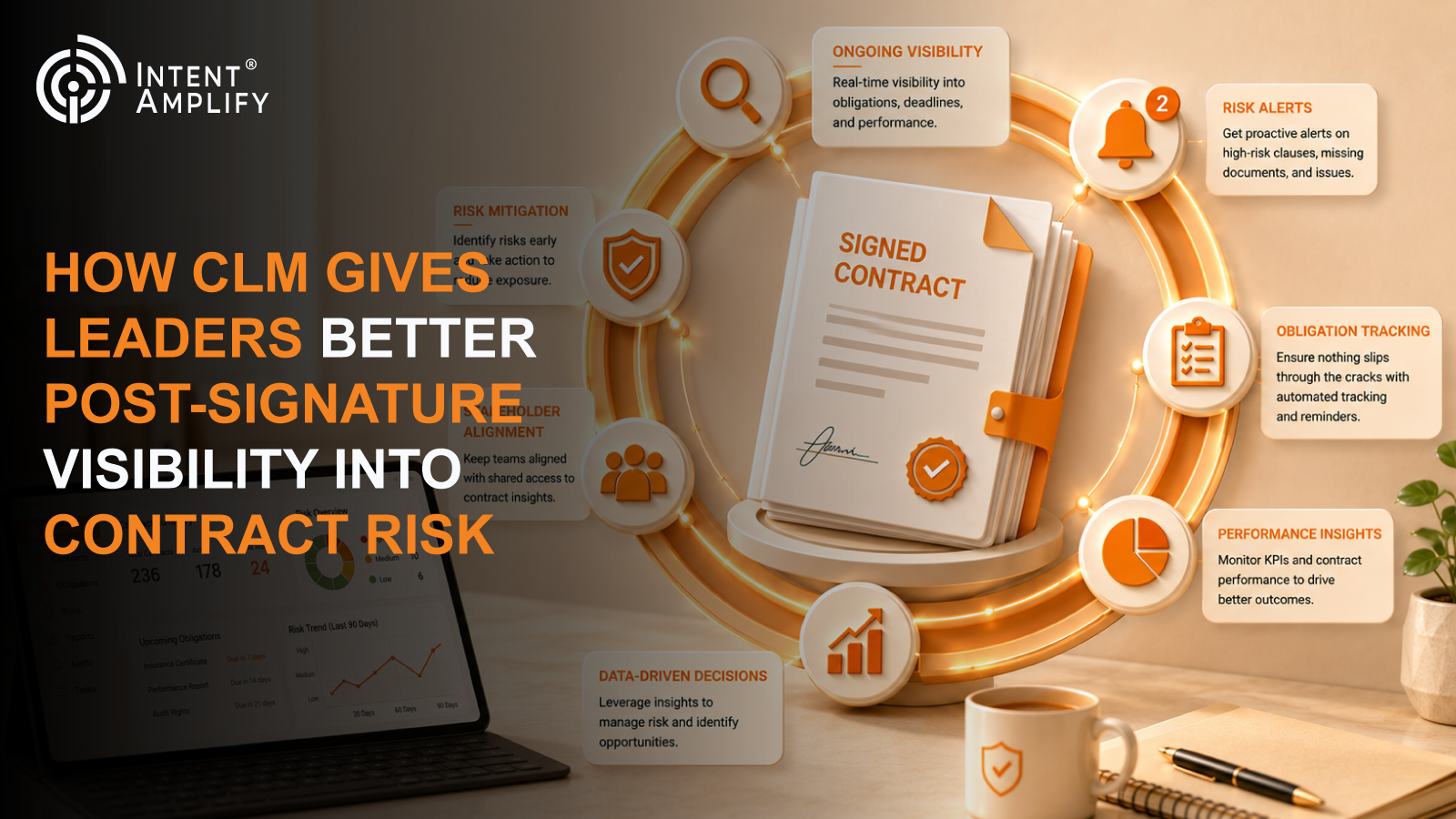
The practical value of CLM should be measured by the decisions it improves. A strong post-signature CLM program should help leaders:
- Identify high-risk contracts by clause deviation, value, counterparty, region, renewal date, or obligation criticality.
- Track contractual obligations before they become performance failures or compliance gaps.
- Monitor service-level agreements, renewal windows, termination rights, and pricing commitments.
- Improve audit readiness through structured records, approval trails, and obligation evidence.
- Reduce contractual risk by standardizing templates, clauses, playbooks, and escalation rules.
- Give executives a contract dashboard that connects legal risk, commercial exposure, and operational accountability.
Deloitte’s work on contract management transformation emphasizes that CLM initiatives should not be treated as system installation projects; they should be designed around transformation, real-time insight, automation, and decision-making. 8
That is the correct leadership lens. CLM ROI is not limited to shorter cycle times. It includes better contract oversight, reduced legal exposure, stronger compliance monitoring, improved renewal discipline, and clearer executive accountability.
Where Intent Amplify Helps
For technology providers, consultants, and solution leaders in the CLM market, the challenge is not only to explain what CLM does. The harder task is to help enterprise buyers understand why contract visibility now belongs in risk, compliance, legal operations, procurement, finance, and cybersecurity conversations.
This is where Intent Amplify’s research-led content approach is commercially relevant. We help translate complex technology categories into executive-facing narratives that connect market evidence, buyer pain points, risk implications, and solution value.
For CLM providers, that means developing assets that do more than describe repositories, workflows, and automation. The stronger message is that CLM enables leaders to identify silent contractual threats before they become financial, operational, or compliance events.
A well-positioned CLM asset should help buyers understand the cost of fragmented contract oversight, the governance value of post-signature visibility, and the strategic role of contract intelligence.
It should also guide decision-makers toward a practical evaluation model: repository maturity, obligation tracking, clause governance, workflow automation, analytics, AI controls, integration readiness, and executive reporting.
To continue the discussion, readers can access Listening for the Silent Threat: How Contract Lifecycle Management (CLM) Transforms Risk into Opportunity.
Strategic Takeaway
Contract risk is often silent because it is embedded in language, dispersed across systems, and activated only when obligations are missed or conditions change. CLM gives leaders a way to make that risk visible.
The strongest programs do not treat contracts as static records. They treat them as active sources of risk intelligence, compliance evidence, commercial insight, and governance accountability.
For executives, the question is no longer whether the organization has a contract management process. The more important question is whether leaders can see, measure, and act on post-signature contract risk before it becomes value leakage, audit exposure, customer friction, supplier failure, or regulatory concern.
References
- Gartner (2025) Magic Quadrant for Contract Life Cycle Management. Available at: https://www.gartner.com/en/documents/7159730
- McKinsey & Company (2026) Procurement power plays: Unlocking value from legal spend. Available at: https://www.mckinsey.com/capabilities/operations/our-insights/operations-blog/procurement-power-plays-unlocking-value-from-legal-spend
- Microsoft (2025) 2025 Responsible AI Transparency Report. Available at: https://cdn-dynmedia-1.microsoft.com/is/content/microsoftcorp/microsoft/msc/documents/presentations/CSR/Responsible-AI-Transparency-Report-2025.pdf
- Deloitte (2025) Contract lifecycle management framework. Available at: https://www.deloitte.com/in/en/services/audit-assurance/solutions/contract-lifecycle-management-framework.html
- Accenture (2025) Only One in 10 Organizations Globally Are Ready to Protect Against AI-Augmented Cyber Threats. Available at: https://newsroom.accenture.com/news/2025/only-one-in-10-organizations-globally-are-ready-to-protect-against-ai-augmented-cyber-threats
- Accenture (2026) AI Approach to Maximizing Value in Supply Chain Procurement. Available at: https://www.accenture.com/us-en/blogs/supply-chain/maximize-value-ai-procurement
- McKinsey & Company (2025) The State of AI in 2025. Available at: https://www.mckinsey.com/~/media/mckinsey/business%20functions/quantumblack/our%20insights/the%20state%20of%20ai/november%202025/the-state-of-ai-2025-agents-innovation_cmyk-v1.pdf
- Deloitte (2025) How to Future Proof Your Contract Management Transformation. Available at: https://www.deloitte.com/au/en/services/consulting/blogs/how-future-proof-contract-management-transformation.html