
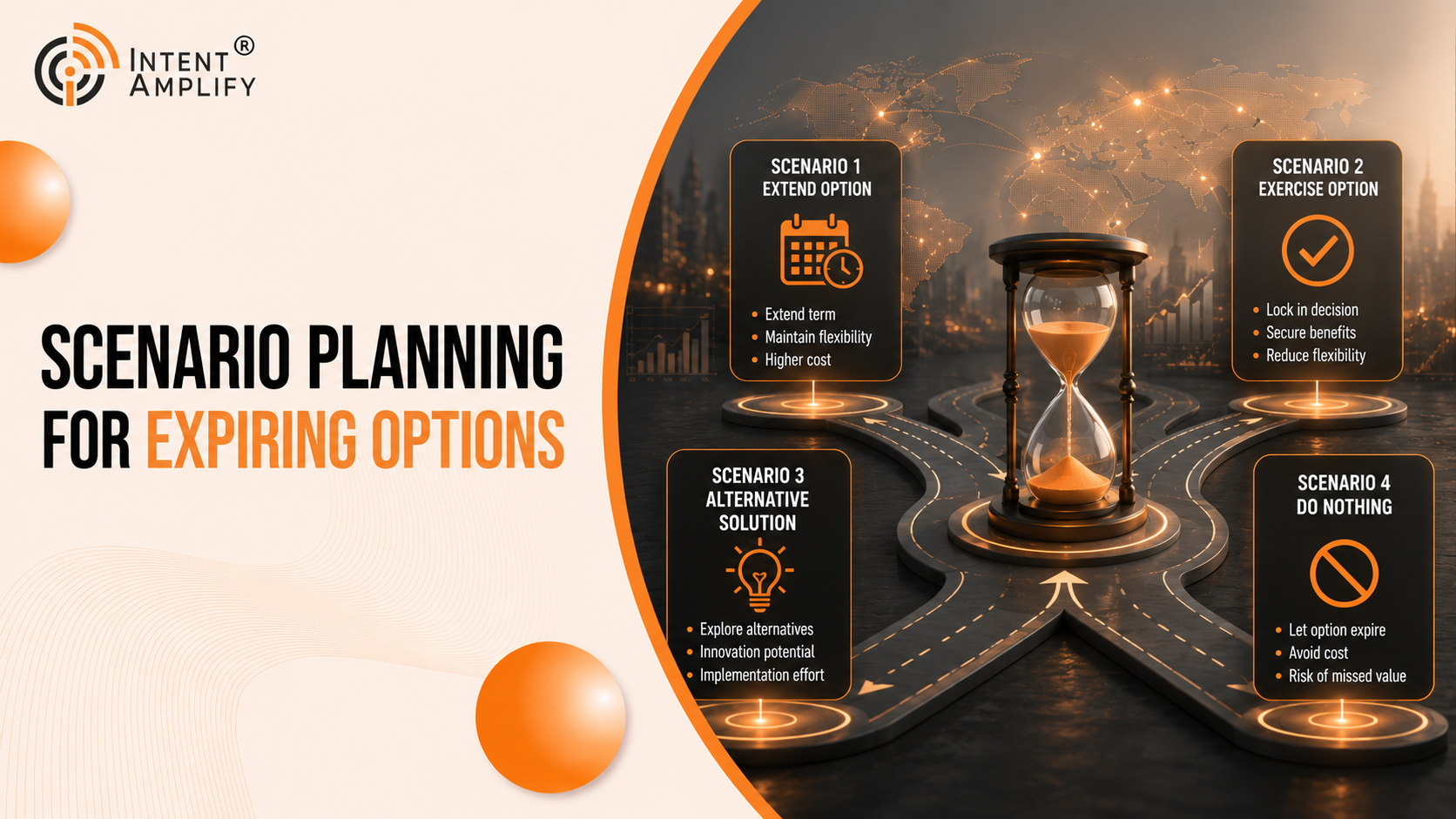
Scenario planning is often treated as an exercise in imagining multiple futures. In a decision-ready supply chain, its more practical purpose is to prepare choices before the organization is forced to make them.
When conditions change, response options do not remain open indefinitely. Capacity fills, inventory moves, bookings commit, customer promises harden, and lead times compress. Scenario planning creates value when it identifies what can be done while those options are still available.
START WITH A DECISION, NOT A DISRUPTION STORY
Rather than model every possible event, select a recurring decision class. Define the trigger, business exposure, response deadline, available options, constraints, and authority. Then model how the option set changes as time passes.
This keeps scenario planning operational. The question becomes: if this signal appears, what choices do we have now, what choices disappear next, and who can act?
BUILD SCENARIOS AROUND CONSTRAINTS
Useful scenarios should expose constraints such as capacity, inventory, lead time, supplier capability, service commitments, cost boundaries, and execution dependencies. They should also identify which assumptions are verified and which remain uncertain.
The goal is not false precision. It is decision clarity.
DEFINE TRIGGER POINTS
A scenario becomes executable when it has trigger points. For example, a response path may become appropriate when a threshold is crossed, a milestone is missed, or a capacity condition changes. Trigger design should be based on verified operating evidence and reviewed by the accountable functions.
CONNECT SCENARIOS TO OWNERSHIP
Every scenario should have a decision owner and execution path. Otherwise it remains an analytical artifact. The owner should know what authority is available and when escalation is required.
USE AI TO ACCELERATE COMPARISON
AI can help assemble scenario inputs, compare alternatives, identify dependencies, and summarize trade-offs. It should not invent missing operational facts. Where evidence is unavailable, the decision brief should label the unknown explicitly.
MEASURE OPTION PRESERVATION
After an exception, review which options were available at first signal, which were available at decision time, and which were actually executed. This creates a practical measure of whether the organization is becoming more decision-ready.
SCENARIO PLANNING AS AN AWARENESS SYSTEM
Scenario planning can improve awareness before a disruption occurs because it teaches the organization what to watch. Once a decision class has been modeled, teams know which signals matter, which constraints change the option set, and which thresholds should trigger attention. The scenario becomes a lens for interpreting live conditions rather than a document stored for occasional review.
This is a major difference between generic contingency planning and decision-ready scenario planning. The goal is not to maintain a library of disruption stories. It is to create recognizable decision patterns that help teams see when a familiar trade-off is forming.
MAP THE OPTION CURVE
For each scenario, map how choices change over time. At the earliest stage, multiple routing, inventory, supplier, capacity, or customer options may be available. Later, some options become infeasible because bookings commit, lead times expire, inventory is consumed, or customer promises harden.
Making that option curve visible gives leaders a concrete reason to act before certainty is complete. It also clarifies which information must arrive early. A signal that appears after the relevant option has expired may still be useful for reporting, but it cannot support that decision.
BUILD A SCENARIO CARD
A compact scenario card can improve operational awareness. It should identify the decision class, earliest reliable triggers, business exposure, critical constraints, option set, last useful decision point, accountable owner, escalation path, required evidence, and execution dependencies. The card should be reviewed against real events and updated when assumptions change.
This format also makes scenario planning easier to communicate across functions. Planning, logistics, procurement, finance, and customer teams can see the same decision structure while contributing their own evidence.
FROM SCENARIO TO SIGNAL MONITORING
Once trigger points are defined, monitoring can focus on conditions that change the decision. This reduces noise. Instead of tracking every available indicator equally, teams can prioritize the milestones, thresholds, and combinations of events that cause an option to open, narrow, or close.
AI can support this process by watching defined inputs, assembling scenario context, and comparing current conditions with prepared response paths. Human owners remain responsible for material choices and for validating uncertain evidence.
LEARN FROM EXPIRED OPTIONS
Post-event reviews should examine not only the chosen action but the options that disappeared. Which choices were available when the first signal arrived? Why were they no longer available at decision time? Was the loss caused by late visibility, slow context assembly, unclear ownership, approval delay, or execution constraints?
This creates a richer learning loop than asking whether the final outcome was acceptable. The organization can improve its ability to preserve choice even when the external event itself cannot be prevented.
THE OPTION CURVE: A PRACTICAL EXECUTIVE VIEW
The option curve is a simple way to visualize how decision flexibility changes over time. At the left side of the curve, the organization may have several viable alternatives. As milestones pass, some options become more expensive, slower, or operationally impossible. At the right side, the organization may be left with only damage-control choices.
The purpose of the curve is not to create a mathematically precise forecast of option value. It is to make timing visible. For each response path, leaders can identify the earliest practical trigger, the evidence required to consider the option, and the last useful decision point. The curve can then be reviewed against actual events to see whether the organization is consistently recognizing risk while options remain open.
The option curve also improves executive communication. Instead of reporting that a disruption is “high risk,” teams can explain which choices are still available and which are about to expire. That makes the urgency more concrete and connects risk awareness directly to action.
TRIGGERS SHOULD CHANGE THE DECISION, NOT JUST THE DASHBOARD
A useful trigger is one that changes what the organization should consider doing. It may be a threshold, milestone failure, capacity condition, lead-time change, inventory position, or combination of signals. The trigger does not need to predict the final outcome with certainty. It needs to create enough confidence that the decision owner should review the available options.
This distinction helps prevent over-alerting. If a signal does not change the decision, its value may be informational rather than operational. Decision-ready monitoring therefore prioritizes triggers that materially affect exposure, time, or choice.
Trigger design should also specify evidence quality. A weak early signal may justify awareness but not action. A stronger signal may justify option preparation. A verified threshold breach may require a decision. This creates a staged response model that avoids both premature action and late escalation.
DESIGNING THE SCENARIO CARD
A scenario card should be concise enough to use during operations but complete enough to support a decision. At minimum, it should include the decision class, trigger conditions, affected exposure, critical constraints, available response paths, last useful decision point, accountable owner, authority boundary, required evidence, execution dependencies, and known unknowns.
The card should also state which inputs are authoritative and how freshness is assessed. If the scenario depends on inventory, capacity, supplier status, shipment milestones, or customer commitments, the owner should know where those facts come from and whether they are current enough to support the choice.
An effective card is not static. After a real event, teams should update it with what they learned: which trigger appeared first, which evidence was missing, which option was feasible in theory but not in practice, which approval delayed action, and which execution dependency was underestimated. Over time, the scenario library becomes an operating memory rather than a collection of hypothetical documents.
SCENARIO PLANNING AND CROSS-FUNCTIONAL COORDINATION
Most meaningful supply chain decisions cross functional boundaries. A planning team may understand demand implications, logistics may understand transport alternatives, procurement may understand supplier constraints, finance may understand cost trade-offs, and customer teams may understand service consequences. Scenario planning should combine these perspectives before a real event forces the conversation under time pressure.
The decision owner should not be responsible for discovering every stakeholder during the exception. The scenario card should identify who provides evidence, who owns the choice, who executes the action, and when escalation is required. That makes cross-functional coordination part of the scenario design.
This also improves awareness. Teams can see not only that a condition is deteriorating, but how it may affect adjacent functions and which trade-offs will likely need to be resolved. That shared understanding reduces the risk that each function optimizes its own outcome while the enterprise decision remains unclear.
AI CAN ACCELERATE SCENARIO WORK—WITH BOUNDARIES
AI can be useful in scenario planning when its role is bounded and evidence-aware. It can help compare current conditions with prepared scenarios, assemble relevant inputs, identify missing data, surface dependencies, summarize trade-offs, and prepare a structured decision brief. These tasks can reduce analytical preparation time when the underlying data is trusted.
AI should not invent missing operational facts or silently convert uncertainty into certainty. If supplier capacity is unknown, the output should say so. If two data sources conflict, that conflict should be visible. If a response path depends on an unverified assumption, the assumption should be explicit.
The most useful AI-enabled scenario workflow keeps the human decision owner in control of material trade-offs while reducing the time required to understand the situation. This preserves accountability while using automation where it is strongest: synthesis, comparison, retrieval, and pattern recognition.
HOW TO MEASURE WHETHER SCENARIO PLANNING IS WORKING
Scenario planning should be measured by operating behavior, not by the number of scenarios created. Useful measures include the percentage of recurring decision classes with a prepared scenario card, the percentage of material exceptions recognized before the last useful decision point, the time from trigger to accountable owner, the completeness of the decision brief at first review, and the proportion of events in which at least one prepared response path remained executable.
Post-event analysis can add a second layer. Compare the options available at first signal with the options available when the decision was made. If choices repeatedly disappear before ownership is engaged, the problem may be late visibility or unclear routing. If choices are known but cannot be executed, the problem may be downstream workflow or partner readiness. If the trigger arrives early but leaders wait for certainty, the issue may be governance or risk tolerance.
These measures should be established from verified internal baselines. External maturity scores are not required to determine whether the organization is improving. The objective is to reduce avoidable option loss over time.
A 30-DAY SCENARIO-READINESS SPRINT
In the first week, select one recurring decision class with meaningful time sensitivity. Review recent examples and reconstruct when the first credible signal appeared, when the business recognized the exposure, when the decision owner was engaged, and which options remained at each point.
In the second week, build the scenario card. Define triggers, evidence requirements, constraints, response paths, authority boundaries, escalation logic, and the last useful decision point. Keep the design practical. If the card requires a large meeting to interpret, it is too complicated for operational use.
In the third week, connect the scenario to monitoring and workflow. Identify which signals can be observed earlier, which systems or partners provide the evidence, and how the issue should be routed when the trigger is met. Test missing-data and conflicting-data cases deliberately.
In the fourth week, run the scenario against a live or realistic event. Track whether the trigger was recognized, whether the owner received complete context, whether the option set was still meaningful, and whether execution could begin without creating a new coordination bottleneck. Use the findings to revise the card and the workflow.
FIVE QUESTIONS FOR EXECUTIVE REVIEW
Executives can use five questions to evaluate scenario readiness. Which recurring decisions lose the most options when teams respond late? Which signals reliably appear before those options expire? Which constraints cause response paths to narrow fastest? Which decisions still lack a clear owner or authority boundary? Which prepared options consistently fail at execution even when the decision is made on time?
These questions move scenario planning away from abstract preparedness and toward operating evidence. They reveal whether the organization is becoming better at recognizing a decision early enough to preserve meaningful choice.
EXECUTIVE TAKEAWAY
Decision-ready scenario planning prepares choices before volatility closes them. By making triggers, constraints, ownership, evidence, response options, and the last useful decision point visible in advance, leaders can recognize material decisions earlier and act while meaningful alternatives remain. The objective is not perfect prediction; it is preserving the ability to make and execute a better decision under uncertainty.
Download The Decision-Ready Supply Chain
REFERENCES
1. Gartner. “Supply Chain Leaders Should Prioritize Advanced Data Visibility and Scenario Planning to Drive Competitive Advantage Amid Global Uncertainty.” May 19, 2025. Research emphasizing scenario planning as a response to supply-chain uncertainty. https://www.gartner.com/en/newsroom/press-releases/2025-05-19-gartner-says-supply-chain-leaders-should-prioritize-advanced-data-visibility-and-scenario-planning-to-drive-competitive-advantage-amid-global-uncertainty
2. McKinsey & Company. “Supply chains: Still vulnerable.” October 14, 2024. Research on resilience, risk and planning under disruption. https://www.mckinsey.com/capabilities/operations/our-insights/supply-chain-risk-survey-2024
3. NIST. “Artificial Intelligence Risk Management Framework (AI RMF 1.0).” January 2023. Framework supporting evidence-aware and accountable AI assistance. https://www.nist.gov/itl/ai-risk-management-framework
4. APL Logistics. “Order Planning: Managing Your Supply Chain in the Age of Disruption.” May 20, 2024. Perspective on proactive order planning and preparing response choices under disruption. https://www.apllogistics.com/2024/05/order-planning-managing-your-supply-chain-in-the-age-of-disruption
5. IntentTechPub. “The Decision-Ready Supply Chain.” Campaign page for APL Logistics, IA-168 - 26-08-001. https://intenttechpub.com/ebook/the-decision-ready-supply-chain/?mtm_campaign=APL_logistics&mtm_kwd=supply_chain_now