
Contract lifecycle management (CLM) business cases are becoming more rigorous because the contract function is no longer viewed as an administrative legal workflow. It is now a control point for enterprise risk, cost exposure, supplier performance, revenue protection, regulatory accountability, and operational speed. The strongest CLM business cases do not begin with software features. They begin with a clearer question: where is contract friction weakening business performance?
This distinction matters. Many organizations still evaluate CLM as a repository, workflow automation tool, or legal productivity system. That view is too narrow. Contracts govern commercial obligations, price protections, renewal rights, data-processing terms, service-level commitments, indemnities, supplier risk clauses, and termination options.
When those obligations are distributed across emails, shared drives, procurement systems, and business-unit spreadsheets, leaders lose the ability to manage risk and value with confidence.
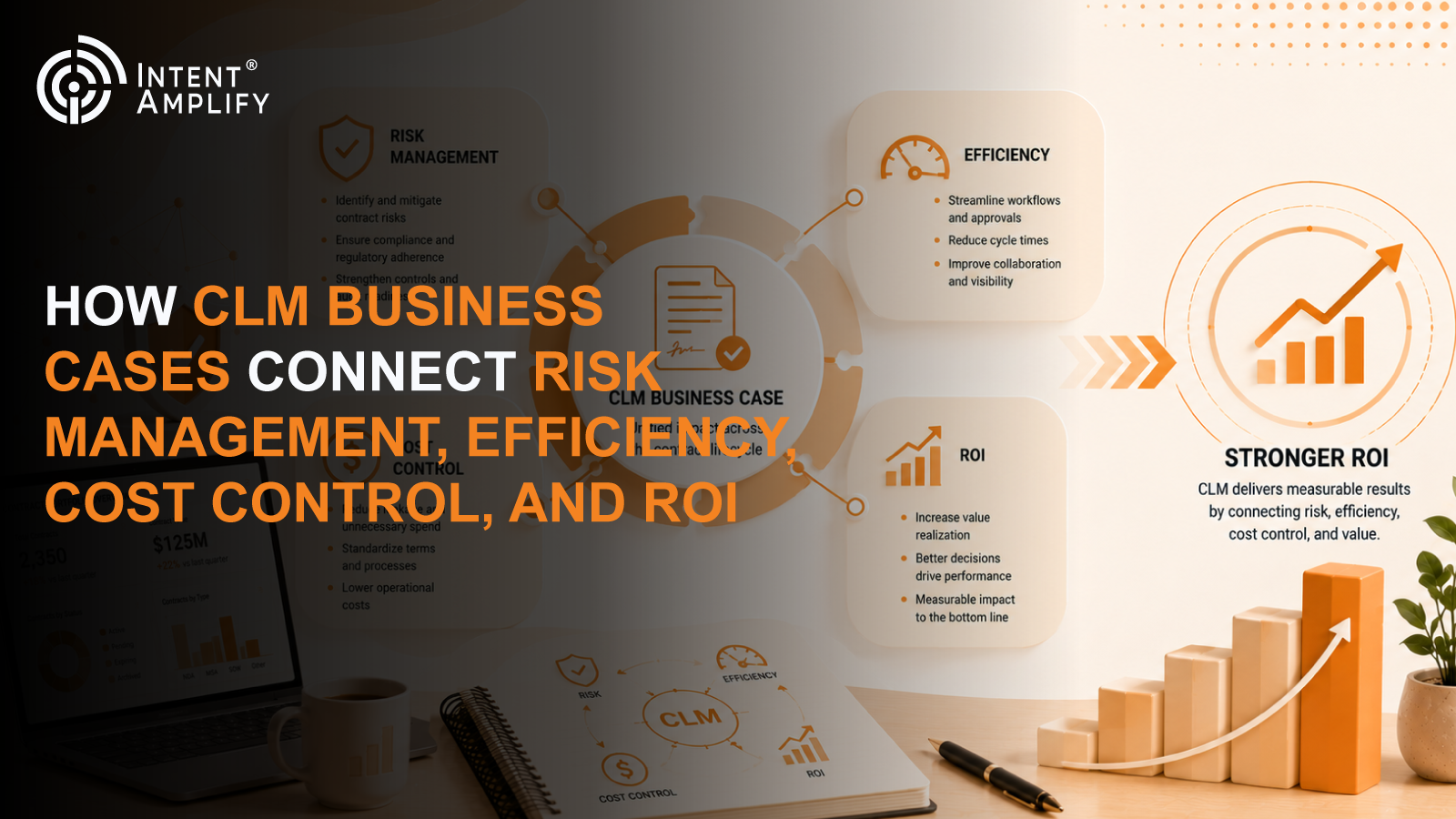
The investment case for CLM therefore sits at the intersection of four outcomes: reducing contractual and compliance risk, improving execution efficiency, controlling avoidable costs, and proving measurable return on investment (ROI). CLM value should be measured through the organization's ability to prevent leakage, enforce obligations, improve visibility, and support better commercial decisions.
Why CLM Business Cases Are Moving from Legal Operations to Enterprise Governance
The business case for CLM has historically been owned by legal operations or procurement transformation teams. Gartner reported in October 2025 that artificial intelligence (AI) and contract analytics had become urgent strategic priorities for general counsel, with 36% of surveyed general counsel focused on AI adoption, AI skills, or AI risk management. The same Gartner survey found that 9% of general counsel wanted advanced contract analytics and technology tools to better manage contract risks and reduce costs; Gartner also noted that 37% of general counsel had relatively low confidence in using advanced contract analytics. 1
This is a useful signal for CLM business-case owners. Demand is not limited to digitizing contracts. Leaders want visibility into risk, obligations, cost levers, and decision quality. A CLM business case that only promises faster drafting will struggle to secure board-level or finance-level support. A stronger case connects contract intelligence to governance: which clauses create exposure, which renewals require action, which suppliers create operational dependency, and which agreements contain pricing or compliance obligations that are not being enforced.
Gartner’s 2025 Magic Quadrant for Contract Life Cycle Management reinforces the shift toward cross-functional CLM strategies, noting that organizations are pursuing enterprise-wide CLM approaches and replacing systems that no longer meet broader requirements. 2
CLM is becoming a shared operating layer across legal, procurement, finance, sales, risk, compliance, and business operations.
Risk Management: The First Layer of the CLM Value Case
Risk reduction is often the least-developed component of a CLM business case. Many organizations continue to treat contract risk as a qualitative issue despite its measurable business impact. Contract risk can be translated into measurable business exposure when teams map it to delayed obligations, missed audit evidence, non-standard clauses, unmanaged renewals, weak supplier commitments, and untracked regulatory terms.
For regulated sectors, the risk argument becomes even stronger. Contracts increasingly contain commitments tied to data protection, cybersecurity controls, artificial intelligence use, subcontractor access, privacy obligations, resilience, service continuity, and incident notification.
If these terms are not searchable, monitored, and mapped to accountable owners, they become a latent risk. Risk increases when organizations cannot identify ownership, monitor compliance, or escalate contractual deviations effectively.
Microsoft’s 2026 Dynamics 365 Supply Chain Management documentation reflects this operational requirement by positioning CLM integration as a way to connect external CLM systems with purchase agreements, non-disclosure agreements, amendments, negotiation, signing, and termination workflows. 3
For business-case development, this matters because risk management depends on integration. A CLM platform that remains isolated from procurement, supply chain, enterprise resource planning, or finance systems may digitize documents while leaving operational risk intact.
The risk-management case should therefore quantify three areas: exposure reduction, control maturity, and decision latency. Exposure reduction examines how many contracts contain non-standard, high-risk, or unapproved clauses.
Control maturity assesses whether obligations, renewals, approvals, and deviations are assigned to accountable owners. Decision latency measures how long it takes to locate risk-relevant contract terms during audits, disputes, supplier reviews, incident response, or renegotiations.
Efficiency: Faster Contracting Is Valuable, but Workflow Redesign Is the Real Lever
Efficiency remains one of the easiest CLM benefits to explain, but it is often measured too narrowly. Cycle-time reduction is important; however, the higher-value question is whether CLM changes how work moves across teams. A legal team can reduce review time, but if sales, procurement, finance, and compliance remain disconnected, bottlenecks simply shift to another part of the process.
McKinsey’s 2025 State of AI research found that 88% of respondents reported regular AI use in at least one business function, but only about one-third said their companies had begun scaling AI programs. McKinsey also noted that high performers are nearly three times as likely as others to have fundamentally redesigned individual workflows. 4
The lesson applies directly to CLM: automation without workflow redesign produces partial gains. Workflow redesign, supported by clean data and governance, produces sustained operating leverage.
In CLM terms, efficiency should be evaluated across intake, authoring, redlining, approval routing, negotiation, execution, obligation extraction, renewal management, and post-signature performance. The strongest efficiency cases identify where manual review is genuinely necessary and where standardized playbooks, clause libraries, approval logic, and AI-assisted summarization can reduce repetitive effort.
This is also where the business case should distinguish between legal efficiency and enterprise efficiency. Legal may save hours on contract review, but procurement may also reduce supplier onboarding delays, sales may shorten deal cycles, finance may gain earlier visibility into payment obligations, and risk teams may reduce manual evidence gathering. These benefits should not be collapsed into a single productivity estimate. They should be modeled by a function because each stakeholder experiences CLM value differently.
Cost Control: CLM as a Defense Against Value Leakage
Cost control is where CLM business cases often become most persuasive for CFOs. Contract costs are not limited to legal team hours or platform licensing. They include missed renewal windows, unfavorable auto-renewals, unclaimed rebates, unmanaged price escalators, duplicate supplier terms, dispute costs, compliance penalties, and weak enforcement of negotiated savings.
Accenture’s 2026 procurement analysis reported that a $15 billion Fortune 500 manufacturer uncovered $30 million in savings through AI-driven spend optimization, and that companies adopting similar tools consistently capture up to 2% savings while reducing per-invoice processing costs and improving cycle times. 5
While this is procurement-focused rather than CLM-specific, it supports a broader point: visibility into spend, suppliers, and contractual commitments can convert operational data into measurable savings.
For CLM, cost control should be modeled through both direct and indirect levers. Direct levers include reduced outside counsel dependency for routine agreements, lower administrative effort, fewer manual escalations, and faster contract approvals. Indirect levers include improved negotiation leverage, better supplier consolidation, stronger compliance with negotiated pricing, and fewer disputes caused by unclear obligations.
The mature CLM business case also accounts for opportunity cost. If commercial teams cannot access approved templates, fallback clauses, or contract status, revenue can be delayed. If procurement cannot identify termination rights or renegotiation triggers, savings can be missed. If finance cannot see renewal obligations, budget control weakens. These are not abstract inefficiencies. They are recurring value leaks.
ROI: Why CLM Measurement Must Move Beyond Payback Period
ROI is the point where many CLM proposals become either too optimistic or too vague. A defensible ROI model should include baseline metrics, benefit categories, adoption assumptions, implementation costs, integration costs, process-change requirements, and governance ownership. Without that discipline, CLM becomes another technology investment with unclear accountability.
Deloitte’s 2025 AI ROI research, based on a survey of 1,854 senior executives conducted between August and September 2025, found that only around one in five surveyed organizations qualified as true AI ROI leaders.
Deloitte also reported that 65% of organizations now consider AI part of corporate strategy, and that leading organizations use broader ROI frameworks that include direct financial return, revenue growth, operational cost savings, and speed to value. 6
The CLM implication is clear: ROI should be designed as a portfolio of measurable outcomes rather than a single productivity calculation. A practical model should include:
-
Risk ROI: fewer non-standard clauses, fewer missed obligations, stronger audit readiness, and faster contract risk assessments.
-
Efficiency ROI: shorter cycle times, fewer manual touchpoints, faster approvals, and reduced rework.
-
Cost ROI: lower legal processing cost, reduced value leakage, fewer unwanted renewals, and improved supplier or customer term enforcement.
-
Strategic ROI: better negotiation intelligence, improved forecasting, stronger compliance governance, and higher confidence in commercial decision-making.
Gartner’s July 2025 commentary on generative AI in procurement is a cautionary datapoint for CLM leaders. Gartner noted that GenAI for procurement had entered the “trough of disillusionment,” with some organizations seeing benefits while others experienced uneven ROI or fell short of expectations. 7
Building a CLM Business Case That Executives Can Defend
A strong CLM business case should be built as an evidence-led operating case, not a software justification. In our assessment, the most credible structure includes five components.
First, define the current-state risk profile. This includes contract volume, contract types, clause variance, approval delays, renewal exposure, dispute history, audit findings, and contract-data accessibility. The objective is to show where the organization lacks visibility or control.
Second, quantify process friction. Measure average cycle time by contract type, number of approval steps, rework frequency, manual handoffs, template deviation, and time spent locating contractual terms. These are the operational indicators that translate CLM pain into measurable inefficiency.
Third, identify cost leakage. This should include unwanted renewals, missed discounts, unclaimed rebates, inconsistent supplier terms, avoidable outside counsel spend, and delay-related revenue or procurement impact.
Fourth, define the target operating model. CLM success depends on more than implementation. It requires clear ownership across legal, procurement, finance, risk, sales operations, and information technology.
Deloitte’s June 2026 strategic alliance around agentic CLM underscores that enterprises are now looking to modernize contracting as AI reshapes how legal and business teams create, negotiate, and manage agreements. 8
Fifth, create a phased ROI roadmap. The first phase should target high-confidence use cases such as template standardization, approval automation, renewal visibility, and searchable contract metadata. The second phase should focus on obligation management, risk scoring, and integration with procurement or finance systems. The third phase can expand into advanced analytics, AI-supported negotiation insights, and enterprise contract intelligence.
Where We Help
For organizations evaluating CLM investment, the challenge is not whether contract modernization is valuable. The challenge is proving which value matters most, how it will be measured, and which stakeholders must own the outcome.
This is where our research-led approach helps. We support CLM-focused business-case development by translating contract pain points into executive-ready narratives, evidence-backed ROI models, buyer education assets, and decision frameworks that speak to legal, procurement, finance, risk, and technology leaders. Our work is designed to help vendors and enterprise teams communicate CLM value with precision: what risk is reduced, what cost is controlled, what workflow improves, and how business impact will be measured.
For teams building or refining a CLM investment case, the CLM Buyer’s Toolkit provides a practical starting point for structuring the business case, aligning stakeholders, and clarifying success metrics.
Download the toolkit.
Conclusion
The most effective CLM business cases connect four value dimensions that executives already care about: risk management, efficiency, cost control, and ROI. Risk management makes contracts visible and governable. Efficiency reduces unnecessary friction across legal and business workflows. Cost control prevents value leakage and strengthens commercial discipline. ROI converts those improvements into measurable business outcomes.
The strategic takeaway is straightforward: CLM should not be positioned as a document-management upgrade. It should be positioned as an enterprise control layer for contractual value. Organizations that frame CLM this way are better equipped to secure executive sponsorship, prioritize implementation, and measure success beyond go-live.
References
[1] Gartner (2025) Gartner Survey Shows AI and Contract Analytics Are Urgent Priorities for General Counsel. Available at: https://www.gartner.com/en/newsroom/press-releases/2025-10-01-gartner-survey-shows-ai-and-contract-analytics-ar-urgent-priorities-for-general-counsel
[2] Gartner (2025) Gartner Magic Quadrant for Contract Life Cycle Management. Available at: https://www.gartner.com/en/documents/7159730
[3] Microsoft (2026) Contract Lifecycle Management Integration Overview — Dynamics 365 Supply Chain Management. Available at: https://learn.microsoft.com/en-us/dynamics365/supply-chain/procurement/contract-lifecycle-management/clm-overview
[4] McKinsey & Company (2025) The State of AI: Global Survey 2025. Available at: https://www.mckinsey.com/capabilities/quantumblack/our-insights/the-state-of-ai
[5] Accenture (2026) A Targeted AI Approach to Maximizing Value in Procurement. Available at: https://www.accenture.com/us-en/blogs/supply-chain/maximize-value-ai-procurement
[6] Deloitte (2025) AI ROI: The Paradox of Rising Investment and Elusive Returns. Available at: https://www.deloitte.com/global/en/issues/ai/ai-roi-the-paradox-of-rising-investment-and-elusive-returns.html
[7] Gartner (2025) Gartner Says Generative AI for Procurement Has Entered the Trough of Disillusionment. Available at: https://www.gartner.com/en/newsroom/press-releases/2025-07-30-gartner-says-generative-ai-for-procurement-has-entered-the-trough-of-disillusionment
[8] Deloitte (2026) Deloitte and Ironclad Form Strategic Alliance to Expand Agentic Contract Lifecycle Management Capabilities. Available at: https://www.deloitte.com/us/en/about/press-room/deloitte-and-ironclad-form-strategic-alliance.html