
Executive Overview
A defensible CLM business case links each use case to a before-state baseline, operational mechanism, adoption dependency, accountable owner, measurement formula, and verification source.
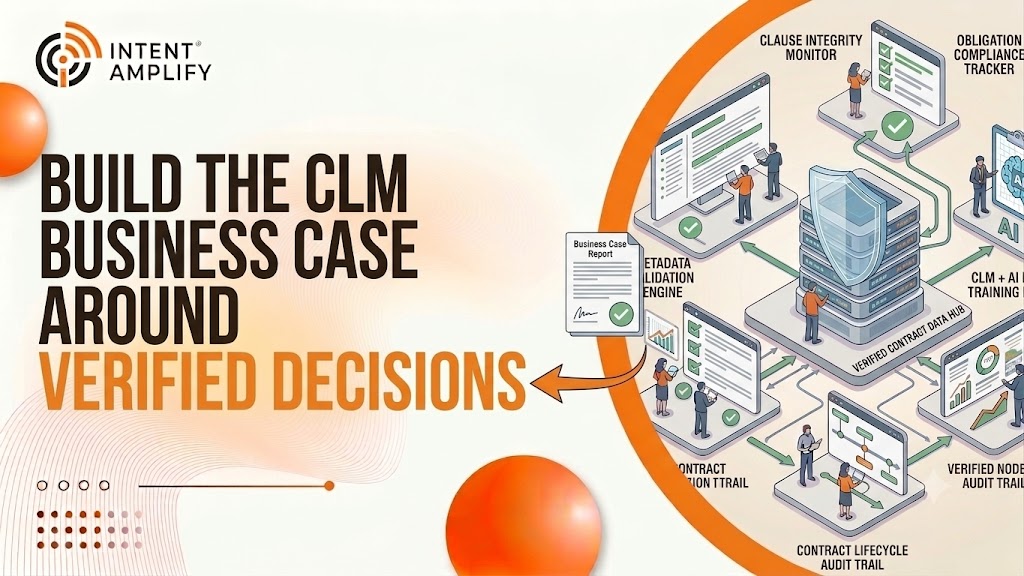
Written for CFOs, CLOs, CPOs, Legal Operations, Procurement Operations, transformation offices, and business-case owners, Build the CLM Business Case Around Verified Decisions applies current public evidence to the CLM Benefits Evidence Chain. Its governing proposition is that a defensible CLM business case links each use case to a before-state baseline, operational mechanism, adoption dependency, accountable owner, measurement formula, and verification source. Internal deployment, customer, revenue, pipeline, ROI, and performance outcomes are not asserted. Any external use of this expert insight 2 remains subject to claim, legal, brand, and channel approval.
|
Leadership brief: Use The CLM Benefits Evidence Chain to turn the central argument of this asset into owned decisions, traceable evidence, and explicit exceptions. |
1. Start With a Decision, Not a Feature
Business value emerges when a workflow changes a measurable decision. For CFOs, CLOs, CPOs, Legal Operations, Procurement Operations, transformation offices, and business-case owners, that shift matters because feature inventories can produce large benefit estimates without a causal path. The Build the CLM Business Case Around Verified Decisions perspective turns the issue into a concrete operating question: which decision should improve, which contract population is in scope, who owns the next action, and what evidence will show that the result is reliable? The useful move is to approve only hypotheses with measurable baselines. This framing gives the reader a practical starting point without assuming that software, AI, or a content download has already changed business performance.
Sources [7] and [11] support the direction of this section but have different evidence bases. Agiloft material describes its platform and product approach; those statements remain vendor claims unless independently verified. Independent or public-framework evidence helps explain why business value emerges when a workflow changes a measurable decision, but it does not prove the condition of a specific enterprise. The reader should therefore test the argument through a use-case value hypothesis. If the source record, definition, owner, or result cannot be reproduced, the evidence state remains partial, and the organization should correct only the affected workflow.
A value-first implementation would define the decision, population, current process, pain, owner, and expected change. Under the CLM Benefits Evidence Chain, the team records the before-state, configures the minimum workflow, assigns an accountable owner, and verifies a use-case value hypothesis. The control should show what happens when data is missing, AI confidence is low, a deadline is missed, or a business owner disagrees with the output. This makes the section useful to practitioners and gives executives a defensible basis to approve only hypotheses with measurable baselines. Expected benefits such as faster answers, clearer obligations, improved renewal readiness, or better visibility remain hypotheses until the organization measures them against an authoritative baseline.
2. Establish the Before-State
Benefits cannot be verified without current performance. For CFOs, CLOs, CPOs, Legal Operations, Procurement Operations, transformation offices, and business-case owners, that shift matters because teams may rely on anecdotes or modeled savings. The Build the CLM Business Case Around Verified Decisions perspective turns the issue into a concrete operating question: which decision should improve, which contract population is in scope, who owns the next action, and what evidence will show that the result is reliable? The useful move is to label gaps rather than invent inputs. This framing gives the reader a practical starting point without assuming that software, AI, or a content download has already changed business performance.
Sources [1] and [8] support the direction of this section but have different evidence bases. Agiloft material describes its platform and product approach; those statements remain vendor claims unless independently verified. Independent or public-framework evidence helps explain why benefits cannot be verified without current performance, but it does not prove the condition of a specific enterprise. The reader should therefore test the argument through a dated baseline with source and owner. If the source record, definition, owner, or result cannot be reproduced, the evidence state remains partial, and the organization should correct only the affected workflow.
A value-first implementation would measure volume, time, handoffs, errors, misses, data quality, and cost where available. Under the CLM Benefits Evidence Chain, the team records the before-state, configures the minimum workflow, assigns an accountable owner, and verifies a dated baseline with source and owner. The control should show what happens when data is missing, AI confidence is low, a deadline is missed, or a business owner disagrees with the output. This makes the section useful to practitioners and gives executives a defensible basis to label gaps rather than invent inputs. Expected benefits such as faster answers, clearer obligations, improved renewal readiness, or better visibility remain hypotheses until the organization measures them against an authoritative baseline.
3. Separate Opportunity From Realization
Identified renewals, obligations, or leakage are not recovered value. For CFOs, CLOs, CPOs, Legal Operations, Procurement Operations, transformation offices, and business-case owners, that shift matters because dashboards can count exposure as savings. The Build the CLM Business Case Around Verified Decisions perspective turns the issue into a concrete operating question: which decision should improve, which contract population is in scope, who owns the next action, and what evidence will show that the result is reliable? The useful move is to report realized value only after verification. This framing gives the reader a practical starting point without assuming that software, AI, or a content download has already changed business performance.
Sources [7] and [8] support the direction of this section but have different evidence bases. Agiloft material describes its platform and product approach; those statements remain vendor claims unless independently verified. Independent or public-framework evidence helps explain why identified renewals, obligations, or leakage are not recovered value, but it does not prove the condition of a specific enterprise. The reader should therefore test the argument through a benefits register with stage and evidence. If the source record, definition, owner, or result cannot be reproduced, the evidence state remains partial, and the organization should correct only the affected workflow.
A value-first implementation would track identified opportunity, approved action, executed change, realized outcome, and finance validation. Under the CLM Benefits Evidence Chain, the team records the before-state, configures the minimum workflow, assigns an accountable owner, and verifies a benefits register with stage and evidence. The control should show what happens when data is missing, AI confidence is low, a deadline is missed, or a business owner disagrees with the output. This makes the section useful to practitioners and gives executives a defensible basis to report realized value only after verification. Expected benefits such as faster answers, clearer obligations, improved renewal readiness, or better visibility remain hypotheses until the organization measures them against an authoritative baseline.
4. Model Adoption and Data Dependencies
Technology produces no outcome when users, data, or integrations fail. For CFOs, CLOs, CPOs, Legal Operations, Procurement Operations, transformation offices, and business-case owners, that shift matters because business cases can assume full adoption and perfect data. The Build the CLM Business Case Around Verified Decisions perspective turns the issue into a concrete operating question: which decision should improve, which contract population is in scope, who owns the next action, and what evidence will show that the result is reliable? The useful move is to fund the operating model as well as software. This framing gives the reader a practical starting point without assuming that software, AI, or a content download has already changed business performance.
Sources [4] and [11] support the direction of this section but have different evidence bases. Agiloft material describes its platform and product approach; those statements remain vendor claims unless independently verified. Independent or public-framework evidence helps explain why technology produces no outcome when users, data, or integrations fail, but it does not prove the condition of a specific enterprise. The reader should therefore test the argument through benefit sensitivity to adoption and data quality. If the source record, definition, owner, or result cannot be reproduced, the evidence state remains partial, and the organization should correct only the affected workflow.
A value-first implementation would include migration, validation, process change, integration, training, and ongoing governance. Under the CLM Benefits Evidence Chain, the team records the before-state, configures the minimum workflow, assigns an accountable owner, and verifies benefit sensitivity to adoption and data quality. The control should show what happens when data is missing, AI confidence is low, a deadline is missed, or a business owner disagrees with the output. This makes the section useful to practitioners and gives executives a defensible basis to fund the operating model as well as software. Expected benefits such as faster answers, clearer obligations, improved renewal readiness, or better visibility remain hypotheses until the organization measures them against an authoritative baseline.
5. Use a Balanced Scorecard
Legal, procurement, finance, and risk require different measures. For CFOs, CLOs, CPOs, Legal Operations, Procurement Operations, transformation offices, and business-case owners, that shift matters because one ROI number can hide service, control, and adoption performance. The Build the CLM Business Case Around Verified Decisions perspective turns the issue into a concrete operating question: which decision should improve, which contract population is in scope, who owns the next action, and what evidence will show that the result is reliable? The useful move is to review the portfolio by use case. This framing gives the reader a practical starting point without assuming that software, AI, or a content download has already changed business performance.
Sources [1], [7] support the direction of this section but have different evidence boundaries. Agiloft material describes its platform and product approach; those statements remain vendor claims unless independently verified. Independent or public-framework evidence helps explain why Legal, Procurement, Finance, and Risk require different measures, but it does not prove the condition of a specific enterprise. The reader should therefore test the argument through a scorecard with definitions and thresholds. If the source record, definition, owner, or result cannot be reproduced, the evidence state remains partial, and the organization should correct only the affected workflow.
A value-first implementation would combine cycle time, answer time, renewal readiness, obligation completion, data quality, adoption, exceptions, and realized value. Under the CLM Benefits Evidence Chain, the team records the before-state, configures the minimum workflow, assigns an accountable owner, and verifies a scorecard with definitions and thresholds. The control should show what happens when data is missing, AI confidence is low, a deadline is missed, or a business owner disagrees with the output. This makes the section useful to practitioners and provides executives with a defensible basis for reviewing the portfolio by use case. Expected benefits such as faster answers, clearer obligations, improved renewal readiness, or better visibility remain hypotheses until the organization measures them against an authoritative baseline.
6. Build an Executive Decision Gate
The business case should support staged investment. For CFOs, CLOs, CPOs, Legal Operations, Procurement Operations, transformation offices, and business-case owners, that shift matters because large commitments can be approved before fit and value are tested. The Build the CLM Business Case Around Verified Decisions perspective turns the issue into a concrete operating question: which decision should improve, which contract population is in scope, who owns the next action, and what evidence will show that the result is reliable? The useful move is to release funding as evidence improves. This framing gives the reader a practical starting point without assuming that software, AI, or a content download has already changed business performance.
Sources [8] and [11] support the direction of this section but have different evidence bases. Agiloft material describes its platform and product approach; those statements remain vendor claims unless independently verified. Independent or public-framework evidence helps explain why the business case should support staged investment, but it does not prove the condition of a specific enterprise. The reader should therefore test the argument through an approve, correct, hold, or stop decision record. If the source record, definition, owner, or result cannot be reproduced, the evidence state remains partial, and the organization should correct only the affected workflow.
A value-first implementation would require pilot evidence, acceptance criteria, risks, dependencies, stop-loss, and next-wave economics. Under the CLM Benefits Evidence Chain, the team records the before-state, configures the minimum workflow, assigns an accountable owner, and verifies an approve, correct, hold, or stop decision record. The control should show what happens when data is missing, AI confidence is low, a deadline is missed, or a business owner disagrees with the output. This makes the section useful to practitioners and gives executives a defensible basis to release funding as evidence improves. Expected benefits such as faster answers, clearer obligations, improved renewal readiness, or better visibility remain hypotheses until the organization measures them against an authoritative baseline.
The CLM Benefits Evidence Chain
|
Analyst-created execution model: a defensible CLM business case links each use case to a before-state baseline, operational mechanism, adoption dependency, accountable owner, measurement formula, and verification source |
|
||
|
Control question |
Required evidence |
Executive use |
|
|
Start With a Decision, Not a Feature |
A use-case value hypothesis |
Approve only hypotheses with measurable baselines |
|
|
Establish the Before-State |
A dated baseline with source and owner |
Label gaps rather than invent inputs |
|
|
Separate Opportunity From Realization |
A benefits register with stage and evidence |
Report realized value only after verification |
|
|
Model Adoption and Data Dependencies |
Benefit sensitivity to adoption and data quality |
Fund the operating model as well as software |
|
Source: Intent Amplify analyst-created execution model based on the referenced evidence. It is not an external standard.
Executive Recommendations
· For start with a decision, not a feature, approve only hypotheses with measurable baselines; verify the result through a use-case value hypothesis.
· To establish the before-state, label gaps rather than invent inputs; verify the result through a dated baseline with source and owner.
Limitations and Practical Risks
Limits specific to Build the CLM Business Case Around Verified Decisions: The campaign workbook contains targets and assumptions, not verified results. Product capabilities are described from Agiloft sources and should be read as vendor claims unless supported by an independent source. The WorldCC figure comes from a survey of nearly 200 businesses conducted with commercial partners and should not be universalized. AI and CLM outcomes depend on contract data quality, workflow design, governance, adoption, integration, and the selected use case. This content is operational guidance, not legal advice, and it does not promise revenue, cost savings, risk elimination, MQL volume, or conversion performance.
Executive Conclusion
Building the CLM Business Case Around Verified Decisions leads to one practical conclusion: a defensible CLM business case links each use case to a before-state baseline, operational mechanism, adoption dependency, accountable owner, measurement formula, and verification source. The reader should use The CLM Benefits Evidence Chain to diagnose the current state, select a bounded use case, name owners, and define evidence before scaling. A content click can indicate interest, but it does not prove readiness or buying authority. The next commercial step should follow explicit interest and verified ICP fit, while implementation claims remain tied to measured customer evidence.
References
[1] Intent Amplify, GTM Execution Plan IA-183-26-04-002-SOF for Agiloft Inc., 8 June 2026 workbook; inspected 6 August 2026. Internal governed source
[4] Agiloft, What Is Data Governance and Why Is It Important for AI-Powered CLM?, 28 May 2026. https://www.agiloft.com/blog/what-is-data-governance-and-why-is-it-important-for-ai-powered-clm/
[7] Agiloft, 6 ways CLM platforms help procurement teams work smarter, 13 March 2026. https://www.agiloft.com/blog/6-ways-clm-platforms-help-procurement-teams-work-smarter-not-harder/
[8] World Commerce & Contracting, Smarter Contracts, Better Margins research summary, 22 September 2025. https://news.worldcc.com/news-from-worldcc/stop-the-leakage-worldcc-report-provides-blueprint-for-recovering-5.4-of-contract-value
[11] Agiloft, Building Success: The Roadmap to CLM Implementation, 2025. https://www.agiloft.com/wp-content/uploads/The_roadmap_to_CLM_implementation_202502_01.pdf