
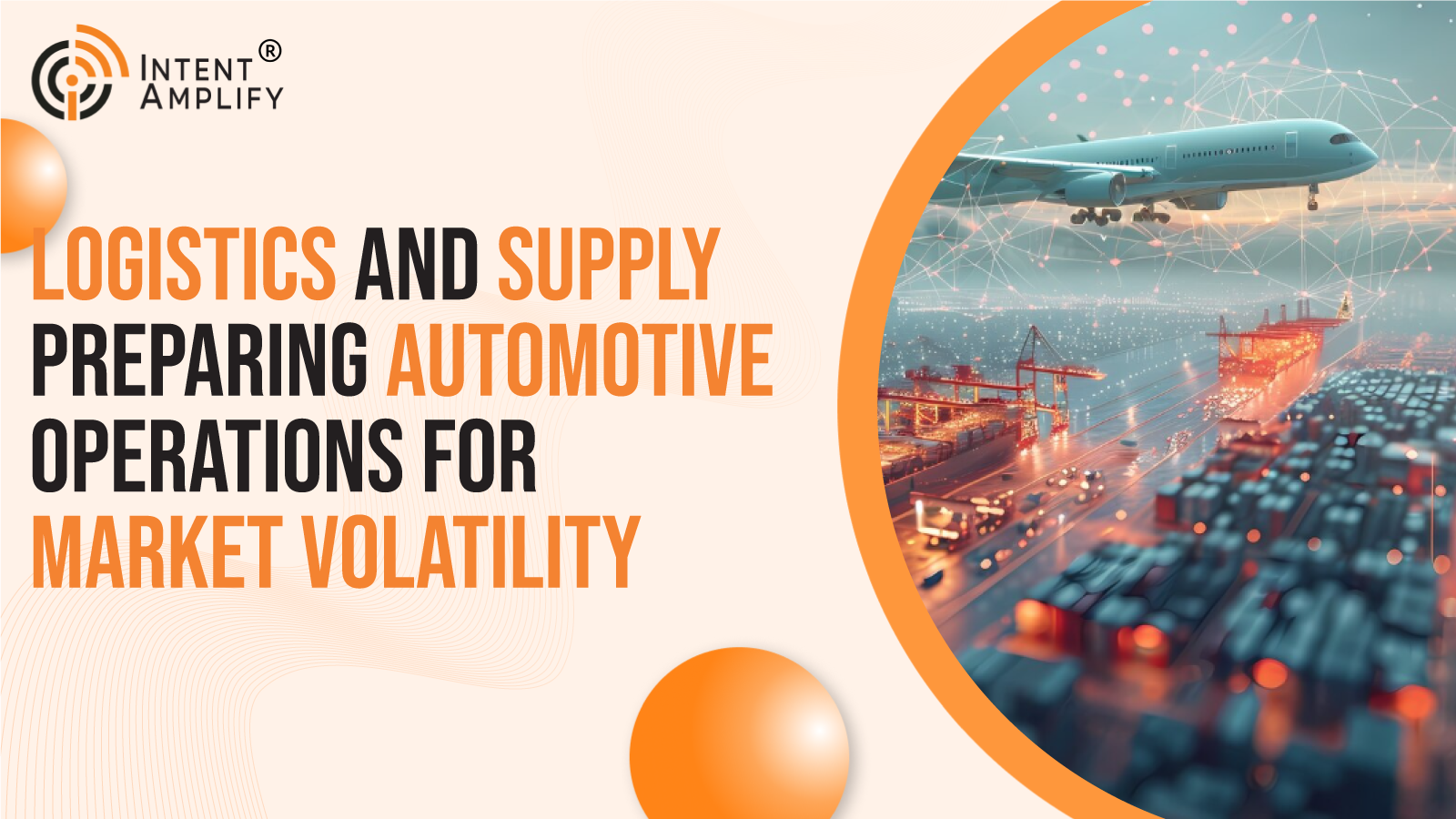
Cross-Border Movement Has Become a Production Decision
Automotive production across the United States, Canada, and Mexico depends on components, subassemblies, packaging, equipment, and finished vehicles moving through synchronized networks. This structure supports scale and efficiency, yet it also allows a customs delay, capacity shortage, documentation error, supplier failure, or policy change to reach the plant floor.
IBM’s Scaling Supply Chain Resilience: Agentic AI for Autonomous Operations reports that 61% of supply chain leaders identify geopolitical risk as a leading challenge, while 58% cite global trade tensions.[1]
For automotive organizations, these pressures influence sourcing economics, lane reliability, inventory requirements, customs exposure, and production schedules. Cross-border logistics can no longer operate as a transportation function separate from manufacturing strategy.
Automotive leaders should govern critical border movements as part of production continuity. Leaders need to understand which component is moving, which plant and vehicle programs depend on it, how much verified inventory remains, what alternate routes exist, and who can authorize intervention before the production window closes.
Market Volatility Is Revealing Execution Gaps
Shipment and supplier data are widely available across automotive organizations, but coordinated decision-making remains difficult. Procurement manages supplier commitments, logistics monitors freight, customs oversees border clearance, inventory planning assesses material availability, and plant operations protect production. Separate escalation processes often delay a common understanding of operational consequences.
PwC’s 2025 Digital Trends in Operations Survey, based on 610 operations and supply chain leaders, found that 91% expect to significantly change supply chain strategies because of United States trade policy changes, while 92% say technology investments have not fully delivered expected results.[2]
The findings show why visibility platforms alone cannot create resilience. Technology can detect exceptions and prepare scenarios, but operating discipline determines whether teams can interpret the signal and act.
Intent Amplify Observation
Cross-border visibility becomes decision-useful only when it is connected to the production context. A delayed shipment deserves executive attention when the organization can identify the affected component, plant, vehicle program, inventory runway, customer implication, recovery options, and remaining decision time. Without that context, visibility describes movement but does not protect output.
Prioritize Logistics Risk by Production Consequence
Traditional logistics management organizes activity by shipment, carrier, lane, supplier, and transportation mode. Resilient automotive operations add production criticality to that structure. A low-cost fastener with no approved substitute may carry more operational risk than an expensive assembly supported by several qualified suppliers and adequate inventory.
Leaders should segment cross-border flows according to line-stop potential, replenishment variability, supplier concentration, border dependency, documentation complexity, inspection exposure, route alternatives, and recovery cost. This reframes the operational question from “How late is the load?” to “How much production time remains, and which response best protects continuity?”
Deloitte’s Fall 2025 Fortune/Deloitte CEO Survey found that 80% of CEOs expected to pursue cost-cutting measures over the following 12 months, while 64% anticipated raising prices as shifting policies continued to influence supply chains and operating costs.[3]
Automotive leaders, therefore, need mitigation options that improve flexibility without automatically transferring every additional cost to customers.
Table 1: Cross-Border Automotive Logistics Risk Prioritization
|
Risk Dimension |
Operational Question |
Leadership Response |
|
Production criticality |
Could the material stop or constrain a line? |
Rank exposure by time to production impact |
|
Border dependency |
Does the flow rely on one crossing or process? |
Preapprove alternate gateways and procedures |
|
Supplier concentration |
Is supply tied to one facility or region? |
Establish qualification and recovery options |
|
Inventory coverage |
How long can the plant continue operating? |
Reposition stock before using premium freight |
|
Decision authority |
Who can approve route, cost, or schedule changes? |
Define escalation thresholds in advance |
Table 1 shifts risk prioritization from shipment lateness to business consequence. It also helps prevent premium freight from being used on highly visible but low-impact exceptions while production-critical dependencies remain unresolved.
Embed Risk Management into Daily Execution
Supply chain risk management becomes valuable when it changes routine decisions. Annual supplier reviews and continuity documents provide useful reference points, but they cannot replace intelligence on transport capacity, customs readiness, supplier condition, inventory accuracy, and production demand.
PwC also found that 57% of respondents had integrated AI into selected functions.[2]
AI can classify exceptions, consolidate documentation, compare routing scenarios, and identify patterns across suppliers or lanes. However, human oversight remains essential when recommendations affect regulatory compliance, production sequencing, customer commitments, quality, or recovery expenditure.
Automotive organizations should define escalation thresholds, alternate routes, broker and carrier contingencies, document-validation controls, supplier communication expectations, and approval limits before disruption occurs. Teams should also know which decisions can be automated, which can be recommended by analytics, and which require plant, procurement, finance, or executive approval.
Measure Decision Speed, Not Only Delivery Performance
On-time delivery, freight cost, transit time, and carrier performance remain necessary logistics measures. They do not reveal whether an organization can interpret a disruption, select an option, coordinate stakeholders, and restore a stable material flow.
IBM reports that 62% of supply chain leaders believe AI agents embedded in operational workflows accelerate action, decisions, recommendations, and communication, while 76% of chief supply chain officers expect agents performing repetitive, impact-based tasks to improve overall process efficiency.[1]
These benefits should be tested against operational outcomes rather than platform activity.
Relevant measures include time to confirm production exposure, percentage of critical lanes with approved alternatives, percentage of priority components mapped beyond Tier 1 suppliers, exception-to-decision time, inventory-repositioning speed, avoided premium freight, and time to restore dependable flow. If alerts increase while decisions remain slow, the organization has improved reporting rather than resilience.
Intent Amplify Cross-Border Continuity Model™
The Cross-Border Continuity Model™ is the logistics-specific application of the broader Automotive Supply Chain Resilience Framework™. It applies the campaign framework to customs, border-dependent production flows, inventory positioning, supplier coordination, and recovery decisions.
Table 2: Intent Amplify Cross-Border Continuity Model™
|
Stage |
Required Capability |
Operational Outcome |
|
Detect |
Monitor supplier, shipment, customs, inventory, and production signals |
Earlier recognition of material exposure |
|
Contextualize |
Link exceptions to parts, plants, programs, and customers |
Clearer business prioritization |
|
Decide |
Compare rerouting, substitution, inventory, and sequencing options |
Faster evidence-based intervention |
|
Coordinate |
Align logistics, customs, procurement, suppliers, and plants |
Reduced execution friction |
|
Recover |
Restore stable flow while controlling cost and compliance |
Shorter disruption duration |
|
Adapt |
Update lane, supplier, inventory, and escalation assumptions |
Stronger readiness for future volatility |
Table 2 provides a path from signal to adaptation. Automotive leaders can apply it to border congestion, supplier distress, missing documentation, capacity constraints, regulatory change, or unexpected demand movement.
Apply the Automotive Supply Chain Resilience Framework™.
Access The Complete Guide to Automotive Supply Chain Resilience: Logistics, Risk Management, and Operational Excellence to operationalize supplier governance, logistics continuity, inventory positioning, and production recovery.
The eBook framework connects sensing, interpretation, positioning, action, recovery, and organizational learning. It can support workshops, network reviews, production-continuity planning, inventory decisions, and assessments of how effectively logistics signals become coordinated operational action.
Use the Research Report Scoreboard
Use the executive scorecard in Automotive Supply Chain Resilience 2026 to evaluate logistics coordination, cross-border readiness, inventory positioning, supplier-risk coverage, production continuity, and recovery performance.
The scoreboard helps leaders assess logistics coordination, cross-border readiness, inventory positioning, end-to-end visibility, supplier-risk coverage, production continuity, and recovery performance. It provides a basis for explaining where fragmented execution may increase plant downtime, premium-freight expenditure, working-capital exposure, and customer-service risk.
Prepare with Supply Chain Now and DP World
Supply Chain Now and DP World’s webinar, From Volume to Resilience: How Automotive Supply Chains Are Adapting to a New Market Reality, focuses on how OEMs and suppliers can build more resilient, production-ready supply chains across North America.
The session connects integrated logistics, strategic inventory positioning, cross-border execution, real-time visibility, plant uptime, and production continuity. Automotive engineering, logistics, procurement, inventory, manufacturing, and operations leaders can gain perspectives on aligning material movement with changing demand, trade uncertainty, and production requirements.
DP World’s integrated logistics perspective is relevant because automotive resilience depends on coordinating transportation modes, border processes, inventory locations, suppliers, and plant schedules as one operating system. Stronger orchestration can help organizations shorten response times, protect production, and maintain control over cost and service.
Join the webinar to examine how automotive OEMs and suppliers are strengthening logistics coordination, inventory positioning, and production continuity across North America.
Assess Your Cross-Border Supply Chain Readiness
Evaluate whether your organization can identify production-critical border exposure, quantify inventory runway, activate alternate routes or sources, coordinate customs and logistics decisions, and restore stable material flow before plant output is affected.
Request an Automotive Supply Chain Resilience Assessment
About Intent Amplify
Intent Amplify helps organizations translate market priorities into go-to-market programs through research-led content, demand intelligence, targeted engagement, and campaign execution. For automotive and supply chain campaigns, Intent Amplify supports executive education, audience activation, and measurable pipeline opportunities.
References
[1] IBM Institute for Business Value, Scaling Supply Chain Resilience: Agentic AI for Autonomous Operations. (2025)
https://www.ibm.com/thought-leadership/institute-business-value/en-us/report/supply-chain-ai-automation-oracle
[2] PwC, 2025 Digital Trends in Operations Survey. (2025)
https://www.pwc.com/us/en/services/consulting/supply-chain-operations/digital-supply-chain-survey.html
[3] Deloitte, Fall 2025 Fortune/Deloitte CEO survey. (2025)
https://www.deloitte.com/content/dam/assets-zone3/us/en/docs/programs/2025/us-fortune-ceo-survey-fall-nov2025.pdf