
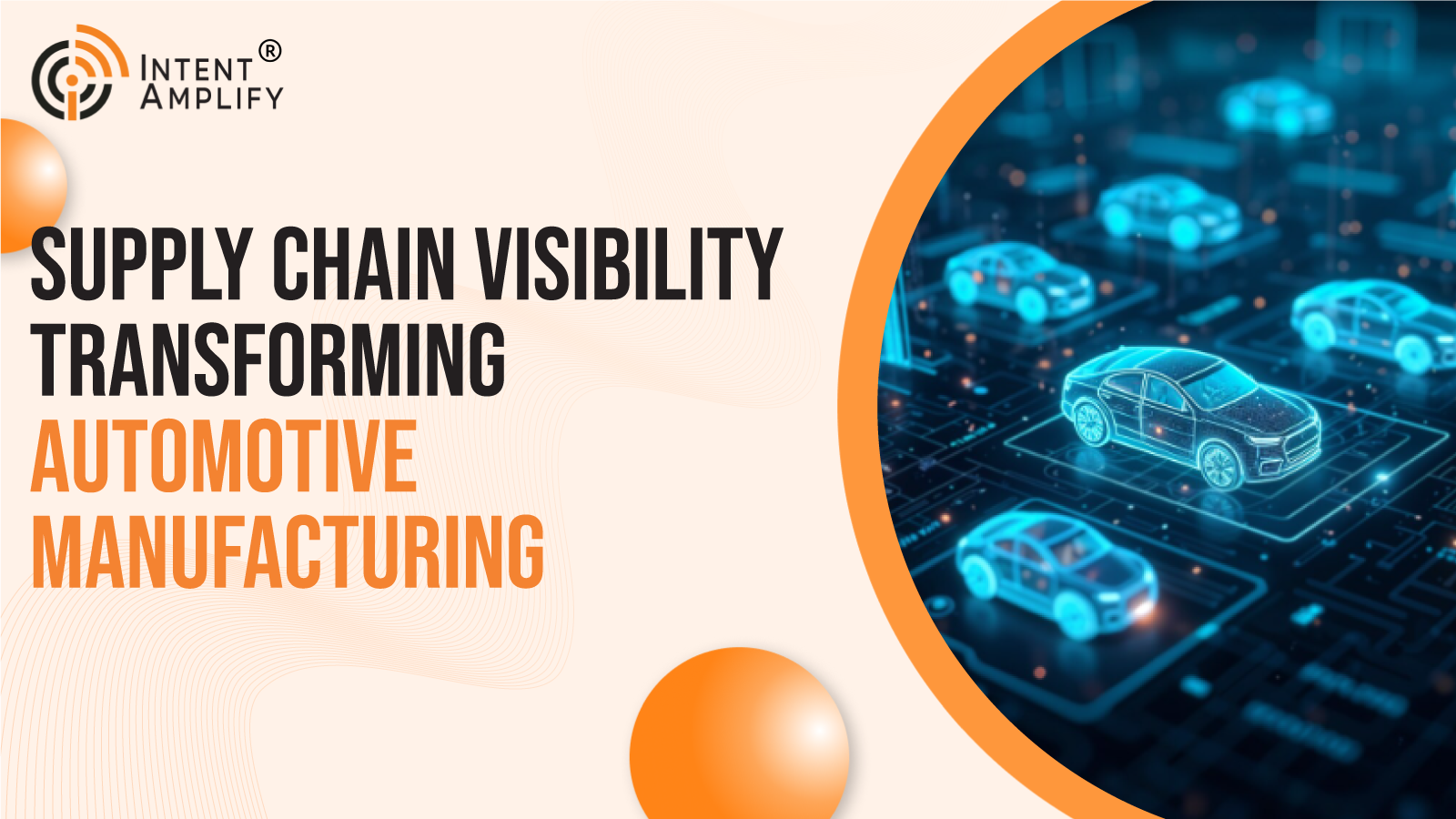
A modern vehicle depends on thousands of parts moving through suppliers, logistics providers, warehouses, sequencing centers, and assembly plants. Yet a single delayed semiconductor, battery input, braking component, or specialized electronic module can disrupt an entire build schedule.
The management challenge is no longer limited to locating materials. Automotive leaders must understand whether each supply event threatens plant throughput, working capital, customer delivery, or revenue, and determine which actions remain available before the disruption reaches production.
At a Glance
- Automotive supply chain visibility is evolving from shipment tracking into a decision capability connecting suppliers, components, stock positions, transportation milestones, plant schedules, and customer commitments.
- Inventory optimization is also moving beyond broad safety-stock increases. Manufacturers are differentiating buffers according to component criticality, replenishment time, sourcing concentration, substitution options, demand volatility, and the financial consequence of a shortage.
- Together, these capabilities help automotive organizations detect exposure earlier, protect throughput, reduce premium freight, and respond without accumulating inventory indiscriminately.
Automotive Supply Networks Face Structural Pressure
Automotive suppliers are operating in a market defined by sustained constraints rather than isolated disruption.
Deloitte reported in July 2026 that approximately 60% of surveyed automotive companies were experiencing increased distress across their North American supply bases. Its Supplier Risk Monitor 2025/2026 also identified six major pressures, including stagnant production volumes, repeated forecast reductions, competitive shifts, electrification pressure, and limited financial resilience among many suppliers.[1]
For chief supply chain officers, the finding changes how supplier exposure should be governed. Financial weakness, capacity limitations, technology transitions, and concentrated upstream dependencies can affect fulfillment well before a delivery is formally missed.
Manufacturers therefore need deeper visibility for the parts that can stop production. The objective is not to map every transaction equally. It is to identify supplier relationships, commodities, tooling dependencies, and logistics corridors carrying the highest operational consequence.
Visibility Must Explain Production Impact
Knowing where a shipment is located is useful. Knowing whether its delay will stop a plant is more valuable.
Decision-ready visibility links a logistics event to the purchase order, part number, bill of material, vehicle program, available stock, assembly schedule, and customer commitment.
For manufacturing leaders, the required capability is consequence-based prioritization. Alerts should show time-to-impact, remaining material coverage, approved substitutes, supplier recovery confidence, affected facilities, and the latest point at which intervention remains practical.
This approach prevents teams from treating every late shipment as equally important. It directs limited planning, procurement, and logistics capacity toward events most likely to affect output.
Inventory Optimization Is Replacing Blanket Stockpiling
The choice between lean operations and resilience is often framed incorrectly.
Holding too little inventory can create line stoppages, emergency transportation, missed customer deliveries, and revenue loss. Holding too much consumes cash, warehouse capacity, and management attention while increasing obsolescence exposure.
Inventory optimization provides a more disciplined answer. A low-cost component with one qualified source and a long replenishment period may require a larger buffer than a high-value part available from several regional suppliers.
IBM recommends assigning criticality to assets and materials so manufacturers can improve stocking decisions while releasing working capital tied up in costly or obsolete maintenance inventory. Better real-time inventory visibility can also reduce blind spots across disconnected enterprise systems.
The executive question should therefore shift from “How much stock do we hold?” to “Where does stock provide measurable continuity?”
For inventory and finance leaders, the decision should account for shortage consequences, lead-time variability, supplier concentration, shelf life, substitution flexibility, service requirements, and total carrying cost.
Real-Time Data Must Lead to Accountable Decisions
Automotive manufacturers already generate data through enterprise resource planning, manufacturing execution, warehouse management, transportation platforms, supplier portals, electronic data interchange, and external risk feeds.
The problem is frequently fragmentation rather than scarcity.
When these sources remain disconnected, planners reconcile conflicting versions of material availability while the decision window narrows. An integrated operating view can reveal that a supplier accepted an order but missed a production milestone, that a shipment will miss its sequencing window, or that current stock cannot support the scheduled build.
Accenture reported in July 2026 that organizations implementing autonomous supply chain capabilities could improve on-time-in-full performance by 5%, reduce cost of goods sold by 4%, shorten order lead times by 27%, and reduce disruption recovery times by approximately 60%. Yet only about 25% of organizations had begun their autonomy journeys, with median maturity across supply chain activities at 16%.[2]
The evidence suggests that technology value depends on governance. Predictive alerts require confidence thresholds, named decision owners, escalation routes, evidence requirements, and approved response actions.
Without those controls, visibility creates more information without producing faster resolution.
Supplier Collaboration Determines Data Credibility
End-to-end supply chain visibility cannot be created from internal systems alone. Suppliers must provide credible information about capacity, production progress, material constraints, quality events, and expected delivery performance.
Programs often underperform when production partners are asked to populate another portal without receiving operational value. A stronger model creates reciprocal benefits: clearer forecasts, earlier schedule-change notifications, consistent exception priorities, and faster resolution of disputed demand signals.
Deloitte reports that only 15% of surveyed organizations had visibility into Tier 2 suppliers and beyond, while only 26% could confidently predict risk within their direct supplier base.[3]
Procurement leaders should therefore establish minimum data requirements for critical sources, define update frequency, and connect non-reporting to commercial and risk governance. Collaboration should extend below Tier 1 where a concentrated sub-supplier, toolmaker, or raw-material provider could interrupt assembly operations.
A Practical Transformation Agenda
Automotive leaders should begin with five actions.
Create a common data foundation. Standardize supplier, component, purchase-order, location, inventory, and vehicle-program identifiers across procurement, logistics, planning, and manufacturing.
Segment components by consequence. Classify materials according to criticality, lead time, sourcing concentration, substitution options, and line-stop exposure.
Connect alerts to business impact. Every significant exception should identify the affected plant, build program, customer commitment, available stock, and decision deadline.
Predefine response authority. Establish who can expedite shipments, reallocate material, modify build sequences, activate alternate sources, or communicate delivery risk.
Measure decision performance. Track shortage avoidance, schedule adherence, inventory turns, premium freight, supplier response time, forecast accuracy, and time from detection to action.
Intent Amplify Automotive Supply Chain Resilience Framework
The Intent Amplify Automotive Supply Chain Resilience Framework organizes transformation around connected disciplines.
Read the eBook.
Read The Complete Guide to Automotive Supply Chain Resilience: Logistics, Risk Management, and Operational Excellence to operationalize supplier governance, logistics continuity, inventory policy, and production recovery.
Download the Automotive Supply Chain Resilience eBook.
The eBook helps automotive leaders operationalize resilience across supplier management, logistics, inventory planning, risk governance, and production continuity.
Intent Amplify Executive Readiness Scorecard
The Intent Amplify Executive Readiness Scorecard evaluates demonstrated capability rather than technology ownership.
It assesses multi-tier supplier visibility, critical-component coverage, inventory segmentation, exception-detection speed, decision authority, alternate sourcing, logistics options, scenario testing, and recovery evidence.
A green rating should mean the organization can identify a consequential shortage, quantify production exposure, determine available inventory, assign ownership, and activate a tested response within the required operating window.
Access the Automotive Supply Chain Resilience 2026 Report
Read Automotive Supply Chain Resilience 2026: Automotive Logistics, Inventory Optimization, and Supply Chain Transformation.
Access the Automotive Supply Chain Resilience 2026 Research Report.
The report helps executives benchmark current maturity, identify execution gaps, and prioritize investments across supply visibility, inventory planning, logistics, supplier coordination, and operational resilience.
Intent Amplify Perspective
Supply chain visibility and inventory optimization are transforming automotive manufacturing because they change the unit of management.
Leaders are no longer managing isolated shipments, stock balances, or supplier transactions. They are managing the relationship between material availability, plant continuity, working capital, and customer delivery.
The strongest organizations will not be those with the most data. They will be those that identify consequential signals, establish trusted information, and coordinate timely decisions across suppliers, logistics partners, plants, procurement, finance, and commercial teams.
From Volume to Resilience
Intent Amplify’s webinar, From Volume to Resilience: How Automotive Supply Chains Are Adapting to a New Market Reality, examines how automotive organizations are responding to supplier pressure, demand uncertainty, inventory complexity, logistics disruption, and changing production requirements.
Participants will learn how to improve network visibility, balance efficiency with resilience, detect supplier and component risk earlier, strengthen logistics coordination, and protect throughput without defaulting to excessive stock.
Register Now
Reserve your seat and explore how automotive leaders are moving from volume-driven supply models toward visible, responsive, and resilient operating networks.
References
- Deloitte, Shifting Gears in the Auto Supply Market: Five Moves to Build Automotive Supply Chain Resilience, July 8, 2026. Available at: https://www.deloitte.com/us/en/industries/consumer/articles/automotive-industry-suppliers-strategies.html
- Accenture, Autonomous Supply Chains as a Cyber Resilience Catalyst, July 8, 2026. Available at: https://www.accenture.com/us-en/blogs/supply-chain/autonomous-supply-chain-cyber-resilience
- Deloitte, Supplier Risk Monitor 2025/2026: Firefighting on Multiple Fronts, June 16, 2026. Available at: https://www.deloitte.com/de/de/Industries/automotive/analysis/supplier-risk-monitor.html