
Executive Overview
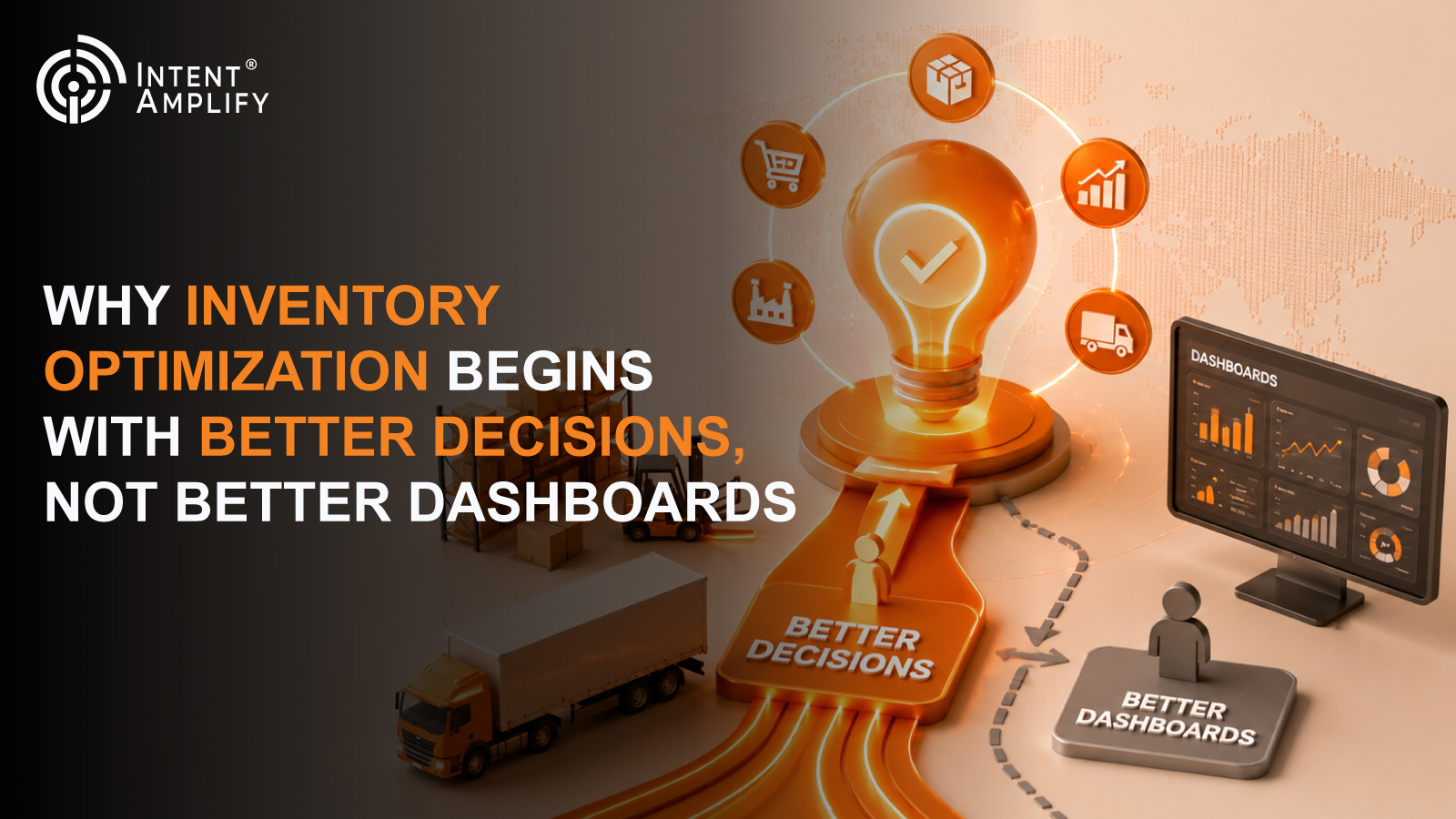
Inventory optimization is frequently approached as a technology initiative. Discussions typically focus on dashboards, data quality, advanced analytics, artificial intelligence, and planning platforms designed to improve supply chain visibility. These capabilities strengthen analytical insight, yet inventory performance ultimately reflects the quality of enterprise decisions rather than the sophistication of planning technology.
Operational visibility identifies inventory above target, slow-moving stock, projected shortages, replenishment gaps, supplier disruption, and coverage risk. Enterprise value depends on interpreting those conditions within their broader business context. Excess inventory may represent strategic protection against supply disruption, regulatory requirements, production timing, customer service commitments, or structural planning inefficiencies. Inventory therefore functions as more than a balance sheet metric. It simultaneously represents service resilience, working capital, regulatory readiness, customer commitments, and supply chain performance.
Bluecrux’s Beyond the Dashboard: Where AI Helps Enterprise Supply Chains and Where It Does Not is built around this exact planning reality. For biotech, pharmacy, pharmaceutical manufacturing, life sciences manufacturing, inventory management, and consumer goods manufacturing leaders, the question is not only whether AI can make supply chain data more visible. The larger question is whether AI can help teams make better, explainable inventory decisions across service, lead time, quality release, working capital, and governance priorities.¹
Inventory optimization is fundamentally a decision-governance capability rather than a dashboard capability. Intent Amplify views inventory performance as the result of judgment, ownership, explainability, and operational accountability. Supply chain organizations require decision intelligence that explains why inventory exists, what business risk it absorbs, who owns the decision, and how AI-supported recommendations should be governed before execution.
Intent Amplify Perspective
Intent Amplify views inventory optimization as a decision-governance discipline, not simply a reporting, dashboard, or AI implementation challenge. Better visibility can show where inventory sits, but sustainable performance depends on whether teams can explain why inventory exists, what it protects, who owns the decision, and how outcomes should be measured after action is taken.
This matters because inventory decisions often sit between planning, finance, manufacturing, quality, procurement, and commercial teams. Stronger inventory performance depends on disciplined decision architecture, explainable AI, workflow ownership, and measurable accountability rather than analytical visibility alone.
1. Intent Amplify Research Desk Observation
Many organizations already know where inventory sits. They can see stock by location, product group, customer segment, or planning horizon. They can track coverage, shortage risk, excess exposure, and the impact on working capital. Yet inventory performance often remains difficult to improve because the business does not agree on what inventory means.
A supply chain planner may see buffer stock as protection against uncertain lead times. Finance may see the same inventory as trapped cash. Commercial teams may see it as service assurance. Quality may view part of the inventory picture through release status and compliance readiness. Manufacturing may see it as the result of campaign efficiency or batch economics.
This is where dashboards reach their limit. They show the number, but they rarely settle the trade-off. Inventory optimization requires a decision model that helps stakeholders understand why inventory is held, what would happen if it were reduced, and which constraints make the recommendation safe or risky.
Organizations rarely struggle because they lack inventory visibility. They struggle because inventory decisions are distributed across planning, finance, manufacturing, quality, procurement, and commercial teams without a unified governance model.
Sustainable inventory performance depends on disciplined decision architecture rather than analytical visibility alone. The strongest organizations will not simply know where inventory sits. They will understand why it exists, what trade-off it reflects, which function owns the decision, and how the outcome should be measured.
2. Key Figures at a Glance
The case for decision-led inventory optimization is stronger when viewed through current enterprise AI adoption data. Microsoft’s 2026 Work Trend Index surveyed 20,000 AI-using workers across 10 countries and analyzed trillions of anonymized Microsoft 365 productivity signals, showing that AI value increasingly depends on how organizations redesign work around people, systems and agents. A privacy-preserving analysis of more than 100,000 Microsoft 365 Copilot chats found that 49% of conversations support cognitive work such as analysis, decision-making, problem-solving, and creative thinking, which closely aligns with inventory planning environments where users need reasoning support rather than another static report.²
Microsoft also found that 66% of AI users say AI allows them to spend more time on high-value work, 58% say they are producing work they could not have produced a year earlier, and 86% treat AI output as a starting point rather than a final answer.²
For inventory planning, those findings point to the right operating model. AI should prepare context, surface trade-offs, and test scenarios, while planners remain responsible for judgment.
Organizational readiness remains uneven. Microsoft reports that only 19% of AI users are in the “Frontier” zone where individual capability and organizational readiness reinforce each other, while organizational factors such as culture, manager support and talent practices account for 67% of reported AI impact compared with 32% for individual mindset and behavior.²
This is highly relevant for supply chain transformation because better inventory outcomes depend on governance, role clarity, and decision ownership, not only on software access.
AWS reports that Bedrock Guardrails can help block up to 88% of harmful content and identify correct model responses with up to 99% accuracy using Automated Reasoning checks.³ Google Cloud lists 1,302 real-world generative AI use cases from leading organizations, showing that AI adoption is moving into practical enterprise workflows.⁴
SAP connects AI to supply chain planning, supplier management, and inventory optimization, while Oracle emphasizes enterprise-grade security, privacy, data management, and governance for generative AI.⁵ ⁶
3. Why Dashboards Do Not Optimize Inventory
Dashboards provide visibility into inventory conditions but do not determine the appropriate operational response. Inventory above target may reflect planning inefficiencies, although it can also represent a deliberate service strategy, regulatory requirement, or resilience objective. Conversely, lean inventory positions may appear efficient while masking exposure created by lead-time variability, supplier performance, quality release constraints, or inaccurate planning assumptions.
Inventory optimization depends on understanding the business context behind operational signals. Similar inventory outcomes can require fundamentally different responses. Demand softening may warrant production adjustment, inventory redeployment, or allocation changes. Quality release constraints require closer coordination between quality and supply planning. Outdated lead-time assumptions call for planning parameter governance rather than additional exception reporting. Enterprise value depends on selecting the operational response that addresses the underlying cause instead of the visible symptom.
Decision intelligence strengthens inventory governance by placing analytical signals within an operational context. Planning teams evaluate the business purpose of inventory, identify the assumptions shaping inventory positions, determine where network imbalances originate, quantify the implications for customer service and working capital, and establish the appropriate decision authority before execution. Inventory optimization consequently evolves from exception reporting into governed operational execution.
4. Inventory Optimization Starts with an Explanation
A better inventory decision begins with a clear explanation of cause and consequence. Planners need to know whether stock is driven by demand variability, supplier unreliability, production batch size, quality release timing, forecast error, service policy, or planning parameter drift.
AI decision support can help by connecting these factors into a decision view. Instead of showing only how much stock exists, it can explain why the stock is there and what trade-offs would emerge if the business acted differently. This is especially valuable for life sciences and pharmaceutical supply chains, where inventory may be tied to regulated release steps, expiry risk, product criticality, and patient access expectations.
The strongest inventory optimization programs do not begin by asking teams to cut stock. They begin by asking which inventory is doing useful work and which inventory is covering up weak planning logic.
Table 1: Inventory Types and Decision Meaning
|
Inventory Signal |
Possible Meaning |
Better Decision Question |
|
High stock |
Service protection, forecast error, or release uncertainty |
Is this inventory protecting availability or hiding planning weakness? |
|
Low stock |
Efficiency or future shortage risk |
Is the business exposed if demand or lead time shifts? |
|
Slow-moving stock |
Obsolescence, market shift, or poor allocation |
Can stock be redeployed before value erodes? |
|
Safety stock growth |
Real volatility or outdated parameters |
Are buffers based on current operational behavior? |
|
Cash-heavy inventory |
Working capital burden or resilience investment |
Can cash be released without harming service? |
5. Quality Release Changes the Inventory Picture
Quality release management directly influences inventory optimization because not every physically existing unit is available for planning. A batch may be manufactured, stored, and visible in the system, yet remain unavailable until quality release is complete. If a dashboard treats that stock as usable supply too early, planners may overestimate coverage and make poor allocation decisions.
In pharmaceutical and biotech environments, this can create a dangerous gap between apparent inventory and usable inventory. It can also cause teams to carry additional buffers without fully understanding why. If release timing is variable, planners may compensate with more stock, finance may question the working capital burden, and quality teams may not see the downstream planning effect quickly enough.
Explainable AI can help connect release status with supply availability, customer commitments, and replenishment actions. It can show where release delays affect service, where buffers are compensating for uncertainty, and which planning assumptions need review.
Inventory optimization becomes more credible when quality release is treated as part of the inventory decision, not a separate compliance workflow.
6. Lead Time Assumptions: Decide How Much Inventory Feels Necessary
Lead time optimization is tightly linked to inventory performance. When lead times are stable and predictable, planners can hold leaner buffers with greater confidence. When lead times vary across suppliers, lanes, sites, product groups, or release steps, the business often carries extra inventory because it does not trust replenishment timing.
The problem is that planning systems may continue using standard lead times long after real operating behavior has changed. A supplier may become less reliable. A transportation lane may face seasonal disruption. A manufacturing sequence may vary by campaign. A release process may introduce variability that the system does not fully capture.
AI can compare planned lead times with actual outcomes and identify where assumptions no longer reflect operational truth. This creates a better foundation for inventory optimization because the business can reduce buffers only where replenishment confidence is real.
A dashboard may show that inventory is too high. Decision intelligence helps determine whether the issue is inventory policy or lead time uncertainty.
7. Working Capital Improvement Needs Inventory Context
Working Capital Optimization often begins with pressure to reduce inventory, but the wrong reduction can create more business risk than value. If a company cuts stock that protects critical products, high-service markets, or uncertain release cycles, the balance sheet may look better for a period while supply resilience weakens.
Decision intelligence gives finance and supply chain teams a better way to work together. It can identify where inventory is financially material, where stock is mispositioned, where buffers are justified, and where cash can be released safely. It can also show when inventory is not the root problem, because the real issue may be poor demand sensing, outdated lead times, or uncoordinated quality release planning.
This matters for consumer goods manufacturers as well. Inventory may look excessive when viewed through finance alone, yet the same stock may be protecting promotion execution, channel commitments, or customer service. Better decisions come from understanding the purpose of the stock before acting on the number.
AWS’s cost and performance guidance for generative AI provides a useful enterprise technology analogy. AWS notes that model distillation can support faster and lower-cost execution, while intelligent prompt routing can reduce cost while maintaining quality.³ The same discipline should apply to supply chain transformation: optimize what creates unnecessary cost, but protect what preserves performance.
8. Digital Twins Help Planners Test Inventory Decisions Before They Commit
A Digital Twin Supply Chain can improve inventory optimization by allowing planners to test scenarios before changing policies in the live network. This matters because inventory decisions create effects across multiple functions. Reducing stock may improve working capital, but it may also affect service. Increasing buffers may protect availability, but it may raise expiry and cash exposure. Changing allocation may solve one market issue while creating another.
Digital twins help teams compare options using a shared view of the network. A planner can test what happens if demand shifts, if lead time increases, if release is delayed, or if safety stock rules change. The value is not only the simulation itself. The value is the conversation the simulation enables across supply chain, finance, quality, commercial, and manufacturing teams.
Google Cloud’s catalog of 1,302 real-world generative AI use cases shows that enterprise AI is expanding across practical workflows, but the lesson for inventory leaders is to avoid use case imitation.⁴
The better move is to start with the inventory decisions that create the highest friction, then apply AI and scenario modeling where better trade-off visibility changes the outcome.
9. Governance Makes Inventory Decisions Defensible
Supply Chain Governance determines whether inventory optimization recommendations are trusted, challenged, or ignored. If AI recommends reducing a buffer, who approves the change? If a model identifies excess inventory, which assumptions are visible to planners? If quality release timing changes the supply picture, which team owns the escalation? If a working capital target conflicts with service risk, how is the decision resolved?
These questions matter because inventory decisions often sit between functions. Supply chain may own the plan, finance may own the cash target, quality may own release readiness, and commercial teams may own the customer promise. Without governance, AI recommendations can trigger debate rather than action.
Microsoft’s research found that organizational factors account for 67% of reported AI impact, which reinforces that AI success depends on the environment around the tool.² Oracle’s generative AI positioning also emphasizes security, privacy, data management and governance across enterprise AI environments.⁶
SAP adds the business-process perspective by connecting AI to functions such as supply chain planning and inventory optimization.⁵
For inventory optimization, governance is the trust layer. It makes clear which decisions AI can recommend, which ones humans must approve, and how outcomes should be reviewed.
Table 2: Governance Questions for Inventory Optimization
|
Governance Area |
Question Leaders Should Resolve |
|
Decision ownership |
Who approves changes to inventory policy or allocation? |
|
Data authority |
Which systems define usable inventory and planning assumptions? |
|
Quality dependency |
How is release status reflected in available supply? |
|
Working capital trade-off |
How are service and cash priorities balanced? |
|
Outcome review |
How are decisions measured after execution? |
10. Intent Amplify Enterprise Inventory Decision Intelligence Framework™
Intent Amplify recommends that inventory optimization be managed through an enterprise decision intelligence framework. The goal is not only to improve dashboards or deploy AI decision support. The goal is to connect decision context, inventory governance, explainable AI, workflow ownership, and outcome measurement into one practical operating model.
This framework helps supply chain, finance, quality, manufacturing, procurement, and commercial teams understand why inventory exists, which business risk it protects, where working capital can be released safely, and when AI-supported recommendations require human review.
|
Framework Pillar |
What It Means |
|
Decision Context |
Teams should understand why inventory exists, what risk it absorbs, and which trade-offs shape the decision. |
|
Inventory Governance |
Inventory decisions should be governed across planning, finance, quality, manufacturing, procurement, and commercial teams. |
|
Explainable AI |
AI recommendations should show assumptions, constraints, scenarios, confidence levels, and decision rationale. |
|
Workflow Ownership |
Each major inventory decision should have a clear owner, approval path, escalation route, and review process. |
|
Outcome Measurement |
Decisions should be measured after execution across service, cash, expiry, lead time, availability, and working capital. |
Microsoft’s 2026 Work Trend Index shows why manager behavior matters in AI adoption. When managers actively modeled AI use, employees reported a 17-point lift in AI value, a 22-point lift in critical thinking about AI use, and a 30-point lift in trust in agentic AI.²
This is relevant for inventory teams because planners need leadership support to change how decisions are made, not only access to new tools.
Flowchart: Inventory Decision Intelligence Roadmap
Identify high-friction inventory decisions.
↓
Map data, assumptions, quality dependencies, and ownership
↓
Deploy explainable AI decision support.
↓
Test inventory scenarios before policy changes.
↓
Measure service, cash, expiry, lead time, and availability outcomes
↓
Scale decision intelligence across connected planning workflows
What Bluecrux Brings to the Conversation
Bluecrux is positioned for this conversation because the campaign challenges the dashboard-first mindset that has shaped many supply chain transformation programs. Better visibility is helpful, but it does not automatically improve inventory decisions. The larger opportunity is to connect visibility with explainable AI, decision ownership, and practical supply chain governance.
For biotech, pharmaceutical, and life sciences manufacturing leaders, the value lies in understanding inventory through the lens of product availability, quality release, lead time variability, and patient or market service needs. For consumer goods manufacturers, the opportunity is to balance promotion readiness, channel service, and cash efficiency without relying on blunt inventory targets. For supply chain executives, the strategic benefit is a planning model that helps teams defend decisions rather than merely observe exceptions.
Inventory optimization begins when the business understands why stock exists, what it protects, and how decisions should change when conditions shift.
Assess Your Enterprise Inventory Decision Intelligence Maturity
Bluecrux’s whitepaper, Beyond the Dashboard: Where AI Helps Enterprise Supply Chains and Where It Does Not, helps enterprise supply chain leaders understand why inventory optimization requires more than visibility. The next step is to evaluate whether inventory decisions are explainable, governed, measurable, and connected to business outcomes.
Through an Enterprise Inventory Decision Intelligence Assessment, leaders can evaluate inventory governance maturity, planning ownership, AI decision support, quality-release integration, lead-time governance, working-capital optimization, and operational decision maturity.
Assessment areas include:
- Inventory Governance Review
- Planning Ownership and Decision Rights Assessment
- Explainable AI and Scenario Planning Review
- Quality Release and Lead-Time Governance Review
- Working Capital and Service Trade-Off Assessment
Download the whitepaper as a starting point for a structured decision-intelligence conversation.
About Intent Amplify
Intent Amplify helps organizations move from market insight to measurable growth through GTM strategy, demand intelligence, pipeline activation, executive roundtables, sponsored research, targeted content, webinars, panels, vendor intelligence, and strategic consulting. For teams that need sharper positioning, stronger executive engagement, and more effective activation, Intent Amplify connects strategy, content, and market intelligence into a practical growth engine.
Conclusion
Inventory optimization does not begin with another dashboard. It begins with the quality of the decisions that supply chain teams make when service, cash, quality release, lead time, and operational reality conflict. Dashboards can show the signal, but decision intelligence explains its meaning.
For biotech, pharmaceutical, life sciences, and consumer goods supply chains, this distinction matters because inventory is never just a number. It represents availability, resilience, cash, compliance dependency, and customer commitment. The organizations that improve inventory performance will not be the ones with the most dashboards. They will be the ones that build stronger decision models, where trusted data improves context, AI explains trade-offs, humans retain judgment, and governance makes every inventory action easier to defend.
References
- Bluecrux and IntentTechPub (2026) Beyond the Dashboard: Where AI Helps Enterprise Supply Chains and Where It Does Not. Available at: https://intenttechpub.com/whitepaper/beyond-the-dashboard-where-ai-helps-enterprise-supply-chains-and-where-it-doesnt/
- Microsoft (2026) 2026 Work Trend Index: Agents, Human Agency, and the Opportunity for Every Organization. Available at: https://www.microsoft.com/en-us/worklab/work-trend-index/agents-human-agency-and-the-opportunity-for-every-organization
- Amazon Web Services (2026) Amazon Bedrock: Build Generative AI Applications and Agents at Production Scale. Available at:https://aws.amazon.com/bedrock/guardrails/
- Google Cloud (2026) 1,302 Real-World Gen AI Use Cases from the World’s Leading Organizations. Available at: https://cloud.google.com/transform/101-real-world-generative-ai-use-cases-from-industry-leaders
- SAP (2026) Joule Business AI Solutions. Available at: https://www.sap.com/products/artificial-intelligence.html
- Oracle (2026) Generative AI Capabilities. Available at: https://www.oracle.com/artificial-intelligence/generative-ai/
- IBM Institute for Business Value (2026) The Enterprise in 2030. Available at: https://www.ibm.com/thought-leadership/institute-business-value/report/enterprise-2030