
logo
logo
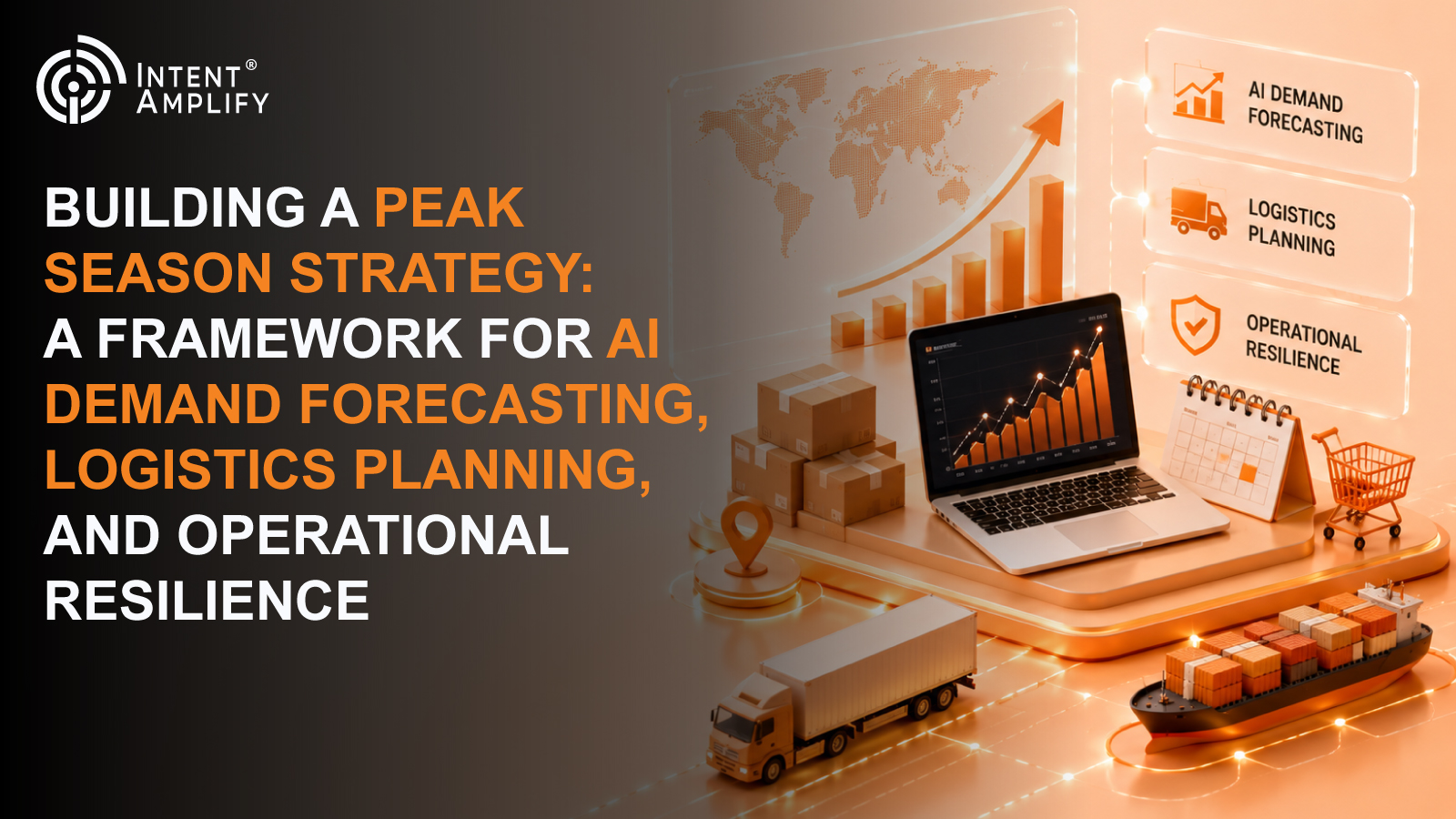
Building a Peak Season Strategy: A Framework for AI Demand Forecasting, Logistics Planning, and Operational Resilience

WHITEPAPER

Building a Peak Season Strategy: A Framework for AI Demand Forecasting, Logistics Planning, and Operational Resilience

Learn how AI demand forecasting, logistics planning, and operational resilience help enterprises build a smarter peak season strategy, improve forecast accuracy, optimize inventory, and strengthen supply chain performance.

Executive Summary

Peak season has become a test of enterprise decision quality. For consumer goods, media, automotive, and healthcare organizations, the pressure no longer comes only from higher order volume. It comes from demand volatility, freight uncertainty, supplier fragility, labor constraints, inventory imbalance, and customer expectations that leave little tolerance for late correction.

The evidence points to a more demanding 2026 planning environment. Gartner predicts that 70% of large organizations will adopt AI-based supply chain forecasting by 2030, which indicates that AI demand forecasting is moving from experimentation into core planning architecture. [1]

Yet adoption alone does not create resilience. PwC's 2025 operations survey found that 92% of operations and supply chain leaders say technology investments have not fully delivered expected results, while 91% expect to significantly change supply chain strategies because of U.S. trade policy changes. The gap is not mainly about access to tools. It is about whether organizations can turn data, forecasts, and scenarios into governed operational decisions. [2]

This whitepaper presents a practical peak season strategy for senior leaders across operations, IT, engineering, fulfillment, inventory, logistics, supply chain, transportation, and warehouse functions. Peak season performance in 2026 will depend less on static forecasts and more on decision readiness. Organizations that detect demand shifts earlier, expose constraints before they break, and adjust transportation plans before capacity tightens will be better positioned to protect revenue, service levels, margin, and continuity.

Why Peak Season Planning Has Become an Enterprise Risk Discipline

Peak season planning used to be treated as a compressed logistics exercise. Demand planners produced projections. Inventory teams built buffers. Transportation teams secured capacity. Warehouse leaders planned labor. Customer service absorbed exceptions. That model worked when volatility was contained enough for each function to optimize its own part of the chain.

That assumption is now weak.

In consumer goods and services, demand can shift because of pricing, promotion timing, marketplace behavior, and regional affordability. In media and entertainment, release windows, live events, fan merchandise, and subscription campaigns can create sharp demand bursts with limited historical comparability. Automotive organizations must plan around aftermarket demand, service parts, dealer networks, and component availability. Healthcare supply chains face a stricter operating standard because stockouts can affect continuity of care and service commitments.

The National Retail Federation forecast that 2025 U.S. holiday retail sales would rise 3.7% to 4.2% and reach $1.01 trillion to $1.02 trillion, crossing the trillion-dollar mark for the first time.[3]

That volume creates commercial opportunity, but it also raises the cost of weak planning. When buyers are more selective, the financial penalty is not distributed evenly. A missed replenishment cycle, late inbound shipment, or unreliable delivery promise can move demand to a competing channel.

Parcel pressure shows the same pattern. ShipMatrix estimated that 2.3 billion packages would be delivered during the 2025 peak season, a 5% increase over 2024. A 5% increase may appear manageable at the aggregate level. In practice, the risk sits in local constraints: parcel zones, carrier pickup limits, warehouse cutoffs, regional weather, labor availability, and service-class congestion. Peak season logistics usually fail in the details. [4]

Peak season planning cannot remain a seasonal checklist. It must become a repeatable operating discipline that links demand sensing, planning assumptions, logistics capacity, inventory exposure, and executive escalation.

Market Signals Shaping Supply Chain Trends 2026

The first force is consumer selectivity. Buyers are still spending, but they are more sensitive to price, availability, and delivery confidence. That makes demand forecasting harder because historical sales curves may not reflect current channel behavior or promotional elasticity. Forecast accuracy can improve at the aggregate level while still missing demand at the SKU, region, channel, or fulfillment-node level.

The second force is trade and sourcing uncertainty. PwC's finding that 91% of operations and supply chain leaders expect major strategy changes because of U.S. trade policy shifts is especially relevant for companies with cross-border supply dependencies across the U.S., Canada, and Europe. Tariffs, customs friction, regional sourcing shifts, and supplier concentration can all alter the cost and timing assumptions behind peak season plans. [2]

The third force is procurement and inventory anxiety. Deloitte's 2025 Retail Holiday Buyer Survey found that 78% of retail buyers were concerned about securing adequate inventory, while 76% were worried about supplier reliability because of geopolitical tensions. Although the survey focuses on retail buyers, the operating lesson applies across industries. Peak season risk begins upstream. If supplier reliability, inbound logistics, and inventory availability are not visible early, the downstream organization is left paying for exceptions. [5]

The fourth force is capability pressure. Gartner reported that demand for supply chain roles requiring AI skills increased 387% between Q1 2023 and Q1 2026, based on analysis of more than 35 million job postings and nearly 600,000 supply chain roles. The same release noted that 58% of supply chain roles requiring AI skills are concentrated at the mid-senior level. AI forecasting for peak season planning is, therefore, also a workforce design issue. [6]

Why AI Forecasting Must Be Connected to Execution

AI demand forecasting can improve supply chain forecasting by detecting patterns that manual planning cycles often miss. It can process demand history, order behavior, promotions, external market signals, product launches, weather, freight indicators, and event calendars at a level of granularity that traditional planning teams struggle to maintain manually.

A forecast becomes operationally valuable only when it changes a decision. That decision may involve inventory allocation, supplier follow-up, warehouse labor, transportation capacity, customer promise logic, or expedited freight approval. If the forecast remains inside the planning team's reporting environment, it may improve visibility without improving resilience.

A mature peak season planning architecture should connect five layers.

Layer

Role in Peak Season Readiness

Signal

Captures demand history, orders, promotions, weather, freight conditions, supplier updates, and customer service demand.

Forecasting

Uses AI demand forecasting, causal modeling, exception detection, probabilistic forecasts, and demand sensing to create plausible scenarios.

Constraint

Maps inventory availability, labor limits, warehouse throughput, carrier commitments, supplier lead times, compliance obligations, and service-level rules.

Scenario

Tests demand upside, inbound delays, carrier underperformance, lane constraints, warehouse bottlenecks, and inventory imbalance.

Decision

Defines actions such as inventory transfer, carrier activation, promise adjustment, expedited freight approval, customer communication, or escalation.

This structure matters because operational resilience is not created by better dashboards alone. The World Bank's Global Supply Chain Stress Index measures the magnitude of container shipping disruptions affecting global supply chains, reflecting the need to track disruption as an ongoing planning input rather than a rare exception. [7]

The U.S. Bureau of Transportation Statistics also maintains freight indicators across port data, freight movement, labor, and capacity tightness, reinforcing the value of timely transportation signals. [8]

Solution Framework: A Peak Season Strategy for 2026 Readiness

1. Build the Demand Intelligence Baseline

The first step is to clarify which demand signals matter by industry, region, and fulfillment model. Consumer goods teams may prioritize sell-through, promotions, retailer inventory, and regional affordability. Media and entertainment companies may focus on release schedules, event calendars, campaign timing, and merchandise drops. Automotive teams need installed-base data, parts consumption, service cycles, and component availability. Healthcare organizations must weigh forecast demand against patient criticality, cold-chain constraints, and continuity obligations.

The baseline should also separate true demand from distorted demand. Customers may order early because they fear shortages, split orders across channels, or over-order when availability appears uncertain. AI forecasting for peak season logistics should detect these behaviors instead of treating every order spike as stable demand.

2. Use Scenario Planning to Test the Operating Model

Scenario planning should be specific enough to support action. It should not stop at "high," "medium," and "low" demand cases. Leaders should test operational questions.

What happens if a high-velocity SKU exceeds plan by 18% in two regions? Which warehouse reaches capacity first? Which carrier lanes become exposed? What inventory can be repositioned without creating service risk elsewhere? Which healthcare or automotive orders require priority allocation?

AI scenario planning for logistics is most useful when it links probability, impact, and decision thresholds. A scenario should identify what must happen, who owns the response, when escalation begins, and what business outcome is protected.

3. Redesign Inventory Planning Around Risk Segmentation

Inventory planning for peak season should not mean simply carrying more stock. Excess inventory can protect service levels, but it can also increase working capital pressure, warehouse congestion, obsolescence, and post-peak imbalance.

A stronger model segments inventory by risk and business value. Some inventory protects revenue because demand is time-sensitive. Some protects service because substitution is limited. Some protect compliance or continuity because failure has a higher consequence. Other inventory only reflects weak planning confidence.

AI inventory optimization strategies should help leaders distinguish between these categories. In healthcare, criticality and service continuity may outweigh pure cost optimization. In automotive, a low-volume part can still carry high service importance. In consumer goods and media, timing determines whether inventory creates revenue or becomes trapped after peak.

4. Convert Logistics Planning Into Logistics Risk Management

Logistics planning for peak season must move beyond capacity booking. It should evaluate transportation risk across capacity, cost, service, and continuity.

Capacity risk asks whether shipments can move. Cost risk asks whether they can move within margin thresholds. Service risk asks whether delivery promises remain credible. Continuity risk asks whether operations can sustain performance if a carrier, lane, facility, technology platform, or cross-border process fails.

This is where geography matters. In the U.S. and Canada, leaders may need closer monitoring of parcel zones, truckload capacity, rail reliability, border crossings, and weather exposure. In Europe, peak season logistics must also account for cross-border complexity, urban delivery restrictions, labor rules, customs processes, and sustainability requirements.

5. Define Decision Rights Before Peak Pressure Begins

Many organizations increase meeting frequency during peak season but still make slow decisions. The issue is not communication volume. It is decision ambiguity.

A resilient operating model defines triggers in advance. When should secondary carriers be activated? When should delivery promises change? When should inventory be transferred between facilities? When should expedited freight be approved? When should finance review margin exposure? When should customer teams communicate availability risks?

These thresholds should be visible before the season begins. They should also be owned by named leaders across the supply chain, IT, operations, finance, logistics, fulfillment, and product. Without ownership, AI-powered supply chain decision-making becomes another advisory layer rather than an operating capability.

Pressure-Test Your Peak 2026 Assumptions

Peak season planning is becoming harder because shippers, analysts, and AI models do not always agree on what comes next. That disagreement is useful because it forces leaders to test assumptions before capacity tightens, costs rise, and customer commitments become harder to protect.

The upcoming webinar examines what logistics professionals, industry analysts, and AI-generated forecasts are predicting for Peak 2026, with practical implications for peak planning, freight capacity, AI forecasting, and operational readiness.

Reserve your seat for "Peak Reality Check: What Shippers, Analysts, and AI Models Are Predicting for 2026"

Expected Benefits: What Better Peak Season Planning Actually Improves

A stronger peak season strategy improves four outcomes. The business case is strongest when leaders can show how earlier decisions protect service, reduce margin leakage, and prevent avoidable operational escalation.

First, it improves demand-to-supply alignment. When AI demand forecasting is connected to inventory, supplier visibility, warehouse capacity, and transportation planning, teams can respond earlier to demand shifts and reduce the gap between plan and execution.

Second, it improves cost control. Peak periods often create a false choice between service and margin. Better freight management and transportation management make the trade-off explicit. Leaders can decide where premium freight protects revenue, where consolidation is acceptable, and where delivery promises should be adjusted before cost leakage becomes unavoidable.

Third, it improves business continuity. Operational resilience is not the absence of disruption. It is the ability to absorb disruption without losing control of service, cost, compliance, or decision quality. That is especially important for healthcare and automotive supply chains, where late or unavailable products can carry consequences beyond lost sales.

Fourth, it improves executive visibility. Senior leaders do not need more status reporting. They need decision-ready views of revenue at risk, margin exposure, service-level risk, inventory imbalance, and customer commitment exposure. Supply chain analytics should translate operational signals into business implications.

Recommendations for a 2026-Ready Peak Season Operating Model

Forecast quality should be evaluated at the level where operational decisions are made rather than through aggregate demand alone. SKU, region, channel, customer segment, warehouse, transportation lane, and service class each influence execution differently. Performance measurement should incorporate forecast bias, demand-spike accuracy, exception response time, and the business impact of forecast variance.

AI contributes greatest value when it strengthens operational judgment within established governance. Anomaly detection, risk identification, inventory recommendations, and scenario analysis accelerate planning, while decision ownership remains responsible for validating assumptions, balancing service, cost, and risk, and approving material trade-offs.

Peak season governance benefits from a cross-functional command structure that includes supply chain, logistics, IT, fulfillment, inventory, finance, product leadership, and executive sponsorship. Decision authority should extend beyond operational monitoring to carrier activation, freight exceptions, customer commitments, and inventory prioritization when predefined thresholds are exceeded.

Reliable forecasting depends on disciplined data management before peak season execution begins. Product hierarchies, location master data, inventory records, lead-time assumptions, carrier performance, supplier information, and exception codes require validation because operational decisions deteriorate when planning relies on inconsistent data.

Workforce capability has become an operational resilience requirement. Rising demand for AI-enabled supply chain talent reinforces the importance of developing planners, logistics managers, operations leaders, engineers, and analysts who can interpret model outputs, challenge assumptions, and convert analytical recommendations into disciplined execution.

Conclusion: Peak Season Readiness Is Now a Decision Capability

The next peak cycle will test more than logistics capacity. It will test how quickly organizations can interpret demand signals, expose constraints, make trade-offs, and act before disruption reaches the customer.

AI demand forecasting, predictive analytics, inventory optimization, and logistics planning each strengthen a different aspect of supply chain execution. Enterprise resilience emerges when these capabilities operate within clear decision rights, disciplined operating cadence, and defined accountability rather than as isolated technology initiatives.

For operations, IT, fulfillment, inventory, logistics, transportation, warehouse, and supply chain leaders, peak season preparation depends on treating uncertainty as a core planning assumption. High-performing organizations distinguish themselves through disciplined forecasting, realistic planning assumptions, and the ability to adapt quickly as operating conditions evolve.

Turn Peak Season Complexity Into a Demand-Generation Opportunity

Peak season planning is now a board-level operations conversation, not just a logistics calendar event. Senior buyers are looking for practical guidance on AI forecasting, freight capacity, inventory exposure, resilience planning, and decision readiness before disruption affects service levels or margin.

Intent Amplify helps B2B supply chain, logistics, and technology brands translate these complex themes into campaign-ready thought leadership and buyer engagement programs.

  • Through content strategy, we shape the narrative around market urgency and executive priorities.
  • With our webinar promotion and lead generation, we help connect that narrative to qualified audiences actively evaluating planning, logistics, fulfillment, and resilience solutions.
  • Our content syndication and demand generation services extend the reach of whitepapers, webinars, and analyst-led assets to decision-makers across operations, IT, supply chain, transportation, and fulfillment roles.

Build a targeted supply chain demand-generation program with Intent Amplify

References

  1. Gartner (2025) Gartner Predicts 70% of Large Organizations Will Adopt AI-Based Supply Chain Forecasting to Predict Future Demand by 2030. Available at: https://www.gartner.com/en/newsroom/press-releases/2025-09-16-gartner-predicts-70-percent-of-large-orgs-will-adopt-ai-based-supply-chain-forecasting-to-predict-future-demand-by-2030.
  2. PwC (2025) PwC's 2025 Digital Trends in Operations Survey. Available at: https://www.pwc.com/us/en/services/consulting/supply-chain-operations/digital-supply-chain-survey.html.
  3. National Retail Federation (2025) NRF Expects Holiday Sales to Surpass $1 Trillion for the First Time in 2025. Available at: https://nrf.com/media-center/press-releases/nrf-expects-holiday-sales-to-surpass-1-trillion-for-the-first-time-in-2025.
  4. Supply Chain Dive (2025) FedEx, Amazon Slated for 2025 Holiday Volume Gains: ShipMatrix. Available at: https://www.supplychaindive.com/news/2025-holiday-delivery-projections-fedex-ups-usps-amazon/802669/.
  5. Deloitte (2025) Retail Holiday Buying Strategies. Available at: https://www.deloitte.com/us/en/insights/industry/retail-distribution/holiday-retail-buyers-survey-strategies.html.
  6. Gartner (2026) Gartner Says There Is an Outsized Need for AI Talent in Supply Chain. Available at: https://www.gartner.com/en/newsroom/press-releases/2026-06-15-gartner-says-there-is-an-outsized-need-for-ai-talent-in-supply-chain.
  7. World Bank (2025) Global Supply Chain Stress Index. Available at: https://www.worldbank.org/en/data/interactive/2025/04/08/global-supply-chain-stress-index.
  8. Bureau of Transportation Statistics (2026) Latest Supply Chain and Freight Indicators. Available at: https://www.bts.gov/freight-indicators.
Prabhanshi   Singh

Prabhanshi Singh

Research Analyst

Let connect with us

AI Demand Forecasting for Peak Season Strategy & Resilience