
Executive Summary
Supply chain leaders have spent years improving visibility, forecasting, planning, and execution inside individual functions. The next constraint is not another shortage of dashboards. It is the distance between a signal and a coordinated enterprise decision. A demand change may be visible to planning while procurement still works from a prior assumption, logistics responds to a different priority, and manufacturing protects a local service target. Each function can be digitally capable while the end-to-end system remains slow.
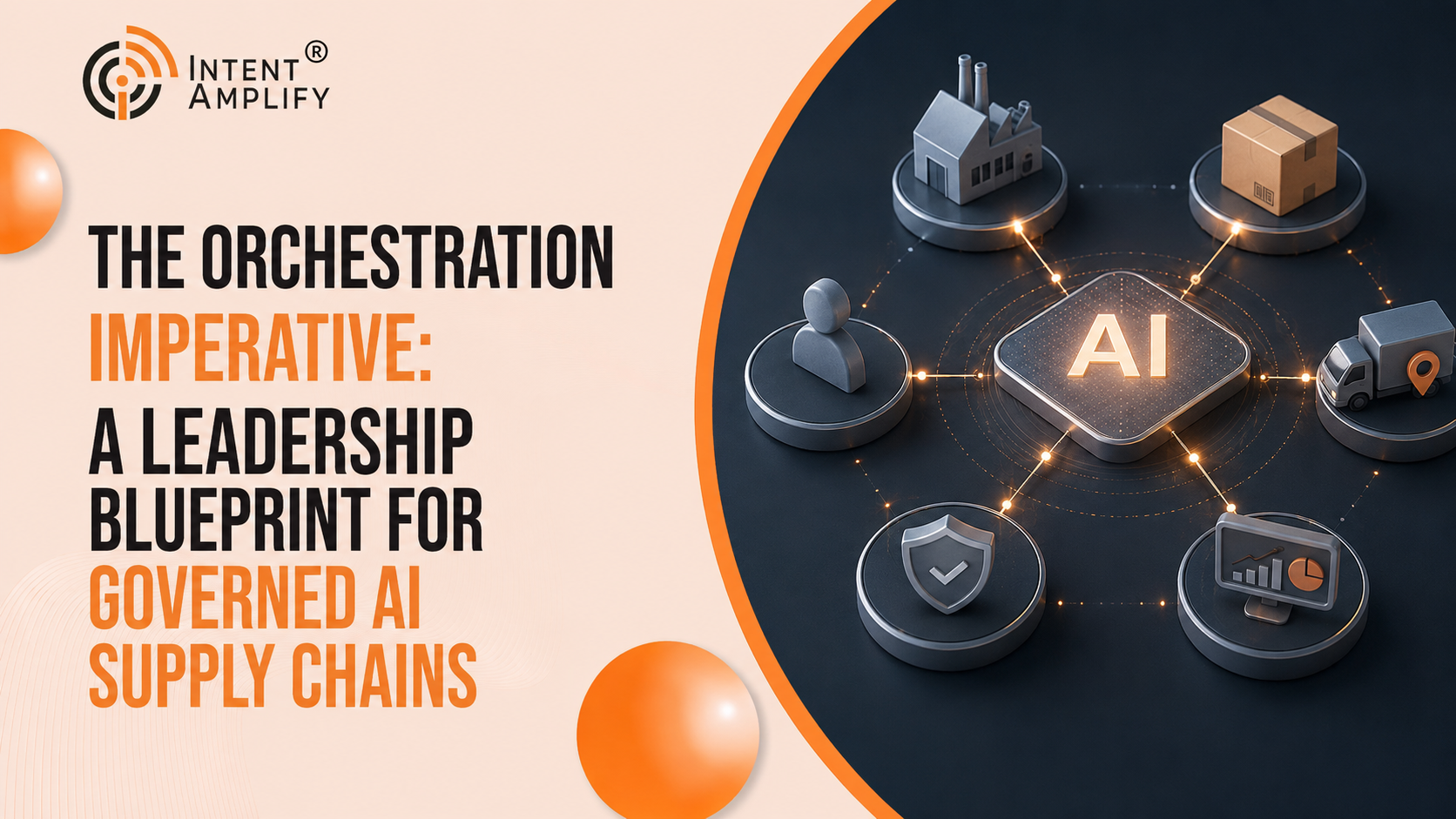
That is why supply chain orchestration is becoming a more useful executive frame than isolated automation. Orchestration connects data, decisions, workflows, people,e and systems around an outcome. AI can strengthen that model by interpreting signals, proposing actions, coordinating exceptions, and, where governance permits, initiating bounded execution. The opportunity is not to remove people from supply chain management. It is to redesign which decisions require human judgment, which can be prepared by AI, which can be automated, and which should never be delegated without explicit controls.
This distinction matters as enterprises evaluate agentic AI in supply chain operations. Generative AI primarily helps create or interpret content. Agentic approaches add goal-directed action, tool use, and multi-step coordination. In supply chain environments, those capabilities touch material decisions: changing a replenishment recommendation, prioritizing an order, escalating a supplier risk, rerouting a shipment, or initiating a workflow. The value can be significant, but so can the cost of weak data, unclear authority,y or poorly designed controls.
The leadership agenda therefore shifts from “Where can we add AI?” to “Which decisions should be orchestrated, with what evidence, authority, and accountability?” This white paper provides a practical operating model for answering that question.
The Real Problem Is Decision Fragmentation
Most supply chains do not lack software. They lack synchronized decision logic. Planning, procurement, manufacturing, logistics inventoryr,y and customer operations often run on different cadences, metrics,cs and exception thresholds. A planning team may optimize forecast accuracy, a logistics team may optimize transport cost, and a procurement team may optimize purchase economics. Those objectives are individually rational but can conflict when a disruption requires a cross-functional response.
The traditional response has been integration: connect systems, centralize data, and build dashboards. Integration is necessary, but it does not by itself establish who decides, when a decision is triggered, which trade-offs matter, or how execution should follow. A connected system can still produce disconnected behavior.
Orchestration starts at the decision. Leaders define an outcome, the signals that matter, the decision rights, the permissible actions, and the escalation path. Technology then supports that operating model. This is the inverse of deploying a tool and hoping the process reorganizes around it.
Consider a supplier delay. A visibility platform may identify the delay. A planning system may calculate inventory exposure. A transportation system may identify expedited options. A procurement platform may expose alternate suppliers. Yet the enterprise still needs a decision: absorb the delay, reallocate stock, expedite, substitute, renegotiate, or change customer commitments. The decision depends on service, margin, inventory, risk, contractual and operational constraints. Orchestration brings those inputs into one governed flow.
Executive insight: the unit of transformation should be the decision, not the application. Applications remain important, but the value case becomes clearer when leaders measure how quickly and reliably the enterprise moves from signal to decision to action.
From Automation to Autonomous Supply Chain Management
Automation and autonomy are related but not identical. Automation executes predefined steps when predefined conditions occur. Autonomy introduces a system that can interpret context, select among possible actions,s and pursue an objective within constraints. In practice, enterprises will operate on a continuum rather than switch from manual to autonomous overnight.
A useful four-level model is:
Level 1 – Human-led visibility. Systems surface data and alerts; people interpret and act.
Level 2 – AI-assisted decisions. AI summarizes context, predicts likely outcomes,es or recommends options; people approve actions.
Level 3 – Governed orchestration. AI coordinates multi-step workflows across systems and functions, with policy gates and human approval for material decisions.
Level 4 – Bounded autonomy. AI agents execute approved classes of decisions within explicit thresholds, with continuous monitoring, auditability,ity and exception escalation.
The objective is not to maximize the autonomy level. The objective is to place each decision at the right level. A low-value, reversible replenishment adjustment may be suitable for bounded autonomy. A decision that changes a strategic supplier, affects regulatory obligations, or creates a major customer commitment may require human authority even if AI prepares the analysis.
This decision-by-decision approach prevents a common failure mode: treating “autonomous supply chain” as a technology destination rather than a governance design problem.
The Five Layers of AI Supply Chain Orchestration
A production-ready orchestration model needs five layers working together.
Layer one: trusted operational context. AI requires current, relevant, and permissioned data. That includes master data, inventory, demand, orders, capacity, supplier status, transportation events,s and business rules. More data is not automatically better. The system needs the right context for the decision and a clear understanding of source quality.
Layer two: decision intelligence. The system must translate data into a decision frame. What changed? What is at risk? What options exist? What are the likely consequences? This is where forecasting, optimization, scenario analysis, and AI reasoning can complement each other.
Layer three: orchestration logic. A recommendation becomes useful only when it is connected to workflow. The orchestration layer determines which systems and teams need to participate, what sequence is required, what approvals apply,y and what evidence must accompany the action.
Layer four: execution. Approved actions must reach operational systems. That may mean creating a task, updating a plan, triggering a procurement workflow, initiating a logistics action, or notifying an accountable owner. Execution should be bounded by permissions and transaction controls.
Layer five: governance and learning. Every material AI-supported action should be observable. Leaders need audit trails, outcome measurement, override analysis,s and controls for model data, data, and policy changes. Learning should improve the process without silently expanding authority.
These layers explain why AI agent orchestration is not simply a chatbot connected to enterprise systems. The critical architecture is the combination of context, decision logic, workflow, execution authority, and governance.
A Leadership Framework for Selecting Decisions
Executives can prioritize AI supply chain use cases with a six-question decision screen.
First, frequency: how often does the decision occur? High-frequency decisions create more opportunities to compound time savings and consistency.
Second, materiality: what is the operational, financial, customer, or compliance impact of a wrong decision? High materiality generally requires stronger controls.
Third, reversibility: can the action be easily undone? Reversible decisions are safer candidates for greater automation.
Fourth, context quality: is the required data available, current,t and trustworthy? AI cannot compensate for missing operational truth.
Fifth, policy clarity: can the decision be expressed with explicit constraints, thresholds,ds and escalation rules? Ambiguous authority is a blocker to autonomy.
Sixth, cross-functional dependency: does the decision require coordination across planning, procurement, logistics, manufacturing, or customer operations? High dependency often increases the value of orchestration.
A practical scoring approach is to place candidate decisions into four portfolios: assist, orchestrate, automate, and retain human control. This creates a transformation backlog grounded in operating reality rather than AI novelty.
Use Case One: AI Supply Chain Planning and Exception Management
Planning is a natural starting point because supply chain teams already work with forecasts, scenarios, constraints, and exceptions. AI supply chain planning can improve the way planners consume information, but the larger opportunity is to redesign exception management.
Traditional planning processes often generate too many alerts. When every deviation becomes an exception, planners spend time sorting noise rather than resolving the decisions with the highest business impact. AI can help classify exceptions, assemble context,t and identify which trade-offs deserve attention.
A governed planning agent might detect a projected inventory shortfall, retrieve demand and supply context, identify alternate allocation scenarios, estimate service implications, and prepare a recommended action. A human planner can then approve, modify,fy or reject the proposal. Over time, low-risk classes of repeatable decisions may move toward bounded execution.
The KPI should not be “number of AI recommendations.” Better measures include time to resolve material exceptions, percentage of recommendations accepted, override reasons, service outcomes, inventory consequences, and decision-cycle time.
Use Case Two: Logistics Orchestration
AI in logistics is frequently discussed through route optimization, predictive ETA, and warehouse automation. Those use cases remain valuable, but end-to-end logistics orchestration addresses a broader problem: how the enterprise responds when transportation events affect customer, inventory,y and production priorities.
A late shipment is not only a transportation problem. It can create a production shortage, a customer-service issue, a working-capital decision, or a procurement escalation. An orchestration workflow can combine shipment status, inventory availability, customer priority, production schedules, and alternate transport options before recommending a response.
The executive design question is whether the organization wants faster alerts or faster resolution. Visibility without coordinated decision rights can simply make the organization aware of problems sooner. Orchestration aims to compress the full resolution cycle.
Use Case Three: Procurement and Supplier Risk
Agentic AI procurement use cases should be approached with particular care because supplier decisions can affect contracts, compliance, continuity, and cost. AI can assist by monitoring supplier signals, summarizing exposure, preparing sourcing options, or coordinating internal review. The authority to commit the enterprise should remain explicitly governed.
A useful pattern is “prepare, verify, approve, execute.” The AI system prepares evidence and options. Relevant owners verify material assumptions. An authorized person approves the decision. The system then executes the approved workflow. This pattern provides meaningful automation while preserving accountability.
For supplier-risk scenarios, leaders should also separate signal confidence from action urgency. A weak signal may justify investigation but not a commercial action. The orchestration design should encode that distinction.
SAP, Joule and the Enterprise Decision Layer
SAP’s public direction around Business AI and Joule is relevant because many supply chain decisions already live close to ERP and supply chain applications. The strategic question for SAP environments is not whether conversational AI can answer questions. It is how AI can participate in governed enterprise workflows where data, business rules, and execution systems are already connected.
For leaders evaluating SAP Joule supply chain scenarios, the useful test is operational: can the experience reduce the distance between a business question and a governed action? Can it retrieve trusted context, explain a recommendation, invoke the right workflow,w and preserve human control where required? Those capabilities matter more than conversational novelty.
SAP has publicly described Joule and AI agents as part of its Business AI direction. Enterprises should validate current product availability, licensing, regional support,rt and specific application capabilities directly with SAP before making implementation claims. The white paper does not assume that every described orchestration pattern is available as a standard product feature.
Governance: The Control Plane for Autonomous AI
AI governance in supply chain operations must be operational, not only ethical or legal. A practical control model includes six elements.
Decision scope. Define exactly what the AI is allowed to recommend or execute.
Authority thresholds. Establish monetary, service, inventory, customer, contractual, or risk limits that trigger human approval.
Data permissions. Limit access to the minimum information required for the task and protect sensitive commercial data.
Action permissions. Separate read, recommend, prepare, and execute privileges. An agent that can inspect an order should not automatically have permission to change it.
Auditability. Record the context, recommendation, approval, action, and outcome for material decisions.
Fail-safe behavior. When data is missing, policy conflicts,s or confidence is insufficient, the system should escalate rather than improvise.
This is the foundation of responsible AI supply chain execution. The enterprise should be able to answer not only “What did the agent do?” but also “Why was it permitted to do it, based on which evidence, and who remains accountable?”
The Orchestration Readiness Framework
Leaders can assess readiness across five dimensions.
Decision readiness: priority decisions are documented with owners, triggers, and outcomes.
Data readiness: the required operational context is accessible and reliable enough for the decision.
Workflow readiness: cross-functional processes and escalation paths are explicit.
Technology readiness: systems can expose relevant data and accept governed actions through supported integration patterns.
Governance readiness: permissions, thresholds, monitoring, audit, and accountability are defined before autonomy expands.
Organizations should resist averaging these dimensions into a single maturity score. A use case can be technically advanced and still be unready because decision ownership is unclear. Readiness should be assessed at the use-case level.
A 90-Day Executive Action Plan
Days 1–30: map decisions, not tools. Select three to five high-friction cross-functional decisions. Document triggers, inputs, owners, current cycle time, failure modes,s and existing systems. Identify where the delay occurs between signal and action.
Days 31–60: design governed workflows. Define the target decision flow, AI role, human role, approval thresholds, evidence requirements,ts and execution permissions. Establish baseline KPIs before introducing AI.
Days 61–90: pilot one bounded orchestration loop. Choose a decision with measurable value, manageable risk, and available data. Run it in recommendation mode first. Compare recommendations with human decisions, capture overrides, and only expand execution authority when performance and controls are demonstrated.
The strongest early pilots are not necessarily the most visible. They are the decisions where cycle time, consistency, and cross-functional coordination can be measured clearly.
Measurement: Proving Value Without Inflating Attribution
AI initiatives often suffer from weak attribution. Leaders should avoid claiming broad revenue or resilience improvements when the evidence only supports process-level changes. Start with observable operational measures.
- Decision-cycle time: elapsed time from qualifying signal to approved action.
- Exception backlog: number and age of unresolved material exceptions.
- Recommendation acceptance: proportion of AI recommendations approved without material modification.
- Override quality: reasons humans reject or modify recommendations.
- Execution accuracy: whether approved actions were completed correctly.
- Outcome measures: service, inventory, cost, risk,k or productivity metrics directly linked to the use case.
The purpose is to build an evidence chain. If faster exception resolution later correlates with better service performance, the organization can investigate attribution rather than assume it.
What Leaders Should Avoid
- Avoid AI theatre. A conversational interface that summarizes information is useful, but it is not autonomous orchestration.
- Avoid uncontrolled action. Do not give broad write permissions to an agent before the decision scope and thresholds are defined.
- Avoid metric substitution. Activity measures such as prompts, recommendations, or agent runs do not prove business value.
- Avoid replacing process design with integration. Connecting more systems does not resolve unclear ownership.
- Avoid treating every exception equally. Orchestration should prioritize material decisions and suppress noise.
- Avoid copying human inefficiency into automation. A poor workflow executed faster remains a poor workflow.
Conclusion
The shift from siloed supply chains to orchestration is ultimately a shift in management design. AI makes that shift more urgent because software can increasingly interpret context, coordinate steps,s and initiate action. The enterprise must therefore become more precise about decision rights, evidence permission, and accountability.
The most credible path to an autonomous supply chain is not a leap into unrestricted autonomy. It is a sequence of governed decisions: make context trustworthy, define the decision, connect the workflow, bound the authority, measure the outcome, and expand only when evidence supports expansion.
For organizations running SAP-centered supply chain environments, the emergence of SAP Business AI, Joule, and AI agents makes the decision layer strategically important. The opportunity is to connect intelligence to execution without losing control. Leaders who design that operating model now will be better positioned to move from AI experimentation to measurable supply chain orchestration.
Explore the webinar “SAP AI Inside the Supply Chain: From Silo to Orchestration” to examine how AI, Joule Assistants, agents, and governed orchestration are reshaping enterprise supply chain decisions.
References and Further Reading
- SAP — Planning Assistant: Autonomous Supply Chain Management, published May 11, 2026 — https://www.sap.com/sea/use-cases/joule-assistant/supply-chain-planning-ai
- SAP News Center — Building the Autonomous Supply Chain, May 2026 — https://news.sap.com/2026/05/more-autonomous-supply-chain/
- NIST — Artificial Intelligence Risk Management Framework — https://www.nist.gov/itl/ai-risk-management-framework
- NIST AI Resource Center — AI RMF operationalization resources — https://airc.nist.gov/
- NIST — AI RMF Core: Govern, Map, Measure and Manage — https://airc.nist.gov/airmf-resources/airmf/5-sec-core/
- SAP — AI in Supply Chain Orchestration — https://www.sap.com/resources/ai-in-supply-chain-orchestration
- SAP — Supply Chain Management and AI — https://www.sap.com/products/scm/ai.html