

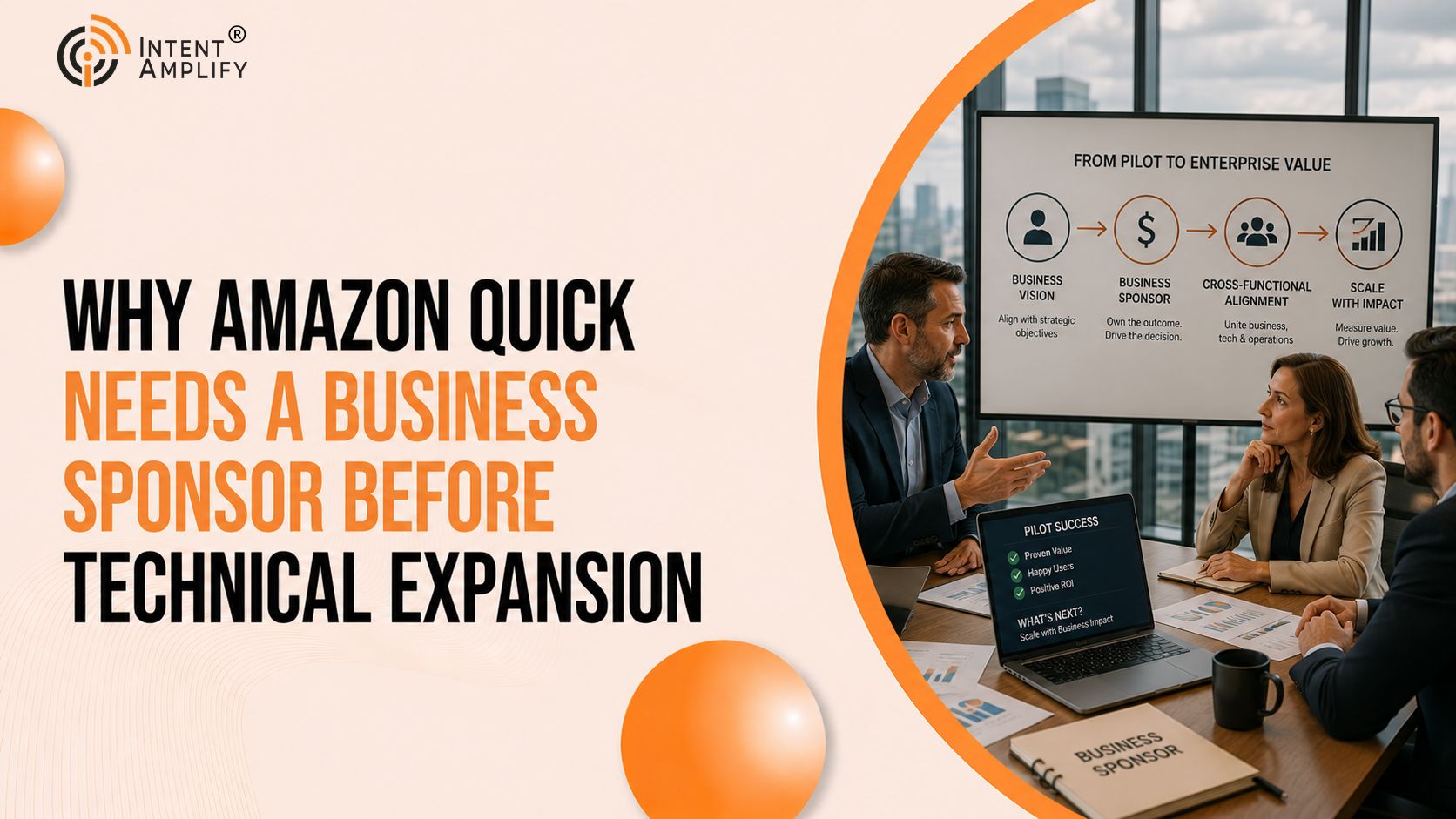
Executive Summary: Technical Momentum Without Business Ownership Is Not Scale Readiness
Enterprise AI programs can move surprisingly far without answering a basic governance question: who owns the business decision? Technical teams can configure access, connect data, build workflows, and demonstrate Amazon Quick capabilities. But they cannot, by themselves, decide which workflow deserves priority, which trade-offs are acceptable, or whether early evidence is strong enough to justify broader operating exposure.
For Amazon Quick, that distinction matters because the service is no longer limited to information retrieval. AWS describes Quick as an AI-powered service for automating tasks, analyzing data, building applications, and conducting research. Quick Flows and Quick Automate can connect AI assistance to workflow execution and actions across applications. As the technology moves closer to business action, the organization needs equally clear ownership of business intent, access boundaries, adoption conditions, evidence, and the next investment decision. [1]
A business sponsor provides that ownership. The sponsor does not replace technology, security, data, or risk teams. The sponsor creates the authority that lets those teams work against one bounded business outcome rather than a growing list of disconnected AI possibilities.
This Expert Insight presents a Sponsor Operating Model for early Amazon Quick programs. It treats a 45-day horizon as a bounded decision window, not as a guaranteed ROI promise. By the end of that window, the organization should know which workflow was evaluated, who owned the result, which sources and permissions governed the experience, how users were expected to participate, what evidence was collected, which counter-signals remained, and whether leadership should expand, remediate, redesign, or stop.
Why Technical Readiness Is Not Enough
Amazon Quick can be technically ready before the business is organizationally ready. An integration may work, permissions may be configured, and representative users may be able to complete a task. Those are necessary conditions for an evaluation, but they do not establish that the workflow has executive priority or that anyone has authority to interpret the result.
The problem becomes more important as AI systems take actions rather than simply generate answers. AWS documentation shows that Quick integrations can bring enterprise data into AI experiences and can use action connectors to trigger processes in external applications. Quick also supports permission management and source-level access controls intended to restrict what users can access and what actions they can perform. [2][3]
Those capabilities create a technology control plane. They do not create a business decision owner.
Without a sponsor, an evaluation can produce plenty of activity but no agreed answer to the questions that matter: Which cases should use the workflow? Which source is authoritative when data conflicts? Who can accept a temporary limitation? What adoption behavior is expected? What evidence is sufficient to fund the next stage? And who has the authority to stop expansion when the evidence is weak?
Executive principle
A technically successful evaluation can still be a business failure if no accountable leader owns the workflow outcome and the closing decision.
The Sponsor Operating Model
The business sponsor should be treated as an operating role with explicit decision rights, not as an executive name placed on a project slide. The role becomes measurable through the artifacts and decisions it creates.
|
Sponsor Responsibility |
Business Question |
Tangible Proof |
|
Decision ownership |
Who owns the workflow result and the closing decision? |
Sponsor charter and decision rights |
|
Priority rationale |
Why does this workflow matter now? |
Priority rationale and dated decision window |
|
Scope protection |
What stays inside and outside the first evaluation? |
In-scope definition, exclusion backlog, change decisions |
|
Evidence-owner mobilization |
Who must provide sources, cases, approvals, and read-back? |
Evidence-owner register and delivery commitments |
|
Risk acceptance |
Which limitations or controls can the business accept? |
Risk/exception decisions and escalation path |
|
Adoption sponsorship |
Which users should change behavior, when, and why? |
Eligible cohort and adoption charter |
|
Mixed-evidence interpretation |
How will favorable and contrary signals be weighed? |
Sponsor decision memo |
|
Day-45 authority |
Who can expand, remediate, redesign, or stop? |
Dated executive decision and next-stage owner |
A Sponsor Owns the Decision, Not the Tool
The strongest early signal is not senior enthusiasm for AI. It is explicit accountability for a business decision.
Technology leaders may own architecture, configuration, integration, observability, and security implementation. The business sponsor owns why the workflow matters, which result the evaluation is meant to improve, which trade-offs are acceptable, and what leadership will do when the evidence window closes.
That distinction protects both sides. The technology team is not forced to manufacture business justification after deployment, and the sponsor cannot treat the program as a feature demonstration disconnected from operating outcomes.
A useful sponsor charter should name the workflow, the current business friction, the intended users, the accountable sponsor, the day-45 decision, the evidence owners, and the conditions under which the initiative should pause.
Executive test
Can one named leader explain the business consequence of the workflow and make the next investment or operating decision when the evidence is reviewed?
Sponsorship Converts AI Interest Into Priority
Most enterprises do not suffer from a shortage of AI ideas. They suffer from too many plausible ideas competing for the same data owners, security teams, subject-matter experts, and implementation capacity.
A sponsor creates priority by connecting the Amazon Quick evaluation to a dated business consequence: a service-level problem, operating cost pressure, cycle-time constraint, compliance requirement, revenue decision, customer-experience issue, or another measurable operating need.
This does not require a fully proven ROI case before work begins. It requires a reason that is specific enough to justify organizational attention and a decision window that prevents the evaluation from remaining open-ended.
The priority rationale should also identify what would make the work less urgent. If the underlying business problem changes, the evaluation should be allowed to change with it rather than continue because technical work has already started.
Executive test
Is there a dated business reason for evaluating this workflow now, or is the initiative competing only on general enthusiasm for AI?
The Sponsor Protects a Bounded First Scope
Rapid AI programs often accumulate adjacent requests: another source, another user group, another action, another geography, another exception. Each request may sound reasonable, but uncontrolled scope growth weakens the ability to interpret the result.
The sponsor should protect the smallest scope that can still produce decision-relevant evidence. That means holding the first user population, governing sources, access boundaries, permitted actions, and excluded conditions stable long enough to understand what is working and what is not.
New requirements should not disappear. They should move into an exclusion or expansion backlog with a reason, owner, and decision date. This gives leadership visibility into demand without allowing the first evidence cycle to become a moving target.
Executive test
Can the sponsor say no to an attractive adjacent use case until the first workflow has produced interpretable evidence?
The Sponsor Mobilizes Evidence Owners
An Amazon Quick evaluation usually crosses organizational boundaries. Business teams understand the workflow. Data and content owners control source quality. Security and identity teams define access. Application owners control downstream systems. Risk teams define review requirements. Measurement owners establish the baseline and evidence method.
The sponsor's job is not to perform all of this work. It is to make participation non-optional when the business has chosen the evaluation as a priority.
AWS documentation shows why this coordination matters. Quick data-access integrations can connect to sources such as Amazon S3, Confluence, Google Drive, OneDrive, SharePoint, and web content, while knowledge bases inherit authentication and access permissions from their parent integrations. Quick also enforces access across source, integration, knowledge-base, and entity levels. [3]
The business cannot test context fitness if the relevant source owner never participates. It cannot validate action completion if the receiving system has no owner. A sponsor therefore converts a cross-functional dependency list into an evidence-owner register with dates and accountable names.
Executive test
Are the people who own context, permissions, controls, and downstream outcomes committed to the evaluation - or merely aware of it?
The Sponsor Owns Adoption Conditions
Adoption is not created by announcing that an AI capability exists. Users change behavior when the new path fits a real moment of work, leadership reinforces the expected behavior, and feedback produces visible corrections.
The sponsor should define the eligible cohort, the work moment in which Amazon Quick should be used, the training or enablement required, the feedback path, and what happens when a user bypasses the workflow.
This is also where organizations should distinguish voluntary exploration from business adoption. A user trying Quick once may demonstrate curiosity. A defined cohort repeatedly using it for an eligible workflow, with understood reasons for bypass and abandonment, provides much stronger evidence of fit.
The sponsor does not need to own training delivery. The sponsor does need to create the business expectation that makes adoption measurable.
Executive test
Does the target user know when Amazon Quick is the expected path, what to do when it fails, and why the workflow matters to the business?
The Sponsor Accepts Business Risk - Within Technical Guardrails
Security, legal, compliance, and technology teams should define non-negotiable controls. The sponsor should not override those controls. But many evaluation decisions still require business judgment: whether a limitation is acceptable for the current scope, whether a workflow should remain read-only, whether a human approval step is necessary, or whether a particular exception justifies pausing the test.
This becomes more important with agentic capabilities. In June 2026, AWS announced autonomous agents in Amazon Quick with configurable autonomy levels ranging from step-by-step approval to broader goal-based execution. AWS also described recurring workflows such as following up on stalled deals, monitoring regulatory changes, and processing purchase orders. [4]
As autonomy increases, technical permissioning and business authority need to remain aligned. The question is not only whether the system can perform an action. It is whether the business has authorized that class of action, under what conditions, with what review, and with what rollback path.
Executive test
Are the action boundaries and approval conditions business-approved, technically enforced, and reversible if the evidence changes?
The Sponsor Interprets Early Value
Early AI evidence is rarely uniformly positive or negative. A workflow may show strong usage but inconsistent context. It may reduce search time but increase review effort. It may work well for routine cases and poorly for high-consequence exceptions.
That is why a sponsor decision memo should combine contribution, action completion, control burden, exceptions, and counter-signals rather than elevating one favorable metric.
The sponsor's responsibility is to interpret evidence within the business context while preserving its limits. Missing downstream evidence should remain missing. A high-consequence failure should not disappear inside a favorable average. A weak user cohort should not be hidden by aggregate adoption.
This makes the sponsor more than a champion. The sponsor becomes the accountable interpreter of whether the evidence supports the next operating decision.
Executive test
What evidence would make the sponsor reduce scope, remediate, redesign, or stop even if overall engagement looks positive?
The 45-Day Sponsor Rhythm
A 45-day horizon is useful when it creates decision discipline. It should not be presented as a universal promise that Amazon Quick will generate ROI within a fixed number of days. The sponsor uses the window to make sure the organization closes with evidence and a decision rather than an open-ended pilot.
|
Phase |
Sponsor Responsibility |
Required Output |
|
Days 1-10: Charter |
Confirm workflow priority, scope, sponsor authority, owners, controls, and decision date. |
Sponsor charter, scope boundary, evidence-owner register |
|
Days 11-25: Observe |
Protect scope, remove ownership blockers, reinforce participation, and review exceptions. |
Representative cases, adoption signals, source/access issues |
|
Days 26-35: Challenge |
Require contrary cases, control burden, downstream read-back, and unresolved evidence gaps. |
Mixed-evidence review and remediation options |
|
Days 36-45: Decide |
Judge the evidence against the |
Expand, remediate, redesign, or |
|
|
original business question and choose the next path. |
stop memo |
The Sponsor Charter: Minimum Evidence Before Technical Expansion
Before technical scope expands, leadership should be able to complete a short sponsor charter. If several fields remain unknown, expanding features or users is likely to increase ambiguity rather than value.
|
Charter Element |
What Must Be Explicit |
|
Business workflow |
One bounded process or decision being evaluated |
|
Business consequence |
Why the workflow matters now and what decision it affects |
|
Accountable sponsor |
Leader with authority over the workflow outcome or a verified route to that leader |
|
Eligible cohort |
Users and cases expected to participate |
|
Governing context |
Approved data, knowledge sources, and source owners |
|
Access/action boundary |
What users and agents may view, recommend, or execute |
|
Baseline and evidence |
How current state and resulting state will be observed |
|
Counter-signals |
Evidence that would argue against expansion |
|
Decision date |
When leadership will choose expand, remediate, redesign, or stop |
What Sponsorship Looks Like by Industry
The sponsor role remains consistent, but the authority, evidence, and acceptable risk change with the workflow.
|
Industry |
Potential First Workflow |
What the Sponsor Must Own |
|
Insurance |
Claims research, underwriting support, policy knowledge, customer service |
Case priority, policy/claims source authority, review requirements, downstream decision owner |
|
Manufacturing |
Maintenance, engineering knowledge, quality investigation, field service |
Plant or process priority, technical-source owners, action boundaries, safety/quality escalation |
|
Retail |
Store operations, merchandising, product knowledge, customer service |
Eligible user group, product/customer source ownership, channel impact, exception handling |
|
CPG |
Commercial planning, brand intelligence, sales support, supply-chain knowledge |
Commercial priority, brand/sales/source ownership, approval boundaries, operating follow-through |
The Executive Sponsor Workshop
A useful sponsor workshop should begin with a recent business case rather than a feature list. Ask the workflow owner to describe the trigger, sources, people, delay, decision, and final action. Then use the case to test whether the proposed evaluation has enough authority and observability to support a decision.
The workshop should close with five answers:
- Which single workflow is important enough to evaluate now?
- Who owns the business result and the day-45 decision?
- Which people own the required context, permissions, controls, and downstream evidence?
- What evidence would justify expansion - and what evidence would argue against it?
- What is the smallest technical scope required to answer the business question?
If those answers are not available, the next step should usually be sponsor alignment and use-case definition rather than broader technical expansion.
When the Buyer Is Not the Sponsor
The person evaluating Amazon Quick may not personally own the business decision. That does not automatically disqualify the initiative, but the sponsor relationship should be recorded rather than assumed.
A credible sponsor path can be classified as direct authority, key influence, verified access to the decision owner, or no verified route. Title similarity is not enough. The evaluation should identify the forum in which the decision will be made, when that forum occurs, and what business consequence is attached to the outcome.
This creates a practical qualification signal for both implementation and go-to-market teams. A technically interested contact with no route to the decision owner may still be valuable, but the next step is different from an initiative with a named sponsor, a dated decision, and committed evidence owners.
The Sponsor Should Preserve the Strongest Contrary Case
Strong sponsorship does not mean advocating for expansion regardless of the evidence. It means protecting the quality of the decision.
A favorable average may hide a high-consequence failure, inaccessible governing source, excessive review burden, weak participation, or an action path that does not work reliably. The sponsor should require the strongest contrary explanation to appear beside the recommendation.
Financial impact should also be expressed as a range rather than a single unsupported figure. Expected user volume, source preparation, integration work, security review, adoption support, human review, and ongoing stewardship can materially affect operating economics. Assumptions should remain distinguishable from verified outcomes.
Decision quality rule
The sponsor is accountable for a credible next decision, not for proving that the original AI hypothesis was correct.
Conclusion: Business Sponsorship Is the Gate Between an AI Pilot and an Operating Decision
Amazon Quick can help enterprises connect AI assistance, analytics, research, workflow automation, and increasingly autonomous agents to real work. But technical capability does not decide which work deserves attention, which risks are acceptable, or whether early evidence supports expansion.
That authority belongs in the business.
Before technical expansion, an Amazon Quick initiative should have one bounded workflow, one accountable sponsor or verified route to the sponsor, one clear priority rationale, named evidence owners, defined adoption and control conditions, and a dated decision forum.
The value of the 45-day window is therefore not speed for its own sake. It is the discipline of reaching a better executive decision with enough evidence to expand, remediate, redesign, or stop.
For AWS-based enterprises evaluating the next stage of Amazon Quick or agentic AI, the practical next step is to establish sponsor authority before adding technical scope.
Download the Live in 45 with Amazon Quick: Business First, Value Fast Brochure
Explore a focused approach to connecting business sponsorship, implementation discipline, and early-value evidence. Download the brochure
For organizations with an active initiative, a 20-minute First-Value Mapping Session can begin with one workflow, the accountable owner, known source or permission constraints, AWS context, and the date of the next investment decision. The desired output is a fit classification, sponsor/evidence gaps, and the next best action - not a generic product demo.
References
- AWS: What is Amazon Quick? - Amazon Quick User Guide
- AWS: Work with integrations in Amazon Quick - Amazon Quick User Guide
- AWS: Data access integrations - Amazon Quick User Guide
- AWS: Amazon Quick announces autonomous agents, multi-dataset analytics, and redesigned activity feed (June 17, 2026)
- AWS: Permissions - Amazon Quick User Guide