Enterprise risk rarely begins with a dramatic failure. More often, it starts with a quiet exception approved without visibility, a supplier obligation left unassigned, a renewal clause that was never tracked, or a liability position that appeared manageable in isolation but became material when repeated across a contract portfolio. These risks become difficult to govern when contract language, review standards, and ownership models vary across business units, regions, or supplier categories.
Agiloft’s report, Eliminating the Silent Threat: How Agiloft Minimizes Risk, addresses this challenge by examining how contractual risk accumulates in clauses, exceptions, and overlooked obligations. The report explores how AI-powered CLM can standardize contract language, improve review consistency, support decision-making, and measure risk-reduction outcomes across the contract lifecycle. ¹
Contract lifecycle management is evolving from an administrative workflow into enterprise governance infrastructure. Modern CLM platforms must help legal, procurement, finance, and executive leaders determine whether contractual risk is being governed consistently across the business, not simply whether agreements completed a review process.
The Risk Control Problem Is Becoming Portfolio-Wide
Manual contract review can identify risk inside one agreement, but enterprise risk control requires visibility across thousands of agreements, suppliers, business units, and obligations. The difference is significant. One nonstandard clause may be a negotiable exception, while hundreds of similar exceptions can become a policy failure. One missed renewal may be an operational error, while repeated misses across supplier categories can become a governance breakdown.
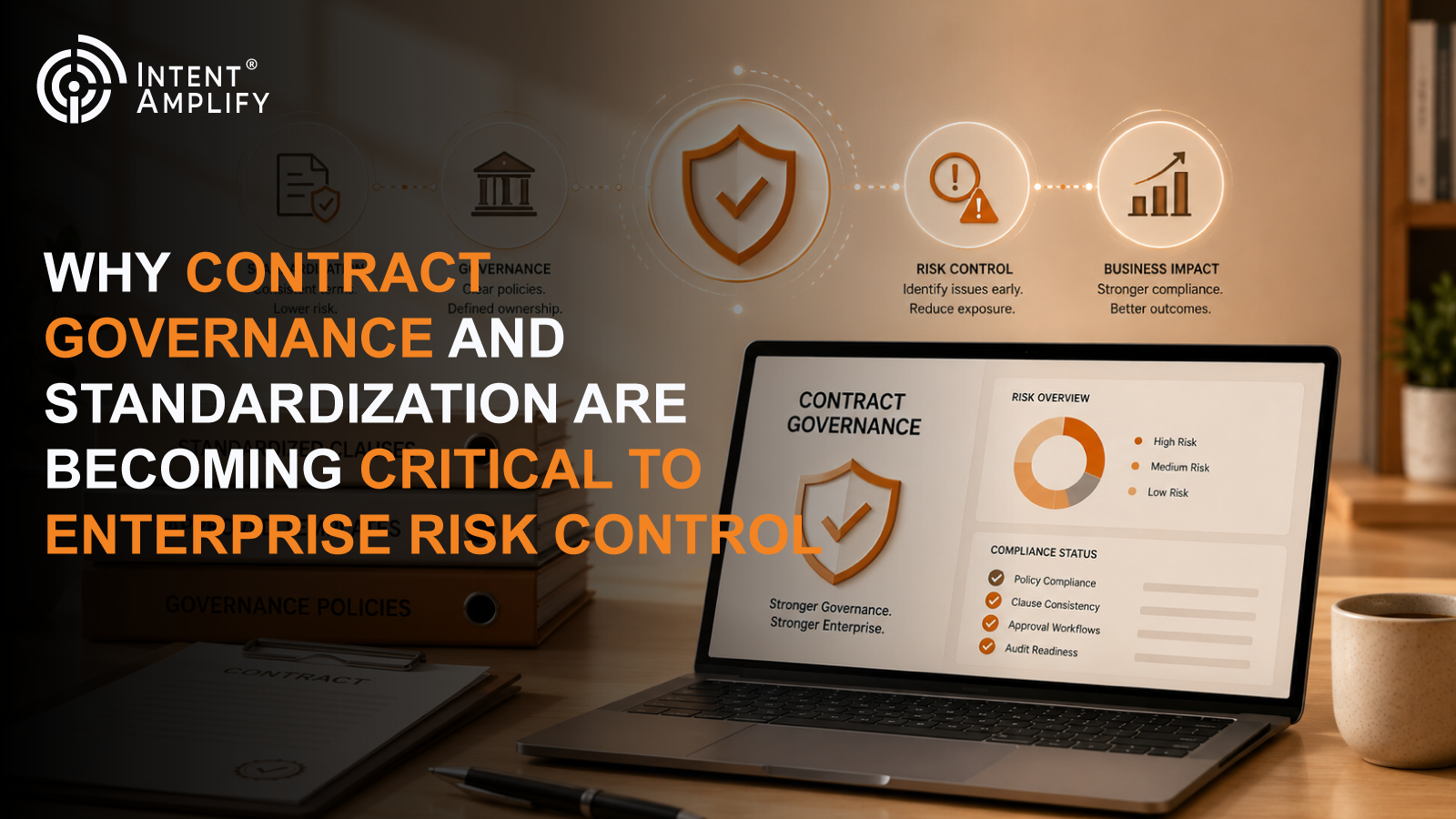
This is why contract governance and standardization are becoming strategic priorities. Legal leaders need a reliable way to control clause variation without slowing business execution. Procurement leaders need supplier contract management processes that can track obligations, renewals, and compliance terms consistently. Executive sponsors need contract dashboards that show risk concentration, approval patterns, exposure, and the financial impact of unmanaged exceptions.
The enterprise cannot control what it cannot see, and it cannot see contract risk clearly when language, data, and approval workflows are inconsistent.
KEY FIGURES AT A GLANCE
Enterprise AI adoption continues to accelerate, with 88% of organizations reporting regular AI use in at least one business function, compared with 78% the previous year. McKinsey also found that 62% of respondents say their organizations are at least experimenting with AI agents, including 23% that are scaling agentic AI somewhere in the enterprise and 39% that have begun experimenting. However, only about one-third of organizations have started scaling AI across the enterprise, while 39% report enterprise-level EBIT impact from AI, which reinforces that adoption alone does not create business value without governance, workflow redesign, and data readiness.²
McKinsey also found that 64% of respondents say AI is enabling innovation, while 51% of respondents from organizations using AI report at least one negative consequence, and nearly one-third report consequences related to AI inaccuracy.²
Microsoft’s 2026 Work Trend Index surveyed 20,000 AI-using workers across 10 countries and analyzed trillions of anonymized Microsoft 365 productivity signals, showing that organizations must redesign work as AI and agents take on more execution. Microsoft also reports that organizational factors account for 67% of reported AI impact, compared with 32% for individual mindset and behavior, while only 19% of AI users sit in the “Frontier” zone, where individual capability and organizational readiness reinforce each other.³
Agiloft’s campaign targets enterprise organizations with 10,000+ employees across the United States and Canada, reflecting the scale at which contract governance, contract compliance, and executive risk reporting become difficult to manage manually.¹
Standardization Converts Contract Risk into Managed Variation
Contract standardization is sometimes misunderstood as a way to make every agreement identical, although the more useful goal is to make variation visible, intentional, and governable. In enterprise contracting, exceptions will always exist because suppliers, customers, markets, and commercial terms are not uniform. The problem begins when exceptions are negotiated, approved, and stored without a consistent way to understand their risk impact later.
Standardized clause libraries, approval playbooks, fallback positions, and deviation tracking give legal and procurement teams a shared language for contract risk management. When a clause departs from the standard position, the system should make that exception visible, route it to the right reviewer, and preserve the decision logic for future analysis. That creates more control than a manual process where exceptions are buried in redlines, email threads, or disconnected files.
Agiloft’s emphasis on standardizing contract language is therefore practical rather than theoretical.¹
Standardization gives AI-powered CLM a stronger foundation because the system can compare contract language against approved positions, identify deviations faster, and support more consistent review.
Governance Must Extend Beyond Pre-Signature Review
Many organizations manage contract risk as if the biggest challenge ends at signature. In reality, some of the most important risks emerge after execution, when obligations must be fulfilled, renewals must be managed, suppliers must perform, and compliance requirements must be monitored.
A contract that was acceptable at signing can still become risky if the business fails to track a renewal, misses a reporting obligation, accepts supplier underperformance, or overlooks a compliance commitment. This is why contract governance needs to extend across the full lifecycle, from intake and drafting through negotiation, approval, execution, obligation tracking, renewal management, and portfolio reporting.
AI contract management can help by extracting obligations, identifying key dates, surfacing nonstandard clauses, monitoring compliance terms, and supporting contract analytics across the portfolio. The result is not only faster contract review. It is a shift from a one-time legal review toward continuous contract intelligence.
Procurement Needs Standardized Supplier Visibility
Procurement risk often appears in supplier agreements that are technically stored but not actively governed. A sourcing platform may contain the contract, while the renewal window sits in a spreadsheet, the service obligation sits in an attachment, and the pricing commitment sits in a procurement note that is difficult to connect later.
That fragmentation weakens supplier governance.
With standardized contract data and AI-driven CLM workflows, procurement teams can monitor renewal dates, compare supplier obligations, identify duplicate vendor agreements, support vendor consolidation, and improve procurement analytics. Vendor contract management becomes more proactive because supplier commitments are visible before a dispute, audit, or missed renewal forces the team to search.
For supply chain leaders, standardization also strengthens resilience. The organization can respond faster when it knows which suppliers have critical obligations, which contracts contain termination rights, which agreements include compliance duties, and which performance terms apply during disruption.
Legal Operations Needs a More Governed Review Model
Legal operations teams are under pressure to deliver faster support while maintaining contract risk control. That balance becomes difficult when every review depends on manual search, individual interpretation, and inconsistent routing.
A more governed review model gives legal teams better leverage. Approved clause libraries define standard positions. Automated workflows route exceptions based on risk. AI contract review surfaces unusual language. Contract analytics show where deviations are appearing across business units or counterparties. Human review remains essential, but it becomes more focused on material risk rather than routine variation.
McKinsey’s finding that 51% of AI-using organizations have experienced at least one negative consequence should be a caution for legal leaders.²
AI contract management should not operate as an unchecked decision engine. It should operate as a governed intelligence layer that helps legal professionals see risk earlier, review exceptions more precisely, and maintain accountability for high-impact decisions.
Executive Risk Control Requires Better Contract Intelligence
For executive sponsors, contract governance is not only a legal operations issue. It is a business control issue because contracts define revenue commitments, spend obligations, supplier exposure, compliance duties, and liability positions across the enterprise.
A CFO may need to know which renewals affect cost exposure. A COO may need to know which suppliers carry performance obligations. A chief compliance officer may need evidence that contract commitments are being monitored. A board may ask for contract risk visibility during an audit, acquisition, or regulatory review.
Those questions cannot be answered dependably if the organization lacks standardized contract data and portfolio-level analytics. Modern contract dashboards should help leaders see risk by clause type, counterparty, business unit, region, renewal window, and approval status, so the business can manage contract exposure before it becomes visible as cost.
AI Governance Makes CLM Intelligence Dependable
AI can make contract management faster, but governance makes it trustworthy. Contract data includes pricing, liability terms, customer obligations, supplier commitments, data protection language, and compliance requirements, which means AI-assisted outputs must be explainable, validated, and auditable.
NIST’s AI Risk Management Framework emphasizes trustworthy AI across design, development, use, and evaluation.⁴
In CLM, that principle should translate into approved data sources, validated extraction rules, human review for high-risk clauses, audit trails, role-based access, model performance checks, and clear accountability for AI-assisted contract decisions.
This is especially important because standardization and AI governance reinforce each other. Standardized contract language improves AI analysis, while governed AI helps organizations maintain confidence in contract intelligence outputs. Together, they create the foundation for enterprise risk control at scale.
What Agiloft Brings to the Conversation
Agiloft is positioned for this conversation because its risk report focuses on making contract risk management repeatable, intelligent, and measurable. The message is directly relevant for enterprises that already understand the limitations of manual review but need a practical way to standardize contract language, streamline reviews, and govern risk across the lifecycle.¹
For legal and contract leaders, Agiloft’s value is stronger clause control, earlier risk visibility, and a more focused review. For procurement and supply chain leaders, the value is standardized supplier obligation tracking, renewal visibility, and stronger contract compliance. For executive sponsors, the value is measurable risk reduction and a clearer view of contract exposure across the business.
Modern contract lifecycle management should not simply accelerate contract work. It should make contract risk easier to govern.
Download Eliminating the Silent Threat: How Agiloft Minimizes Risk
Agiloft’s report gives legal, procurement, and executive teams a practical view of how AI-powered CLM can standardize contract language, streamline reviews, empower decision-makers, and measure risk reduction ROI.
About Intent Amplify
Intent Amplify helps organizations move from market insight to measurable growth through GTM strategy, demand intelligence, pipeline activation, executive roundtables, sponsored research, targeted content, webinars and panels, vendor intelligence, and strategic consulting. For teams that need sharper positioning, stronger executive engagement, and more effective activation, Intent Amplify connects strategy, content, and market intelligence into a practical growth engine.
Executive Takeaway
Contract governance and standardization are becoming critical to enterprise risk control because contract risk no longer lives in isolated agreements. It accumulates across clauses, exceptions, approvals, renewals, obligations, and supplier commitments. Organizations that rely only on manual review may still catch individual issues, but they will struggle to manage portfolio-level exposure.
The next phase of contract lifecycle management will belong to enterprises that treat standardization as a control system, AI contract management as an intelligence layer, and governance as the operating model that connects both. In that environment, legal and procurement teams can move faster without losing control, while executives gain a clearer view of the risks and commitments shaping the business.
References
- Agiloft and IntentTechPub (2026). Eliminating the Silent Threat: How Agiloft Minimizes Risk. Available at: https://intenttechpub.com/report/eliminating-the-silent-threat-how-agiloft-minimizes-risk/
- McKinsey and Company (2025). The State of AI in 2025: Agents, Innovation and Transformation. Available at: https://www.mckinsey.com/capabilities/quantumblack/our-insights/the-state-of-ai
- Microsoft (2026). 2026 Work Trend Index: Agents, Human Agency, and the Opportunity for Every Organization. Available at: https://www.microsoft.com/en-us/worklab/work-trend-index/agents-human-agency-and-the-opportunity-for-every-organization
- National Institute of Standards and Technology (2026). AI Risk Management Framework. Available at: https://www.nist.gov/itl/ai-risk-management-framework