
Book a Demo
Home Platform Audience Accounts Intent Evidence Activation SignalAtlas Solutions Industries Programs Research Pricing About Careers Press Contact Brands Trust Privacy Accessibility Demo ABM Advertising Content Demand Intent Data Sales Blog Infographics Events Product Sheets Videos Webinars White Papers E-books Customer Stories Corporate Presentation Newsletters Expert Insights Expert Analysis Research Reports
Expert Insight

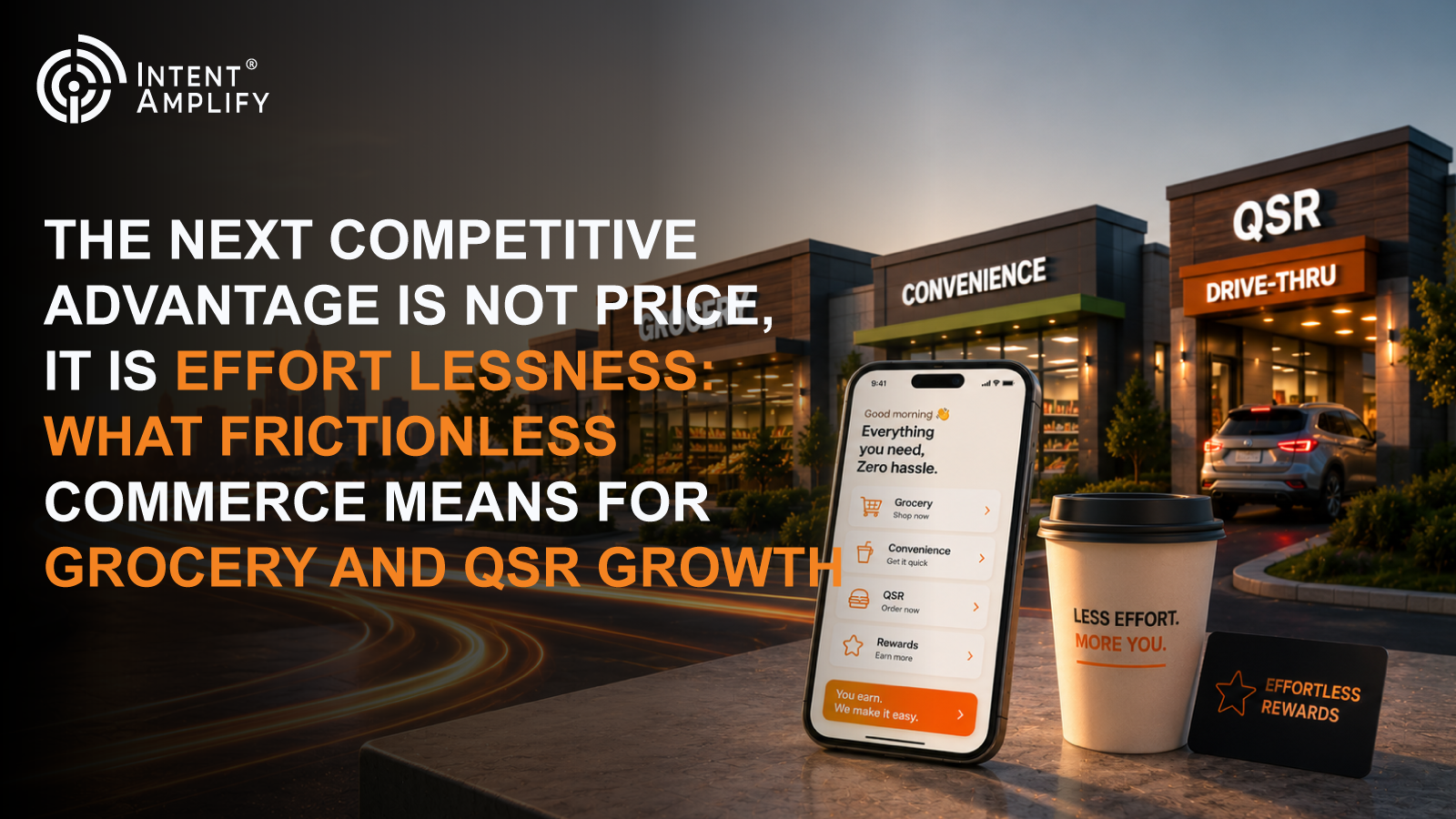
The Next Competitive Advantage Is Not Price, It Is Effortlessness: What Frictionless Commerce Means for Grocery and QSR Growth

Expert Insight
The Next Competitive Advantage Is Not Price, It Is Effortlessness: What Frictionless Commerce Means for Grocery and QSR Growth
June 22, 2026 8 min read

Quick Answer

Learn how frictionless commerce, self-service technology, AI, and unified retail platforms help grocery and QSR brands drive growth and loyalty.

For grocery, convenience, and quick service restaurant leaders, price will always matter, although it is no longer enough to explain why customers return, abandon a basket, choose one location over another, or shift loyalty toward a competitor. In a market where consumers are pressed for time, digitally informed before they arrive, and less tolerant of avoidable delays, the more durable advantage is beginning to form around effortlessness.

Effortlessness is not the same thing as speed, even though transaction speed remains essential. It is the removal of unnecessary work from the customer journey, from product discovery and ordering to payment, loyalty, pickup, age verification, and service recovery. When a customer can complete a mission without repeating information, waiting for avoidable assistance, or moving between disconnected systems, the experience feels more valuable even before price enters the conversation.

RETHINK Retail’s The Frictionless Frontier: Why Grocery, Convenience, and QSR Need a Reset makes this point in practical retail terms. The report treats checkout friction, manual intervention, and disconnected commerce journeys as business performance issues because they affect throughput, basket size, labor productivity, satisfaction, and repeat behavior.¹

From an analyst's perspective, this is where the growth conversation becomes more interesting. Discounts can generate demand, but frictionless retail can protect demand after the customer has already decided to engage.

Why Effort Has Become a Retail Growth Signal

A grocery shopper does not need to understand the store’s point of sale integration to know that a coupon did not apply correctly. A QSR guest does not need to understand menu architecture to know that a self-service kiosk made customization harder than ordering at the counter. A convenience customer does not need to know the compliance workflow to feel the delay caused by repeated age verification interruptions.

These small moments are often treated as operational tolerances, yet they become commercially meaningful when multiplied across thousands of transactions, dayparts, and store locations. Waiting has become a signal that the retail environment is not aligned with customer expectations for control, speed, and convenience.

IBM and the National Retail Federation’s Own the Agentic Commerce Experience found that 72% of consumers still shop in stores, which reinforces the continued importance of physical retail even as digital tools increasingly shape purchase planning. The same study found that 41% of consumers use AI assistants to research products, 33% use them to review information, and 31% use them to search for deals, showing that many shoppers arrive with digital context already influencing their decisions.²

For grocery and QSR leaders, this changes the role of the store. The store is no longer only the place where demand is captured. It is where digitally shaped expectations are either fulfilled or disappointed.

KEY FIGURES AT A GLANCE

The case for frictionless commerce is grounded in both customer behavior and operating economics. 84% of consumers prefer self-service kiosks, kiosk deployments can lift ticket sizes by 30%, and AI age estimation can reduce human intervention by 75% in regulated product journeys.¹

Physical retail remains highly relevant, with 72% of consumers still shopping in stores, yet AI is increasingly shaping the pre-store journey because 41% of consumers use AI assistants to research products, 33% use them to look for reviews, and 31% use them to search for deals. Trust also remains central to personalization, since 52% of consumers are comfortable sharing data, while 83% still express concerns about privacy, misuse, or unwanted marketing.²

Retail leaders are planning for growth while demanding stronger execution from technology investments. 96% of global retail executives surveyed by Deloitte expect industry revenues to grow in 2026, and 81% expect margin expansion. The same research found that 88% of retail executives view retail media networks as crucial to revenue and profitability, while 30% of retailers currently use AI for supply chain visibility, and that figure is expected to reach 41% within the next year.³

Store operations remain under pressure, with 87% of retail leaders identifying generative AI as important to loss prevention, in-store shopper satisfaction falling to 79%, online shopper satisfaction falling to 73%, and 88% of retail associates reporting difficulty getting timely assistance or information, up from 82% the previous year.⁴

Checkout Friction Is Where Growth Quietly Leaks

Checkout friction is rarely dramatic in a single transaction, which is why it often survives inside retail operating models longer than it should. A slow payment step, a failed offer, a manual approval, an unclear kiosk screen, or a handoff between mobile order and store fulfillment can look minor on the floor, but the accumulated effect is lower throughput, weaker satisfaction, and reduced confidence in the brand experience.

The larger problem is that friction often sits between systems rather than inside one visible process. It appears that where loyalty data does not connect cleanly to the checkout flow, where a QSR technology platform cannot handle menu complexity, where age verification software interrupts associate productivity, or where retail automation software works well in one channel but not across the full customer journey.

RETHINK Retail’s report is useful because it pushes leaders to think beyond lane speed and conduct a broader friction audit.¹

The more useful question is not whether checkout is fast enough under ideal conditions. It is whether the entire commerce platform supports a smoother journey when the customer brings coupons, modifiers, payment preferences, regulated products, loyalty expectations, and pickup requirements into the same interaction.

Self-Service Creates Value When It Shapes the Order

Self-service technology is often justified through labor savings, but its stronger growth potential comes from its ability to influence ordering behavior. A well-designed self-ordering kiosk does not simply move a customer away from the counter. It can guide choices, reduce mistakes, present relevant add-ons, support promotions, and make loyalty participation more visible.

RETHINK Retail’s finding that kiosk deployments can increase ticket sizes by 30% matters because it reframes the self-service kiosk as a revenue tool rather than a queue management device.¹

For QSR operators, that creates a more reliable way to present upsell prompts during busy dayparts when associates may be focused on speed. For convenience operators, it creates a path to connect foodservice, promotions, loyalty, and payment inside one more controlled experience.

Unified commerce creates commercial value by connecting ordering, loyalty, payments, promotions, and fulfillment into a single operating environment. Retailers gain greater ability to influence basket composition while reducing customer effort.

Automation Should Protect the Associate Experience

The labor conversation in grocery, convenience, and QSR is often framed too narrowly as a cost reduction issue, although the better strategic lens is capacity. Associates are being asked to move faster, handle more exceptions, support more channels, and maintain service quality in environments where customer patience is thinner.

If AI age estimation reduces human intervention by 75%, the benefit is not only fewer interruptions at checkout. It also gives associates more room to focus on service recovery, fresh food execution, replenishment, cleanliness, pickup handoffs, and the moments where human judgment matters most.¹

Zebra Technologies’ finding that 88% of retail associates struggle to obtain timely assistance or information points to a deeper issue. Many frontline teams are expected to deliver modern customer experiences while working around fragmented systems. A strong frictionless commerce strategy should therefore make store teams more capable, not simply more measured.⁴

Trust Is the Boundary Around Frictionless Growth

Retailers cannot remove effort at the expense of confidence. As grocery, convenience, and QSR environments adopt AI checkout, computer vision retail systems, self-checkout security tools, automated checkout, and AI loss prevention, leaders need to treat governance as part of the customer experience rather than as a back-office control.

IBM and NRF’s finding that 52% of consumers are comfortable sharing data, while 83% remain concerned about privacy, misuse, or unwanted marketing, shows why trust must be designed into the value exchange. Customers may accept personalization when the benefit is visible, but they will resist experiences that feel intrusive or poorly explained.²

Palo Alto Networks’ finding that 99% of organizations have encountered an attack on an AI system in the past year adds another layer of urgency. Connected store platforms, cloud-based POS environments, APIs, and identity controls must be secured as part of the same modernization roadmap that improves speed and convenience.⁵

What RETHINK Retail Brings to the Conversation

RETHINK Retail is positioned to guide this discussion because it helps retail leaders connect customer expectations, store modernization, checkout automation, retail innovation, labor automation, self-checkout security, and platform unification into one strategic view. Through The Frictionless Frontier, RETHINK Retail gives grocery, convenience, and QSR executives a practical framework for identifying where effort is hidden, where revenue is leaking, and where frictionless commerce can create measurable growth.¹

The report’s strongest contribution is its focus on the full journey rather than a single technology decision. For executives navigating the future of retail, that perspective matters because growth will depend on how well retailers connect customer experience, workforce efficiency, transaction speed, and trust inside one operating model.

Download The Frictionless Frontier: Why Grocery, Convenience, and QSR Need a Reset

RETHINK Retail’s report helps grocery, convenience, and QSR leaders identify where friction is limiting revenue, slowing associates, and weakening customer experience across the front end.

Download Now

About Intent Amplify

Intent Amplify helps organizations move from market insight to measurable growth through GTM strategy, demand intelligence, pipeline activation, executive roundtables, sponsored research, targeted content, webinars and panels, vendor intelligence, and strategic consulting. For teams that need sharper positioning, stronger executive engagement, and more effective activation, Intent Amplify connects strategy, content, and market intelligence into a practical growth engine. Learn More

Executive Takeaway

The next competitive advantage in grocery and QSR will not be won by price alone because pricing moves can be matched quickly, while a consistently effortless experience requires deeper operational discipline. Retailers that reduce unnecessary effort across ordering, checkout, loyalty, compliance, pick-up,p and service recovery will be better positioned to improve transaction speed, protect margins, support associates, and turn customer convenience into measurable growth.

References

  1. RETHINK Retail and IntentTechPub (2026) The Frictionless Frontier: Why Grocery, Convenience, and QSR Need a Reset. Available at: https://intenttechpub.com/report/the-frictionless-frontier-why-grocery-convenience-and-qsr-need-a-reset/
  2. IBM and National Retail Federation (2026). Own the Agentic Commerce Experience. Available at: https://nrf.com/research/own-the-agentic-commerce-experience
  3. Deloitte (2026) 2026 Retail Industry Global Outlook. Available at: https://www.deloitte.com/us/en/insights/industry/retail-distribution/retail-distribution-industry-outlook.html
  4. Zebra Technologies (2025) 18th Annual Global Shopper Study. Available at: https://investors.zebra.com/news-and-events/news/news-details/2025/Zebra-Study-87-of-Retailers-Believe-Gen-AI-to-Have-Significant-Impact-on-Loss-Prevention/default.aspx
  5. Palo Alto Networks (2025) State of Cloud Security Report 2025. Available at: https://www.paloaltonetworks.com/state-of-cloud-native-security
Contact
Sales