
Book a Demo
Home Platform Audience Accounts Intent Evidence Activation SignalAtlas Solutions Industries Programs Research Pricing About Careers Press Contact Brands Trust Privacy Accessibility Demo ABM Advertising Content Demand Intent Data Sales Blog Infographics Events Product Sheets Videos Webinars White Papers E-books Customer Stories Corporate Presentation Newsletters Expert Insights Expert Analysis Research Reports
Research Report

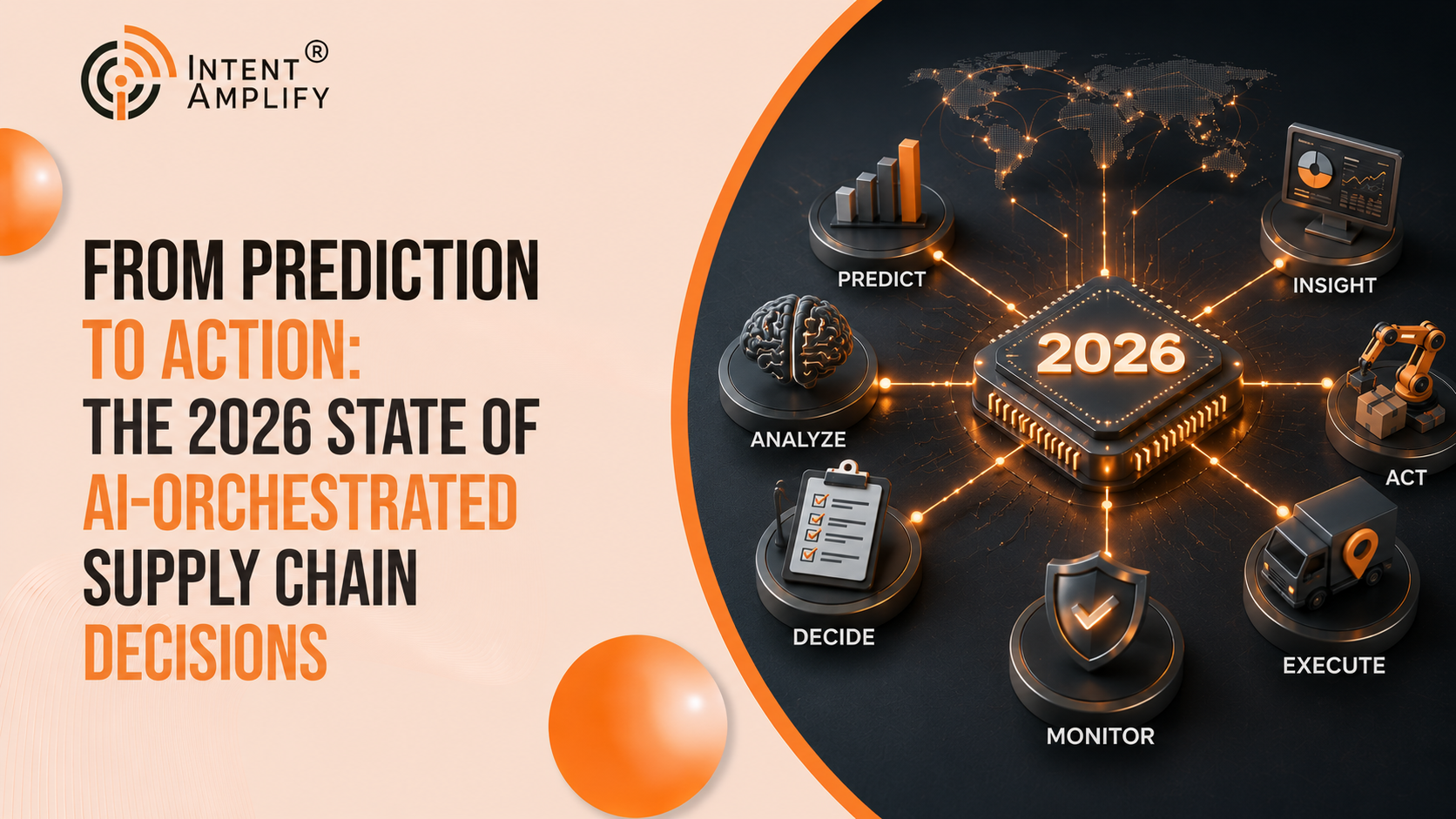
From Prediction to Action: The 2026 State of AI-Orchestrated Supply Chain Decisions

Research Report
From Prediction to Action: The 2026 State of AI-Orchestrated Supply Chain Decisions
August 14, 2026 13 min read

Quick Answer

An executive analysis of how agentic AI is moving supply chains from prediction and alerts toward decision orchestration, bounded execution, cross-functional workflows, and measurable decision latency.

Executive Summary

Supply chain AI has entered a different phase in 2026. For most of the last decade, the dominant enterprise conversation focused on prediction: better demand forecasts, better estimated arrival times, better risk signals, better anomaly detection and faster access to operational data. Those capabilities remain important, but they do not solve the full management problem. A prediction has value only when the organization can convert it into a coordinated decision and then into governed execution.

That gap between insight and action is where supply chain orchestration is becoming strategically important. SAP’s 2026 supply chain direction illustrates the shift clearly. Its Planning Assistant is positioned around exception management, demand fulfillment, inventory drivers and one-click resolution patterns. Its Logistics Assistant is positioned around autonomous detection, planning and execution across warehousing and transportation. Its Manufacturing Assistant is described as a multi-agent system that can monitor disruption, coordinate corrective processes and support next-best-action decisions. SAP has also described Autonomous Supply Chain Management as a model in which people define goals and priorities, assistants orchestrate activity across domains, and agents execute work within governed processes.

The significance is larger than any individual feature. The operating model is changing from “AI helps me see” toward “AI helps the enterprise decide, coordinate and act.” For executives, that introduces a new class of management questions: Which decisions should AI prepare? Which should it coordinate? Which can it execute? What data and permissions should it use? How should human oversight be designed? How should leaders measure whether an AI-supported decision actually improves service, inventory, cost, resilience or working capital?

This research report examines that transition through eight findings. First, supply chain value is moving from isolated prediction toward decision-cycle compression. Second, agentic AI increases the importance of workflow design and decision rights. Third, planning is emerging as an important proving ground because exception management is already structured around signals, scenarios and trade-offs. Fourth, logistics shows why orchestration must cross functional boundaries. Fifth, manufacturing raises the control bar because digital decisions can affect physical operations. Sixth, business networks extend orchestration beyond the enterprise into partner workflows and commitments. Seventh, governance is becoming part of the operating architecture rather than a separate compliance exercise. Eighth, decision latency is emerging as a useful process metric for locating where AI-supported orchestration can reduce friction without overstating business attribution.

Explore the 2026 State of AI-Orchestrated Supply Chain Decisions

The report is designed for senior operations, planning, sourcing, inventory, risk, digital transformation, engineering, program management and supply chain leaders—the audience defined in the campaign SOF. It does not assume that every organization is ready for autonomous execution. Instead, it provides an evidence-based framework for deciding where to begin.

Research Approach and Evidence Boundary

This report is an executive synthesis, not a statistical market study. Its evidence base combines the supplied campaign SOF, the campaign keyword research, current SAP product and News Center materials, and NIST AI risk-management guidance. The report does not infer market share, adoption rates, productivity uplift, ROI, pipeline impact, search demand or product readiness where those figures are not verified in the supplied evidence.

Evidence is treated in three categories.

Verified product direction. Statements about SAP Planning Assistant, Logistics Assistant, Manufacturing Assistant, Business Network Assistant, Joule and supply chain orchestration are grounded in current SAP materials cited in the reference section.

Cross-industry governance guidance. Statements about AI risk-management structure, trustworthiness and governance are grounded in NIST AI RMF materials.

Executive interpretation. Frameworks such as decision classes, orchestration sequences, readiness questions and scorecards are original analytical constructs developed for this campaign. They are recommendations, not claims that SAP or NIST prescribe the same operating model.

This separation matters because executive content becomes less useful when vendor roadmap language, observed operating patterns and original recommendations are blended together without distinction. The aim here is to preserve that boundary.

1. Research Finding: Prediction Is No Longer the End State

The first generation of supply chain analytics concentrated on visibility and forecasting. Leaders invested in control towers, planning systems, IoT telemetry, event feeds and optimization models because fragmented data made it difficult to detect changes early. The result was a major improvement in sensing. Many organizations can now see more exceptions than their operating model can absorb.

That creates a paradox: more visibility can produce more work. If planners receive hundreds of alerts but must manually assemble context for each one, the system has accelerated detection without accelerating resolution. If logistics teams see a delay immediately but must still call planning, customer service, procurement and manufacturing to decide what to do, the business has improved awareness without improving orchestration.

The next productivity frontier is therefore not merely the quality of a prediction. It is the elapsed time and coordination required to move from signal to decision to action.

SAP’s current Planning Assistant reflects this shift. SAP states that the assistant can support accelerated exception management by monitoring issues, creating context, running what-if scenarios and recommending plan changes. It can also help identify persistent shortages, evaluate stock targets, surface inventory drivers and analyze unmet demand. The strategic pattern is clear: AI is being placed inside the decision flow rather than outside it as a reporting layer.

Executive implication: measure AI at the point where work changes. A forecasting model may be technically impressive, but the more important question is whether it reduces the cycle time for material decisions while preserving or improving decision quality.

2. Research Finding: Agentic AI Changes the Unit of Automation

Traditional automation is built around tasks. A rule triggers, a workflow runs, a transaction is created, or a report is generated. Agentic AI introduces a different possibility: systems can interpret context, choose among possible next steps, invoke tools and coordinate multi-step work toward a defined objective.

In supply chain environments, that distinction matters because decisions are rarely isolated tasks. Resolving a component shortage may require identifying affected demand, reviewing inventory across locations, analyzing substitutes, evaluating supplier options, testing production scenarios and deciding which customers or plants should receive constrained supply. The work is distributed across data, applications and functions.

An agentic operating model can potentially assemble those steps. But it also expands the control surface. A system that can recommend a plan change is different from a system that can execute the change. A system that can prepare a supplier alternative is different from one that can create a commercial commitment. The more an AI system can act, the more precisely the organization must define authority.

SAP’s May 2026 announcement around Autonomous Supply Chain Management describes people defining goals and priorities, assistants orchestrating across domains, and agents executing work in governed end-to-end processes. That model suggests a useful executive distinction among three roles:

  • Human authority: defines objectives, risk tolerance, policy and decision thresholds.
  • Orchestration: assembles context, coordinates specialized agents and manages cross-functional workflow.
  • Execution: carries out approved or pre-authorized actions within bounded permissions.

These roles should not be collapsed. The most credible path to autonomy is not to give an AI system broad enterprise permissions and then add monitoring. It is to design the decision scope first and grant only the permissions needed for that scope.

3. Research Finding: Planning Is the Natural Proving Ground

Planning is one of the strongest environments for testing AI-supported orchestration because the discipline already operates through structured decisions: forecast, supply, inventory, capacity, allocation, constraints and exceptions.

The problem is that planning teams can become overloaded by exception volume. A minor deviation can receive the same attention mechanism as an event with large service or financial consequences. Planners spend time finding context before they can even begin deciding.

The 2026 SAP Planning Assistant is relevant because it places AI agents into these workflows. SAP describes an Exception Management Agent that detects and prioritizes exceptions, proposes mitigations and speeds planner response. It also describes agents for inventory investment allocation, component shortages, deployment order confirmation, long-term capacity shortage resolution and footprint optimization.

The executive opportunity is not to automate planning as a monolithic function. It is to decompose planning into decision classes.

  • Class A: high-frequency, low-materiality decisions. Examples may include bounded adjustments that are easily reversible. These are the strongest candidates for greater automation if the data and policies are reliable.
  • Class B: high-frequency, moderate-materiality decisions. AI can assemble context and recommend actions, while humans approve or monitor.
  • Class C: low-frequency, high-materiality decisions. These often require human judgment even when AI performs most of the analysis.
  • Class D: ambiguous or policy-sensitive decisions. These should remain human-led until the organization can define the decision and its boundaries more precisely.

This classification prevents a common mistake: evaluating “AI planning” as a single capability. The real question is which planning decisions can be improved and how much authority is appropriate for each one.

4. Research Finding: Logistics Shows Why Cross-Functional Orchestration Matters

Logistics has long been an AI-rich domain. Route optimization, estimated arrival times, warehouse slotting, labor planning and freight analytics are familiar use cases. In 2026, however, SAP’s Logistics Assistant is being described in broader terms: autonomous detection, planning and execution across warehousing and transportation, with attention to inbound and outbound flows, labor, inventory, dispatch and freight decisions.

This is important because a logistics exception rarely stays within logistics. A delayed shipment may create production risk. A carrier failure may affect a customer promise. A warehouse constraint may require reallocation of inventory. An unexpected cost increase may force a service-versus-margin trade-off.

If each application optimizes locally, the enterprise can make contradictory decisions. The transportation system may choose the lowest-cost alternative while the planning system is trying to protect a critical customer. The warehouse may prioritize throughput while production needs a specific material immediately.

Orchestration changes the design objective from “optimize the logistics task” to “resolve the enterprise outcome.”

A practical logistics orchestration sequence can be expressed as:

  • Sense: detect the disruption or emerging constraint.
  • Contextualize: identify affected orders, inventory, customers, plants, carriers and commitments.
  • Prioritize: determine which outcomes matter most based on policy and business value.
  • Generate options: evaluate rerouting, expediting, inventory transfer, schedule change or customer commitment adjustment.
  • Authorize: apply policy thresholds and human approval where required.
  • Execute: trigger the approved logistics and adjacent business workflows.
  • Learn: measure the result and capture overrides, failure modes and exceptions.

The important insight is that the intelligence layer must be connected to operational authority without becoming uncontrolled.

5. Research Finding: Manufacturing Extends Agentic AI Into Physical Operations

Manufacturing introduces even higher consequences because digital decisions can affect physical production, quality, workforce allocation and material movement.

SAP’s Manufacturing Assistant, published in May 2026, is described as a multi-agent system for aligned manufacturing execution. SAP highlights real-time disruption monitoring, corrective processes across quality, scheduling and workforce, material staging, inventory impacts and next-best-action scenarios with pros and cons.

This points to a critical distinction for executives: an AI agent is not valuable merely because it can create a recommendation. Its usefulness depends on whether it understands the operational context and whether the recommended action can be executed safely within plant and quality controls.

For manufacturing use cases, the governance bar should therefore be higher. Leaders should explicitly define:

  • Which data sources are authoritative.
  • Which production decisions can be recommended versus executed.
  • Which actions require supervisor, quality, engineering or safety approval.
  • What happens when systems disagree.
  • How the organization detects and reverses an incorrect action.
  • How agent decisions are logged for audit and root-cause review.
  • Where human-in-the-loop control is mandatory.

The transition from digital insight to physical execution should be staged. Recommendation mode should generally precede autonomous execution for material manufacturing decisions.

6. Research Finding: Business Networks Expand Orchestration Beyond the Enterprise

Supply chain orchestration becomes more complex when decisions involve suppliers, carriers, contract manufacturers and external partners. SAP’s Business Network Assistant, published in May 2026, extends the agentic model into sourcing, contracting, procurement, transportation coordination and asset-related workflows.

The strategic opportunity is faster partner response. A disruption can potentially be connected to alternate sourcing options, transportation events and procurement workflows without waiting for multiple manual handoffs.

The strategic risk is that external commitments carry contractual, compliance and commercial consequences. Supplier recommendations may be appropriate for automation at the analysis stage, but changing a strategic supplier or accepting contractual terms requires explicit authority.

A useful operating rule is: automate evidence collection and workflow preparation aggressively; automate enterprise commitment conservatively.

That rule preserves speed without confusing operational assistance with delegated corporate authority.

7. Research Finding: Governance Is Moving Into the Architecture

AI governance is sometimes treated as a policy document owned outside operations. That approach is insufficient for agentic supply chain systems because governance is expressed through permissions, thresholds, data access, escalation and execution rights.

The NIST AI Risk Management Framework provides a useful cross-industry foundation. NIST’s AI RMF is intended to help organizations manage AI risks and incorporate trustworthiness considerations across the AI lifecycle. NIST has continued to update related guidance, including a 2026 concept note for trustworthy AI in critical infrastructure and ongoing revision work for the AI RMF itself.

For supply chain orchestration, governance should be operationalized through seven controls:

  • Decision scope: define the exact decision the AI is supporting.
  • Data scope: define which sources the AI may use and which are authoritative.
  • Action scope: define read, recommend, prepare, approve and execute permissions separately.
  • Materiality thresholds: establish financial, service, inventory, customer, safety and compliance thresholds.
  • Escalation rules: specify conditions that require a human decision.
  • Auditability: record context, recommendation, approval, action and outcome.
  • Learning controls: ensure model, rule or workflow changes do not silently expand authority.

These controls create a boundary around autonomy. Without them, organizations risk turning faster decision-making into faster propagation of errors.

8. Research Finding: Decision Latency Is Becoming a Management Metric

As AI systems move closer to operational workflows, leaders need a way to measure the distance between sensing and action. Traditional supply chain metrics typically focus on outcomes—service level, inventory, forecast accuracy, logistics cost, capacity utilization or supplier performance. Those remain essential, but they often do not reveal why an organization was slow to respond.

Decision latency fills that gap. It is the elapsed time between a qualifying business signal and an approved, executable response. The metric can be decomposed into four components: detection time, context-assembly time, decision time and execution-initiation time.

This decomposition is useful because different bottlenecks require different remedies. If detection is slow, the issue may be signal quality or monitoring. If context assembly dominates, the issue may be fragmented data and manual research. If the decision itself is slow, ownership, policy or approval design may be the constraint. If execution initiation is slow, integration or workflow handoffs may be the problem.

Agentic AI can potentially reduce several parts of this latency by assembling context, preparing options, routing approvals and initiating bounded actions. But leaders should not assume that introducing an agent automatically improves the full cycle. A fast recommendation can still wait in an unclear approval process. A well-designed recommendation can still fail if execution systems are not connected.

The research implication is that decision latency should be measured before and after an AI-supported workflow is introduced. It provides a process-level indicator that can be observed directly, without prematurely attributing broader business outcomes to the technology.

Executive implication: if an AI initiative cannot identify which component of decision latency it is intended to improve, the value hypothesis is probably too vague.

Conclusion

The 2026 supply chain AI conversation is moving beyond prediction. The emerging management challenge is orchestration: how to convert signals into decisions and decisions into coordinated, governed action.

Planning demonstrates the value of AI in exception management and scenario preparation. Logistics demonstrates the need to coordinate beyond functional boundaries. Manufacturing demonstrates why operational safety and human authority remain essential. Business networks demonstrate that orchestration increasingly extends outside the enterprise. Governance connects all four because every useful autonomous action depends on explicit permissions, trusted context and accountable decision rights.

The strongest executive strategy is therefore not “deploy more agents.” It is “redesign the decisions where agents can create measurable value.” Start with the decision, define the evidence, bound the authority, connect the workflow, measure the outcome and expand only when performance supports expansion.

That is the difference between AI experimentation and an autonomous supply chain operating model.

Explore the webinar “SAP AI Inside the Supply Chain: From Silo to Orchestration” for a deeper discussion of how SAP’s AI, Joule Assistants and agentic capabilities are reshaping supply chain planning and execution.

References

Contact
Sales