
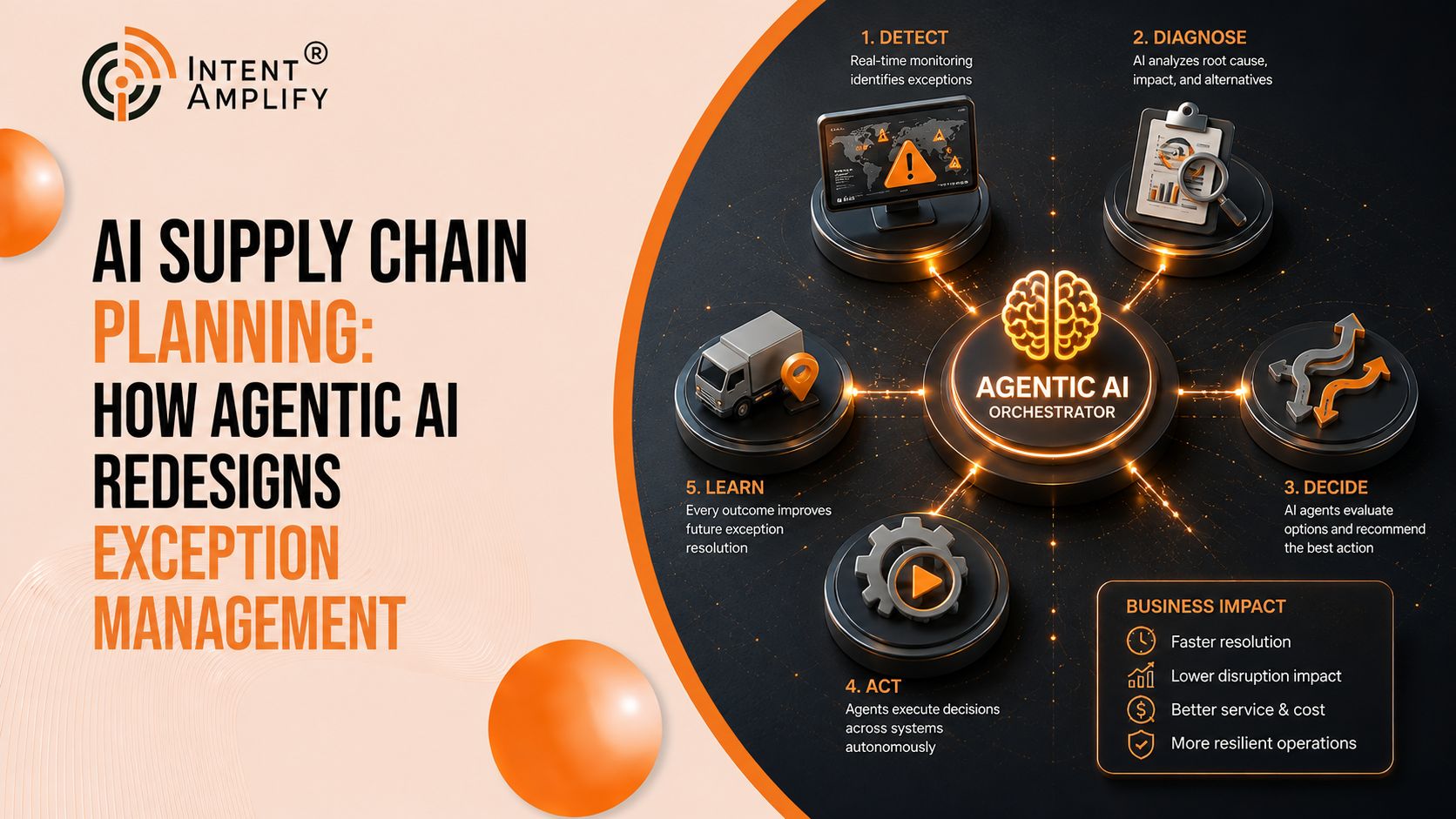
Supply chain planning has spent decades improving the forecast. More data, better algorithms, demand sensing, and machine learning have all expanded the planner’s analytical toolkit.
Yet many planning teams still experience the same daily reality: an overflowing exception queue.
The problem is not that forecasting stopped mattering. The forecast improvement addresses only one part of the planning system. Once reality diverges from the plan, the organization still has to decide what deserves attention, assemble the relevant context, evaluate trade-offs, and execute a response.
That is the exception economy: a world in which scarce planning attention must be allocated across more signals than humans can investigate manually.
AI supply chain planning becomes valuable when it improves the allocation of attention.
Explore Agentic AI in Supply Chain Planning
EVIDENCE BOUNDARY — VERIFIED PRODUCT DIRECTION VS. EDITORIAL MODEL
SAP product-direction statements in this article are grounded in the SAP sources listed under Reference Links. The four-tier exception model, Exception Value Score, Decision SLA, planner–agent handoff model, exception-debt concept, five failure modes, and 90-day pilot are editorial operating-model frameworks developed for this campaign; they are recommendations, not claims that SAP or NIST prescribe these structures.
The article does not assert verified ROI, productivity improvement, adoption, pipeline impact, conversion performance,e or implementation readiness. Product availability, licensing, regional support, and prerequisites should be checked against current SAP documentation before publication or implementation decisions.
EXCEPTIONS ARE NOT CREATED EQUAL
A late purchase order, a capacity shortfall, a demand spike, and an inventory imbalance may all appear as exceptions. But their business consequences differ dramatically.
One may resolve itself before it matters. Another may threaten a strategic customer. A third may create an avoidable expedite. A fourth may require a policy decision rather than a planning adjustment.
A traditional threshold-based system can identify deviations. The harder task is prioritization.
Prioritization requires context: which demand is affected, how much inventory is available, what alternatives exist, what service commitment is at risk, what constraints are real,l and what policies govern the trade-off.
This is why agentic AI is particularly relevant to planning.
SAP’s 2026 Planning Assistant is positioned around accelerated exception management. SAP describes an Exception Management Agent that can detect and prioritize exceptions, investigate root causes, propose mitigations,ns and support planner response. Other announced agents address inventory investment, component shortages, deployment order confirmation, long-term capacity shortages, and footprint optimization.
The common pattern is not better forecasting. It is a better decision to prepare.
THE NEW PLANNING BOTTLENECK: CONTEXT ASSEMBLY
Ask a planner what happens after a material exception appears.
The answer often includes opening several views, checking history, messaging another function, reviewing inventory at another location, confirming a customer requirement, testing a scenario, a nd waiting for someone to approve the change.
The analytical model may run in seconds. The decision may take hours.
That gap is where AI orchestration can create operational leverage. An agent can potentially gather the evidence before the planner opens the exception, explain why the issue matters, and present bounded alternatives.
The planner then spends more time on judgment and less time on navigation.
A FOUR-TIER EXCEPTION MODEL
Planning leaders can redesign exception management by classifying decisions into four tiers.
- Tier 1 — Informational exceptions. The event is worth monitoring but does not require immediate action. AI can summarize and group these signals to reduce noise.
- Tier 2 — Routine resolvable exceptions. The response is governed by clear policy and is easily reversible. These are candidates for AI recommendations and, after validation, bounded automation.
- Tier 3 — Material trade-offs. The response affects service, inventory, capacity,y or cost in a meaningful way. AI should prepare scenarios and evidence, while a human decision owner approves the action.
- Tier 4 — Strategic or ambiguous exceptions. These involve policy conflicts, major commitments,s or insufficient evidence. The AI should escalate rather than improvise.
This tiering creates a more useful planning queue. Human attention is reserved for decisions where judgment has the greatest value.
FROM ALERT COUNT TO DECISION FLOW
Planning organizations often measure the number of exceptions, planner productivity, or forecast accuracy. Those measures are useful but incomplete for an agentic workflow.
A redesigned system should also measure:
- Exception age: how long a material issue remains unresolved.
- Time to context: how long it takes to assemble enough evidence to decide.
- Time to decision: elapsed time between material signal and approved response.
- Recommendation acceptance: whether AI-prepared actions are accepted without major modification.
- Override reason: why a planner changed or rejected the recommendation.
- Reopened exceptions: whether an apparently resolved issue returns.
These measures expose whether AI is improving the planning process itself.
THE DANGER OF OPTIMIZING THE WRONG OBJECTIVE
AI planning can also fail faster than manual planning if the objective is too narrow.
Imagine an agent instructed to minimize inventory. Without enterprise context, it could recommend actions that increase service risk. An agent focused on service could recommend expensive expedites. An agent focused on production stability could preserve a schedule that is no longer economically rational.
Planning decisions are multi-objective decisions.
That means the organization must define priorities and constraints before it delegates authority. The agent should know not only what metric to improve but also which outcomes it may not sacrifice beyond a defined threshold. This is a decision policy, and it is becoming a core part of AI planning design.
THE PLANNER’S ROLE DOES NOT DISAPPEAR
As AI absorbs more context assembly and routine exception handling, the planner’s work can shift toward policy, scenario judgment, and exception governance.
Planners become the people who teach the system where the boundaries are. Their overrides reveal missing rules. Their escalation decisions reveal where context is insufficient. Their scenario choices reveal trade-offs that are not captured by a single optimization target.
That makes planner feedback a critical data source for improving the operating model.
The goal is not to remove people from planning. It is to stop using expert planners as middleware between applications.
A PRACTICAL STARTING POINT
Select one exception family with high volume and a measurable current process—for example, a recurring shortage or deployment decision.
Map the current workflow from detection to execution. Identify every manual context lookup and handoff. Define the authoritative data. Establish the actions the AI may recommend. Set the threshold at which a human must approve. Then run the agent in recommendation mode and compare its output with planner decisions.
Do not begin by asking whether the entire planning function is ready for autonomy. Begin with one decision loop.
THE EXCEPTION VALUE SCORE: WHICH ISSUES DESERVE ATTENTION FIRST
A mature exception-management model needs more than severity labels. “High,” “medium,” and “low” are often too subjective to guide scarce planner attention. A better design is to score exceptions according to business consequence and decision urgency.
A practical Exception Value Score can combine five dimensions.
Business impact. What revenue, customer commitment, production output, working capital,l or cost exposure could be affected if the exception is left unresolved?
Time sensitivity. How quickly does the decision window close? Some shortages can be resolved tomorrow. Others require action in the next hour because an inbound shipment or production sequence is already moving.
Reversibility. Can the response be changed easily if new information appears, or does the action create a costly commitment?
Cross-functional dependency. Can one planner resolve the issue, or does it require procurement, logistics, manufacturing, finance,ce or customer service input?
Confidence in context. Is the data complete and authoritative enough to support action, or is the exception surrounded by conflicting signals?
This scoring model changes the queue from a list of system alerts into a portfolio of business decisions. A high-impact, time-sensitive, low-reversibility exception should move to the top even if its technical variance is smaller than another event. A high-variance alert with low business consequence may be monitored rather than escalated.
The important design principle is that AI should help allocate attention according to business consequence, not simply according to statistical deviation.
DECISION SLAs: MANAGING TIME AS A SUPPLY CHAIN RESOURCE
Most supply chain organizations have service-level agreements for customers and suppliers, but fewer have explicit service levels for internal decisions. That is a missed opportunity.
An exception is not valuable because it was detected early. It is valuable only if the organization can resolve it before the decision window closes. Planning leaders should therefore define Decision SLAs for material exception families.
A Decision SLA can specify how quickly an issue should move through four stages: detection, context assembly, decision, and execution. For example, a production-critical shortage may require context within 30 minutes, an approved decision within two hours, and execution confirmation within four hours. A long-term capacity exception may have a multi-day decision window. The exact times must be grounded in operating reality rather than imposed as arbitrary targets.
AI can support these SLAs in three ways. It can assemble context automatically, prioritize exceptions whose decision window is shrinking, and escalate when a required owner has not acted. This is more operationally useful than simply generating more alerts.
Decision SLAs also expose process bottlenecks. If context assembly is consistently fast but approvals are slow, the problem is not data. If approvals are fast but execution lags, the problem is workflow integration. If the AI repeatedly escalates because context confidence is low, the problem is data governance.
This turns exception management into a measurable operating system rather than a planner-by-planner working style.
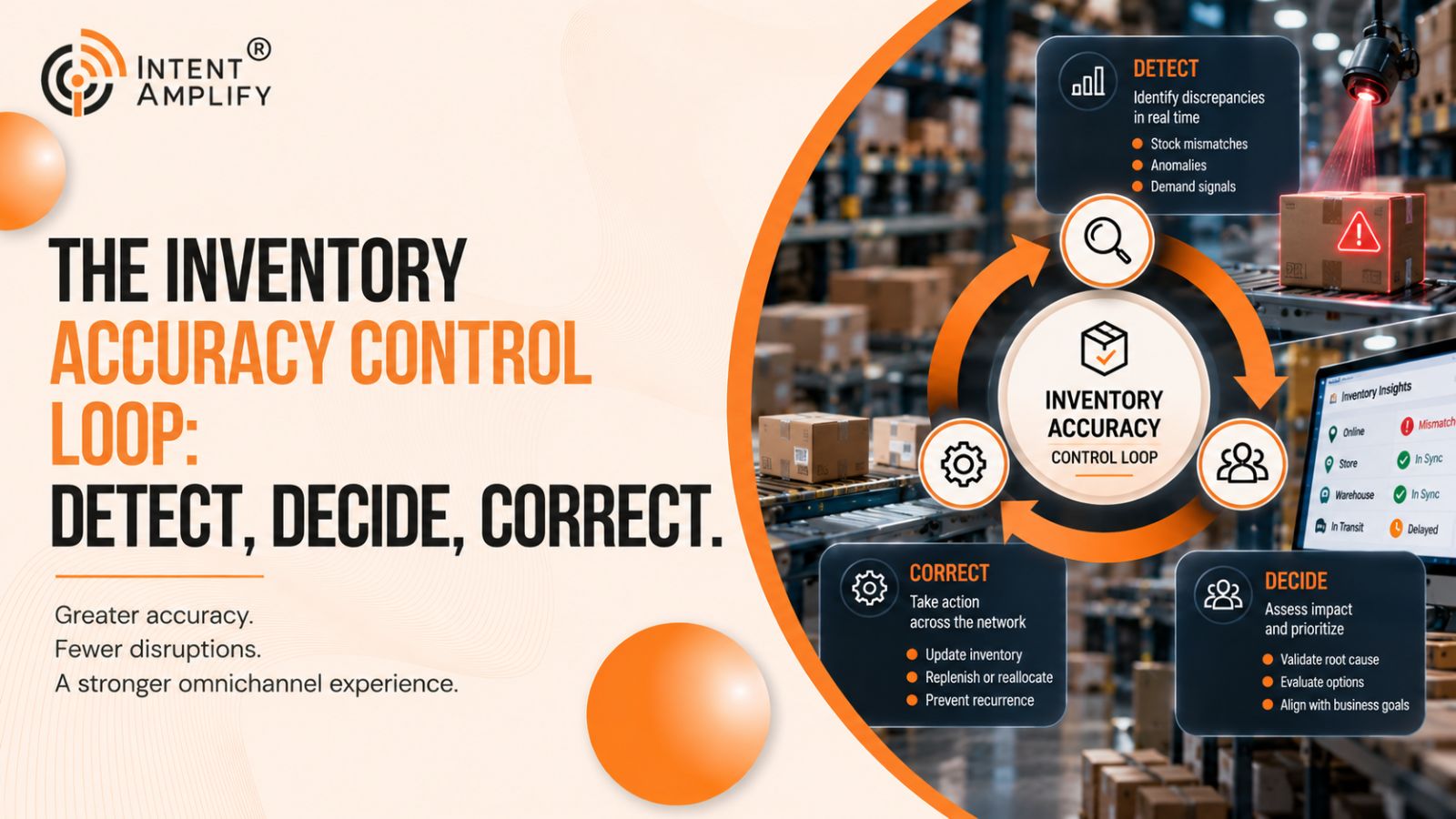
THE PLANNER–AGENT HANDOFF MODEL
As agentic AI enters planning, teams need a clear handoff model that defines what the system does before a planner becomes involved and what remains exclusively human.
- Stage 1 — Sense. The system identifies the exception from planning, inventory, supplier, production, or logistics signals.
- Stage 2 — Contextualize. The agent assembles the affected demand, inventory, capacity, supply, customer commitments, alternative options, and relevant policy.
- Stage 3 — Classify. The exception is assigned to a tier and given a business-priority score based on impact, urgency, reversibility,y and evidence confidence.
- Stage 4 — Recommend. For resolvable exception classes, the agent produces one or more response options and explains the trade-offs.
- Stage 5 — Decide. A planner or designated business owner accepts, modifies, or rejects the recommendation where human authority is required.
- Stage 6 — Execute. Approved changes are posted to the relevant workflow or system, either automatically within defined permissions or by the accountable operator.
- Stage 7 — Learn. The organization captures whether the recommendation worked, whether it was overridden, and why.
This model gives planners a more useful starting point. Instead of opening an alert with little context, they open a prepared decision package. The planner’s time is directed toward evaluating trade-offs rather than gathering evidence.
It also gives leaders a clear path for increasing automation. Organizations can start by automating sensing and context assembly. They can add recommendation capability once evidence quality is reliable. They can automate execution only for decision classes where policy, reversibility, and monitoring support it.
WHY ROOT-CAUSE QUALITY MATTERS MORE THAN ALERT VOLUME
A weak exception system tells a planner what is wrong. A strong one explains why the issue occurred and what levers are available.
Consider a recurring shortage. The immediate symptom may be an insufficient supply to meet demand. But the root cause could be very different: forecast bias, inaccurate lead time, supplier performance, quality holds, production yield loss, inventory in the wrong location, an allocation rule, a master-data issue, or a customer-priority change.
These causes demand different responses. If AI treats every shortage as a replenishment problem, it may generate repetitive actions that never solve the underlying issue.
Planning teams should therefore distinguish between event resolution and systemic correction.
Event resolution answers: “What should we do about this exception now?”
Systemic correction answers: “Why does this exception continue to appear, and what operating rule, data source, or process should change?”
Agentic planning can support both. The first is real-time operational work. The second is pattern analysis across historical exceptions, overrides, and outcomes. Together, they create a learning loop in which the planning system becomes better at preventing avoidable exception volume rather than merely processing it faster.
This is especially important for executive leaders because a falling exception count can be misleading. Fewer alerts may reflect stronger planning, or they may reflect weaker detection. The more meaningful measure is whether repeated exception families are being eliminated at the root while material issues are resolved faster.
EXCEPTION DEBT: THE HIDDEN COST OF UNRESOLVED DECISIONS
Organizations often track technical debt in software. Planning teams also accumulate a form of debt: unresolved or repeatedly deferred exceptions that consume future attention.
Exception debt builds when teams postpone decisions because context is incomplete, ownership is unclear, or the issue does not appear urgent enough. Over time, these exceptions can become more expensive because the available response options narrow. A supplier delay that could have been addressed with a routine mode change may eventually require premium freight. A modest inventory imbalance may become a customer-service problem. A capacity risk that was visible weeks earlier may become a production crisis.
This creates an important leadership metric: not only how many exceptions are open, but how much of the exception portfolio is aging beyond its useful decision window.
AI can help identify this debt by detecting issues whose consequences are increasing over time. But the operating response still requires clear ownership. Every material exception class should have a named decision owner and an escalation path. Otherwise, AI simply produces better visibility into organizational indecision.
THE FIVE FAILURE MODES OF AI-DRIVEN EXCEPTION MANAGEMENT
The move to agentic planning introduces new failure modes that leaders should design against.
- Failure mode 1 — Faster noise. The organization adds AI but does not redesign exception criteria, so planners receive more sophisticated alerts without better prioritization.
- Failure mode 2 — False context confidence. The agent produces a polished explanation using incomplete or stale data, causing users to over-trust the recommendation.
- Failure mode 3 — Local optimization. The agent solves the planning metric while creating cost, service, inventory, or production problems elsewhere.
- Failure mode 4 — Hidden policy. Experienced planners make decisions using unwritten business rules that the system does not know. Recommendations look technically sound but conflict with how the business actually operates.
- Failure mode 5 — Automation without rollback. The system is allowed to execute actions, but the organization has not designed a fast way to detect and reverse an incorrect decision.
These failure modes are preventable. The remedy is not less AI. It is better operating design: authoritative data, explicit policies, transparent rationale, bounded permissions, clear escalation,n and outcome monitoring.
A 90-DAY EXCEPTION ORCHESTRATION PILOT
Planning leaders do not need to transform the entire function at once. A 90-day pilot can establish whether agentic exception management is creating measurable value.
Days 1–30: baseline one exception family.
Select an exception type with meaningful volume and business consequence—for example,le component shortages, deployment imbalances,ces or persistent unmet demand. Measure current exception volume, time to context, time to decision, handoffs, override reasons,s sons, and rework. Document the people, systems, and policies involved.
During this period, define the Decision SLA and Exception Value Score for that family. Identify the authoritative data sources and the actions a planner can currently take.
Days 31–60: introduce AI-supported preparation.
Use the agent to assemble context, classify priority, and generate recommendations, but keep execution with the human owner. Compare agent output with planner decisions. Track where the agent lacks data, misinterprets policy, or recommends an impractical action.
The most important artifact in this phase is the override log. Every meaningful override should be classified as a data, policy, context, judgment, or risk issue. This reveals what must be improved before authority expands.
Days 61–90: automate bounded workflow steps.
Once recommendation quality is stable, allow the agent to automate low-risk preparation activities or execution steps that are reversible and clearly governed. Preserve human approval for material trade-offs. Measure whether context time, decision time, and exception age improve without increasing reopened exceptions or execution errors.
At the end of 90 days, leaders should have evidence to answer three questions: Did AI reduce decision friction? Did it improve attention allocation? Did it operate safely inside the defined boundaries?
If the answer is yes, the organization can expand to additional exception families. If not, the evidence should show whether the blocker is data, policy, integration, workflow,w or model quality.
EXECUTIVE QUESTIONS FOR THE NEXT PLANNING REVIEW
The most useful executive discussion is not “How many AI agents have we deployed?” It is whether the planning operating model is becoming faster, more selective,ve and more accountable.
Leaders should ask:
- Which exception families consume the most planner time today?
- Which exceptions carry the greatest business consequence, not merely the largest technical variance?
- How long does it take to assemble context for the top five material decision types?
- Where do planners rely on unwritten policies or personal relationships to resolve issues?
- Which exceptions could be resolved automatically if the organization had a stronger policy and data confidence?
- Which decisions must remain human because they involve ambiguity, strategic commitments, or irreversible consequences?
- How often are AI recommendations overridden, and what do the override reasons reveal?
- Which repeated exceptions should be eliminated at the root rather than processed more efficiently?
These questions move the planning conversation from technology adoption to operating performance.
CONCLUSION
The future of AI supply chain planning will not be determined only by who has the most accurate model. It will be determined by who can turn exceptions into high-quality decisions with less delay and less coordination overhead.
Forecasting predicts the future. Exception orchestration determines what the organization does when the future refuses to follow the forecast.
That is where the next planning advantage is likely to be built.
Join “SAP AI Inside the Supply Chain: From Silo to Orchestration” for a deeper discussion of AI agents, Joule Assistants, and decision orchestration in supply chain planning.
Reference Links:
- SAP — Planning Assistant: Autonomous Supply Chain Management: https://www.sap.com/india/use-cases/joule-assistant/supply-chain-planning-ai
- SAP News Center — Building the Autonomous Supply Chain: https://news.sap.com/2026/05/more-autonomous-supply-chain/
- SAP — Supply Chain Management and AI: https://www.sap.com/products/scm/ai.html
- SAP — AI in Supply Chain Orchestration: https://www.sap.com/resources/ai-in-supply-chain-orchestration
- NIST — Artificial Intelligence Risk Management Framework: https://www.nist.gov/itl/ai-risk-management-framework